
What if the pour isn’t where a concrete project is most likely to lose time? The greater risks often begin earlier, with an unclear scope, unresolved design details, or a site that isn’t ready. Knowing how to manage a concrete construction project means controlling those dependencies before crews, equipment, and materials converge.
It’s reasonable to focus on the pour itself. Concrete placement requires careful coordination, but a reliable result also depends on clear responsibilities, a workable sequence, and preparation across the site and project team. When those pieces are missed, schedule disruptions, safety concerns, quality issues, and rework can follow.
This guide lays out a practical sequence from project definition through closeout. You’ll see how to align scope and responsibilities, coordinate design and site readiness, plan concrete work, monitor safety and quality, and maintain useful project records. The goal is to make each phase easier to manage and reduce avoidable gaps.
Key Takeaways
- Define the concrete scope, project boundaries, responsibilities, and acceptance criteria before work begins.
- To understand how to manage a concrete construction project, sequence the work around design coordination, site readiness, trade interfaces, placement, and acceptance.
- Use project documents, inspection points, and field records to support quality oversight and manage changes as they arise.
- Keep safety planning active throughout the work, with clear communication among the project team and trades.
- Align the delivery approach with project complexity, then close out by reviewing completed scope, outstanding items, records, and stakeholder acceptance.
How to Manage a Concrete Construction Project: Define Scope and Success
Clear scope is the first control point in a concrete project. Before setting the work sequence, establish what must be built, where the work begins and ends, and how stakeholders will determine that it is complete. Understanding how to manage a concrete construction project starts with making expectations specific enough for the team to plan and coordinate.
Concrete project management brings planning, execution, and control together. Planning establishes the scope, responsibilities, sequence, and objectives. Execution coordinates people, materials, site access, and field activities. Control compares progress and completed work with the agreed documents and objectives, then records decisions and changes. These functions align with the broader construction-management responsibilities outlined in Construction Management.
What should a concrete project scope include?
Describe deliverables in project terms, such as concrete paving, slabs, foundations, or structural concrete, as applicable. Set the physical limits of the work and identify interfaces with earthwork, underground utilities, paving, and other trades. For example, a slab scope should clarify how it connects to site preparation and which party coordinates work and information at that boundary.
Keep current drawings, specifications, assumptions, exclusions, and required approvals in one reference set. Clarify who provides access and coordination information, who makes design or field decisions, and who reviews and accepts completed work at each stage. This helps prevent teams from relying on different expectations.
How do you set workable project objectives?
Set objectives with the owner, design team, contractor, inspectors, and other relevant stakeholders. Make them practical and reviewable: define quality criteria in the project documents, establish schedule milestones, identify how safety planning will be communicated, and agree on how questions and changes will be raised and recorded. Avoid objectives that sound measurable but lack a shared way to evaluate them.
Record site constraints and unresolved coordination decisions before they become field assumptions. These may include access limits, existing utilities, incomplete design information, or dependencies between trades. Assign an owner and a decision path to each open item so the team knows who is responsible for moving it forward.
A concise responsibility matrix can make those decision paths visible. Use project roles rather than individual names if staffing may change, and identify who is responsible, who approves, and who needs to be informed about key decisions. The matrix does not replace contract documents. It is a practical reference for keeping communication orderly and accountability clear.
Plan the Concrete Project Schedule Around Site and Trade Dependencies
A concrete schedule is useful only when it reflects the work that must be complete before each activity can proceed. Drawings, site access, underground utilities, subgrade preparation, formwork, reinforcement, and required inspections all affect readiness. A delay or unresolved handoff in one area can change the sequence for crews and other trades.
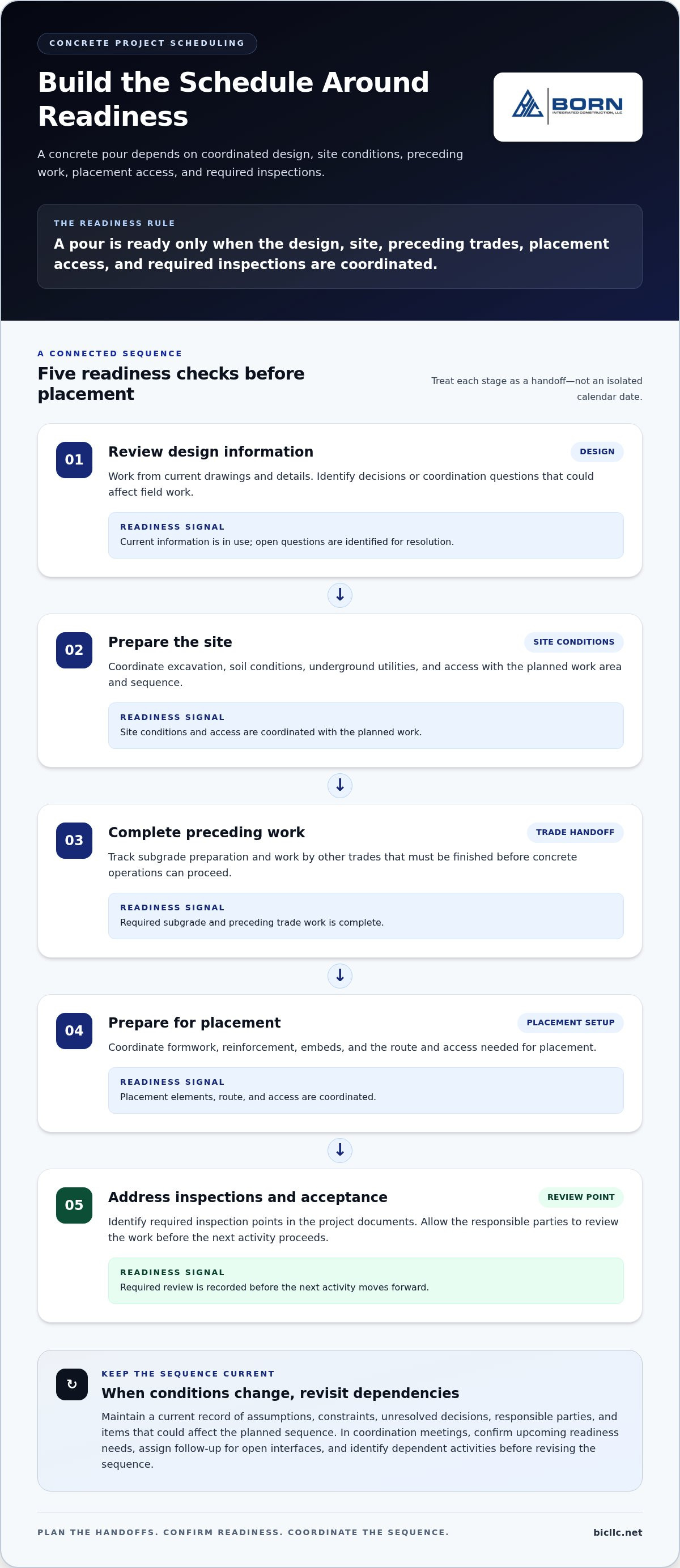
A concrete pour is ready only when the design, site, preceding trades, placement access, and required inspections are coordinated. This dependency-based approach supports the broader construction-management role of coordinating scope, schedule, quality, and safety, as described by the Construction Management Association of America.
Which activities must be coordinated before concrete placement?
Build the schedule as a sequence of readiness checks rather than a set of isolated dates. A practical planning order is:
- Review design information. Work from current drawings and details. Identify decisions or coordination questions that could affect field work.
- Prepare the site. Coordinate excavation, soil conditions, underground utilities, and access with the planned work area and sequence.
- Complete preceding work. Track subgrade preparation and work by other trades that must be finished before concrete operations can proceed.
- Prepare for placement. Coordinate formwork, reinforcement, embeds, and the route and access needed for placement.
- Address inspections and acceptance. Identify required inspection points in the project documents and allow the responsible parties to review the work before the next activity proceeds.
Assign an owner and a clear readiness signal to each step, such as completed work, resolved information, or a recorded review. This makes the schedule a coordination tool, not just a calendar.
How should the schedule handle changing site conditions?
Site conditions and design coordination can change as work advances. Keep a current record of assumptions, constraints, unresolved decisions, responsible parties, and items that could affect the planned sequence. At regular coordination meetings, review upcoming activities, confirm what must be ready, and assign follow-up for open interfaces. If access or utility work changes, identify dependent activities before revising the sequence.
For Texas projects, use the project documents and applicable local authorities to establish approval and inspection steps for the specific work. Requirements can vary by project and location, so do not treat a schedule assumption as an approval. Reviewing concrete and civil project examples can also help stakeholders understand how coordinated scopes relate to field execution.
Control Concrete Project Quality, Safety, and Changes in the Field
Once field work begins, consistent oversight depends on a clear reference point. The team should work from current, approved drawings, specifications, and documented project requirements, then compare field conditions and completed work against those documents. Inspection points help make reviews timely, while organized records preserve what was observed and what decisions followed.
How can teams monitor concrete quality during execution?
Set up a project log to capture relevant inspections, field observations, questions, decisions, and corrective actions. Record the date, work area, responsible party, and status of each item so the team can track open issues through resolution. Where the project documents call for inspections or testing, coordinate the responsible parties and file the results. The specific checks should follow the project’s approved requirements, not assumptions.
Timely documentation makes project decisions traceable, from the field observation that raised a question to the action taken to resolve it. This record is especially useful when work spans multiple areas or trades because it gives the team a shared account of progress and outstanding matters.
How should project managers address changes and field issues?
Address an unexpected condition through a consistent review process. First, describe the issue and identify the affected work. Then determine who owns the decision and what information is needed to evaluate it. Before directing a change, consider its possible effects on scope, sequence, quality, safety, and cost. The project team can assess these impacts without treating unverified estimates as settled facts.
- Document: Record the condition, location, relevant project information, and any immediate coordination concern.
- Assess: Identify affected activities and potential effects on other work or project objectives.
- Decide: Route the issue to the designated decision-maker and record the approved direction.
- Communicate: Share the decision with affected teams, then update working documents and the issue log.
Keep safety planning active throughout execution. As work areas, activities, or site conditions change, the project team should communicate relevant concerns, coordinate responsibilities, and address issues through the project’s established processes. Safety is not limited to a kickoff discussion. It remains part of daily coordination and field oversight.
For teams learning how to manage a concrete construction project, the essential discipline is to avoid undocumented assumptions. A field adjustment may appear local, but its effects can extend to connected work, inspection timing, or the planned sequence. Current records help ensure everyone is working from the same approved direction.
Compare Project Delivery Approaches and Keep Stakeholders Aligned
Delivery structure affects how information moves between concrete work, site work, design, and other trades. A single-scope approach can keep responsibility focused on a defined portion of the project, while integrated civil-and-concrete coordination can bring related scopes into a more connected workflow. Neither model is automatically the better choice. The right fit depends on the number of interfaces, project complexity, and how clearly responsibilities and decisions are assigned.
What should stakeholders compare between delivery approaches?
Assess how many scopes, trades, approvals, and site handoffs the work involves. Then compare who coordinates each interface, how questions reach decision-makers, and how stakeholders will track schedule status and unresolved items.
| Consideration | Single-scope coordination | Integrated civil-and-concrete coordination |
|---|---|---|
| Interfaces | More handoffs may need to be coordinated between separate scopes. | Related site and concrete activities can be coordinated within a connected scope. |
| Responsibilities | Scope boundaries and responsibility for each handoff need to be explicit. | Responsibilities across included scopes still need clear assignment. |
| Information flow | Communication pathways between parties should be established and maintained. | Shared coordination can support connected information flow, with decision authority still defined. |
| Schedule visibility | Teams need visibility into activities and dependencies beyond their scope. | Related activities can be reviewed together, while external dependencies remain visible. |
Project-specific conditions determine the fit. A focused scope with limited interfaces may be managed effectively through clear handoffs. A project involving earthwork, utilities, paving, and concrete may benefit from closer coordination across those connected activities. In either case, how to manage a concrete construction project depends on making accountability and communication practical, not simply selecting a delivery label.
How do regular project controls keep work coordinated?
Use a shared workflow to track completed work, upcoming activities, open decisions, constraints, and the person responsible for each action. Keep current drawings, meeting records, submittals, inspection information, and change documentation organized together. At each coordination review, confirm what has changed, which teams are affected, and whether decisions or information are needed before the next handoff.
For paving scope, reviewing commercial concrete paving project examples can help stakeholders understand how this work relates to coordinated project delivery.
Close Out the Concrete Project and Choose a Dependable Execution Partner
Closeout gives the owner and project team a clear record of what was completed, what remains open, and what has been accepted. It is more than the final exchange of documents. A deliberate handover connects the delivered work to the agreed scope and preserves useful information for future reference. This final phase completes the sequence of how to manage a concrete construction project.
What belongs in a concrete construction project closeout?
Review the work against the documented scope and the project’s applicable acceptance requirements. Then identify outstanding items, assign responsibility for resolving them, and record their status. Organize current project records so stakeholders can follow the work and decisions without relying on informal recollection.
- Confirm completed scope: Review deliverables and record their status against project requirements.
- Resolve open items: List remaining work or decisions, identify responsible parties, and track completion.
- Assemble project records: Gather relevant drawings, approved changes, inspection documentation, and other records required for handover.
- Document acceptance: Record stakeholder reviews and acceptance in the manner established for the project.
- Capture lessons learned: Note coordination issues and effective practices that can inform future concrete work.
A complete record makes handover easier to understand and gives the owner a reference for later project questions. It also preserves the reasoning behind approved changes, rather than leaving future teams to infer why field conditions or documented work differ from earlier plans.
How can the right execution partner support project delivery?
Assess whether a contractor’s concrete and civil construction capabilities align with the project scope and its interfaces. Work that connects concrete with earthwork, utilities, or paving requires clear communication across those activities, along with defined responsibilities and documented decisions. The delivery approach should support the project’s coordination needs rather than rely on assumptions about who owns each handoff.
Born Integrated Construction provides concrete and civil construction work, including concrete paving, slabs, structural concrete, and earthwork. The company emphasizes safety, integrity, efficiency, quality, and reliable relationships with customers and vendors. The Born Integrated Construction project portfolio provides examples of its work, and the company overview offers additional context about the organization.
For a project that requires coordinated concrete and civil work in Texas, including Houston, Austin, San Antonio, Dallas, Fort Worth, San Marcos, New Braunfels, Boerne, Beaumont, Conroe, Woodlands, or Arlington, discuss the scope, interfaces, and project objectives with Born Integrated Construction. Clear expectations at the outset help establish a sound basis for planning, execution, and closeout.
Build a Clear Path from Planning to Closeout
Successful concrete project management depends on decisions made well before placement. Define scope and responsibilities, sequence work around site and trade dependencies, and maintain clear records as quality checks, safety planning, and field changes are managed. A deliberate closeout gives stakeholders a useful account of completed work and outstanding items.
Knowing how to manage a concrete construction project means keeping these phases connected. Born Integrated Construction brings concrete paving, slab, structural concrete, and civil site-work capabilities to project coordination, guided by a commitment to safety, integrity, efficiency, and quality.
Start a conversation about your project’s scope and coordination needs. Discuss your concrete construction project with Born Integrated Construction and take the next step with a clear foundation for planning and execution.
Frequently Asked Questions
How do you manage a concrete construction project?
Manage a concrete construction project by defining scope, responsibilities, requirements, and site constraints before work begins. Build the schedule around design decisions, site preparation, utilities, inspections, and concrete activities, then coordinate stakeholders at each handoff. During execution, track quality, safety, field issues, and approved changes in organized records. Closeout should review completed work, outstanding items, and handover documents. For each phase, follow the project’s drawings and applicable local requirements.
What should be done before a concrete pour?
Before a pour, confirm readiness against the project’s approved documents and planned sequence. Coordinate site access, preceding earthwork and utility activities, formwork, reinforcement, embeds, and required inspections. Resolve open design decisions and communicate responsibilities to affected teams so unresolved questions do not become field assumptions. The exact readiness criteria depend on the project documents and applicable requirements. A general checklist can guide coordination, but it does not replace a project-specific review.
How do you keep a concrete construction project on schedule?
Keep the project on schedule by planning around dependencies, not treating concrete placement as an isolated activity. Identify the design decisions, site preparation, utility coordination, access, inspections, and trade handoffs that must come first. Review upcoming work and unresolved constraints with responsible stakeholders at regular intervals. Record changes and promptly communicate approved updates. A realistic schedule depends on the project scope, site conditions, coordination needs, and approvals.
What are the biggest risks in a concrete construction project?
Common risks include unclear scope, unresolved design decisions, incomplete site readiness, trade conflicts, weak communication, and undocumented changes. These issues can affect schedule, quality, safety, and coordination. Reduce avoidable gaps by assigning responsibility for open items, tracking decisions and constraints, following current project documents, and keeping field records organized. Risks vary by project, so identify them during planning and revisit them as site conditions, design information, or work interfaces change.
How do you manage changes during concrete construction?
Manage a field change by documenting the issue, identifying affected work, and determining who has authority to decide. Gather the information needed to assess possible effects on scope, sequence, quality, safety, and project cost. Route the issue through the project’s established approval process rather than relying on assumptions or informal direction. After a decision, update relevant records and communicate the approved change to affected teams so they can coordinate from current information.
What should be included in a concrete project closeout?
Concrete project closeout should verify completed work against the documented scope and applicable acceptance requirements, identify outstanding items, and organize relevant project records. Include approved changes, inspection documentation, and the handover information required for that project. Record who is responsible for unresolved items and the next steps. An orderly file gives stakeholders a clear reference to the work and decisions. Use the project documents to determine the specific closeout package.
How can an owner compare concrete project delivery approaches?
Compare delivery approaches by examining scope interfaces, trade handoffs, decision pathways, communication, and schedule visibility. Consider how closely concrete work connects to civil site work or utilities, and how responsibility will be managed across those scopes. No single approach suits every project; assess the project’s complexity, documented requirements, and coordination priorities. These considerations apply to Texas projects in Houston, Austin, San Antonio, Dallas, Fort Worth, San Marcos, New Braunfels, Boerne, Beaumont, Conroe, Woodlands, and Arlington.