For commercial clay sites, lime is often a strong candidate when testing shows high plasticity, while excavation and replacement may suit weak or unsuitable soils that aren’t practical to treat in place. The National Lime Association identifies soils with at least 25% passing a 75-micron screen and a plasticity index of 10 or greater as generally good candidates for lime stabilization. Choosing the best soil stabilization methods for clay starts with understanding the soil’s properties and comparing treatment with replacement.
Clay’s response to moisture affects compaction, subgrade performance, and the stability of the work above it. The best soil stabilization methods for clay depend on its plasticity, moisture sensitivity, site conditions, and project requirements. This guide explains what testing can reveal and how lime, cement, other additives, and excavation compare, so you can assess options for a specific site rather than assume one treatment fits every clay soil.
Key Takeaways
- Use soil testing to assess plasticity, moisture sensitivity, organic content, and sulfate risk before selecting a treatment.
- Compare lime and cement based on the clay’s characteristics: their effects and suitability differ, especially as plasticity changes.
- Account for drainage and moisture conditions, since water can affect clay’s workability and performance beneath commercial construction.
- Weigh in-place stabilization against excavation and replacement by considering soil condition, treatment suitability, and project requirements.
- Determine additive type and dosage through laboratory mix-design testing rather than relying on a fixed amount per cubic yard.
What Is Soil Stabilization, and When Do Commercial Projects Need It?
For commercial clay sites, lime treatment is often a candidate when soil testing shows sufficient fines and plasticity. The National Lime Association identifies soils with at least 25% passing a 75-micron screen and a plasticity index of 10 or greater as generally good candidates for lime stabilization. High-plasticity soils above 25 PI are also typically considered for lime treatment.
Stabilization modifies soil in place so it can provide a more suitable construction base. Clay can become soft and plastic when wet, then shrink as it dries. These shifts may move a foundation or leave weak areas beneath parking surfaces. Lime can reduce clay plasticity and expansive behavior, while cement generally suits granular, coarse-grained soils with a plasticity index of 10 or less.
The type of lime matters. Quicklime is used to strengthen and dry wet, high-plasticity clay, and can dry wet material in hours rather than days. Hydrated lime has minimal drying capacity because it is already hydrated. Lime kiln dust, including material referred to as Calciment LKD, is used for clay-rich parking-lot or building-pad subgrades.
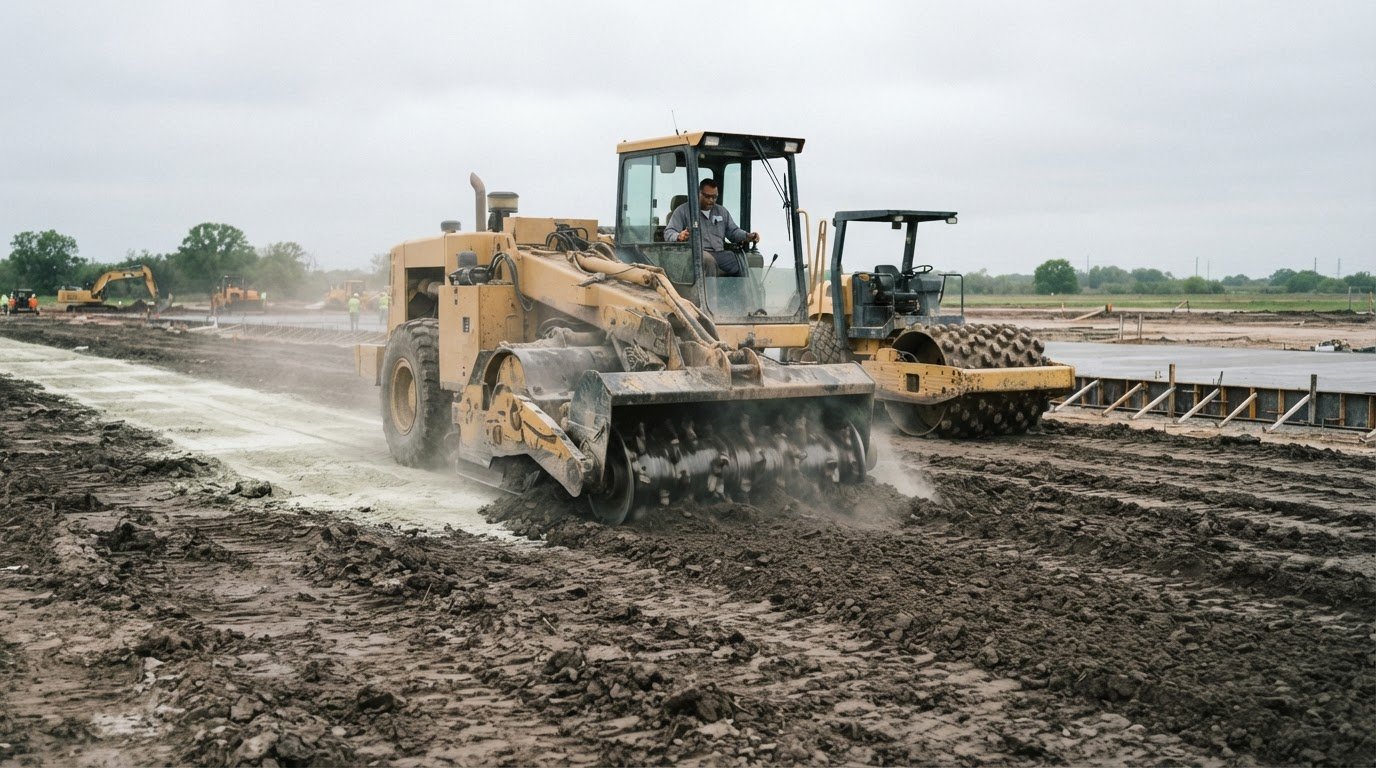
For wet, clayey soil, lime treatment can reduce excess wetness and make mixing and compaction more manageable. Lime also reduces plasticity soon after application, often within hours. A mellowing period of 24 to 48 hours typically follows treatment; the soil then needs compaction and time to set before construction proceeds.
Typical lime-treatment stages include laboratory suitability testing, spreading the selected additive, thoroughly mixing it into the soil, allowing a mellowing period, and compacting the treated layer. The sequence and dosage depend on soil properties and project requirements. Where sulfate-related expansion is a concern, sulfate testing is essential before lime or cement treatment.
Geogrids and geotextiles can reinforce or separate soil layers, while mechanical compaction can improve clay’s load-bearing capacity. These methods do not change clay plasticity in the same way as chemical treatment, so their role depends on the subgrade and design requirements.
What does clay soil stabilization cost per square foot in the United States? The price depends on the project and is provided after a quote request. Treatment depth, additive selection, mixing, and site preparation all affect the scope.
How long does stabilized clay take to cure, and when can construction begin? Lime treatment typically includes 24 to 48 hours of mellowing and may take a few days to set before construction begins.
What are the risks and environmental impacts of lime or cement soil stabilization? Organic matter above approximately 1 to 2 percent can interfere with additive reactions, and sulfate-related expansion is a concern in susceptible soils. Testing and controlled mixing help address these material-specific risks.
Clayey soil, plasticity index, and moisture sensitivity
The Atterberg limits test measures soil moisture content, plasticity, and shrink-swell limits before clay stabilization. The results help explain how the subgrade may respond as water conditions change.
Clay Plasticity and Moisture Sensitivity
Clayey soil’s plasticity index reflects how its consistency changes with moisture. A higher index indicates more clay and greater sensitivity to water-related changes. The Atterberg limits test helps establish this behavior alongside shrink-swell limits. In the Southeast’s Piedmont region, high-plasticity clays frequently have plasticity index values exceeding 30-40. That range illustrates why a site’s soil profile matters: a moisture change can affect workability and the support beneath commercial construction.
Moisture Conditioning
Moisture conditioning adjusts soil moisture content before compaction so crews can work and compact the material more consistently. Too much water can leave clay soft and difficult to handle; too little can prevent effective compaction. A project specification may call for moisture within OMC ±2% and at least 95% of maximum dry density. These are specification-dependent criteria, not universal targets for every clay site.
Drainage is part of moisture control, not a finishing detail. Water flowing onto or into clay can change its physical properties and make it harder to work. Site grading can direct runoff away from building areas, while French drains or extended downspouts can carry water away from a foundation. Managing these flow paths helps limit repeated wetting of prepared subgrade.
Moisture barriers can limit water penetration around a foundation, and landscaping can support surface-water management. For example, grade around a building to direct runoff outward, not toward the foundation. Extended downspouts can also carry roof water away from nearby clay. These measures manage water exposure, but they do not replace soil testing or correct unsuitable subgrade on their own.
For a commercial pad, moisture control may require coordinating drainage, soil preparation, and compaction before foundation work. Chemical stabilization can improve clay cohesion and reduce moisture fluctuations, while moisture conditioning prepares soil for compaction. The right approach depends on test results and how water moves across the site. Addressing these conditions early can help avoid costly rework caused by soft or uneven areas.
A cited study found lime treatment increased optimum moisture content by 2.1%. Electro-osmosis can remove excess water from waterlogged clayey soils, improving load-bearing capacity and stability.
Chemical additives including calcium chloride and sodium chloride
Choose chemical additives for the soil problem they address, not simply because a site contains clay. Calcium chloride and sodium chloride can influence moisture behavior, while lime and cement serve different soil-stabilization purposes. Their effects depend on soil and water conditions and the treatment design. For a commercial site, distinguish moisture or frost control from improving subgrade strength and consistency.
Calcium chloride can lower soil’s freezing point, helping reduce frost damage. It may require repeated application because leaching gradually removes the additive. This matters where water moves through or across treated ground: the additive can diminish over time, unlike a treatment intended to create lasting cementing compounds. Site drainage and expected moisture exposure help determine whether calcium chloride fits the problem.
Sodium chloride has been used to stabilize soil beneath highways and roads since the early 1900s. Its use in that setting doesn’t make it interchangeable with calcium chloride, lime, or cement. Each chemical addition acts differently, and the intended result matters. A road application focused on soil behavior should not automatically be treated as a suitable specification for a commercial building pad or parking area.
Other stabilizers include Class C and Class F fly ash. Class C fly ash has self-cementing, drying, and strengthening properties. Class F fly ash can be combined with hydrated lime, quicklime, or cement to modify or stabilize soils. Hydrated lime and quicklime also differ in drying capacity: hydrated lime has minimal drying capacity because it is already hydrated. Soil conditions and the desired outcome guide additive selection.
Deep soil mixing mechanically blends a stabilizing binder into soil below the surface. It can treat ground in place, with the binder and mixing approach selected for subsurface conditions. Unlike surface application, the mixing must reach the intended treatment zone. For clay beneath a proposed structure, the goal is to create more consistent treated ground where the design requires support.
Chemical grouting introduces grout into soil to fill or bind targeted areas, rather than blending an additive through a broad soil layer. It may suit localized ground conditions, while deep mixing treats a zone through mechanical blending. The methods are not interchangeable. A site investigation identifies the soil profile and problem area, helping determine whether salts, fly ash blends, deep mixing, or grouting suit the intended outcome.
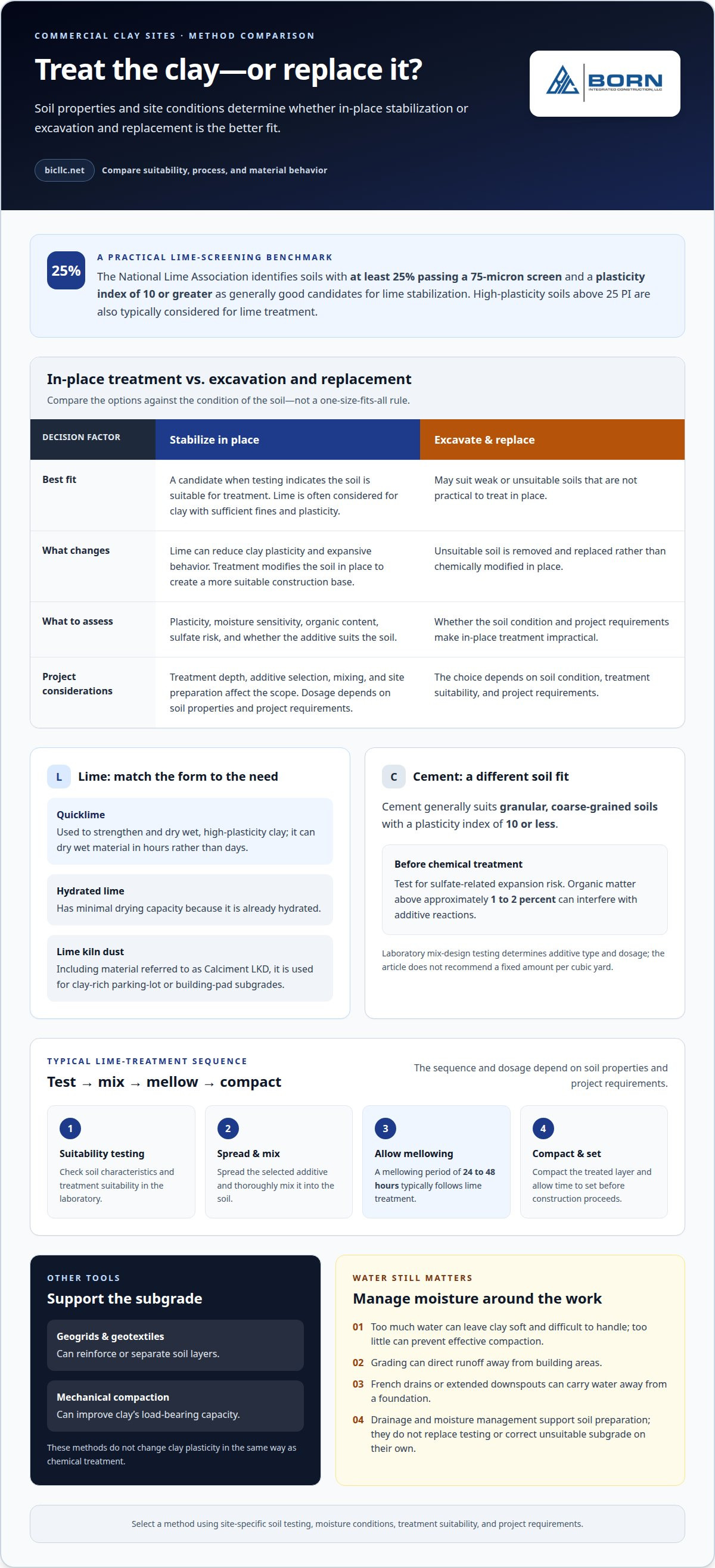
Soil stabilization versus excavation and replacement
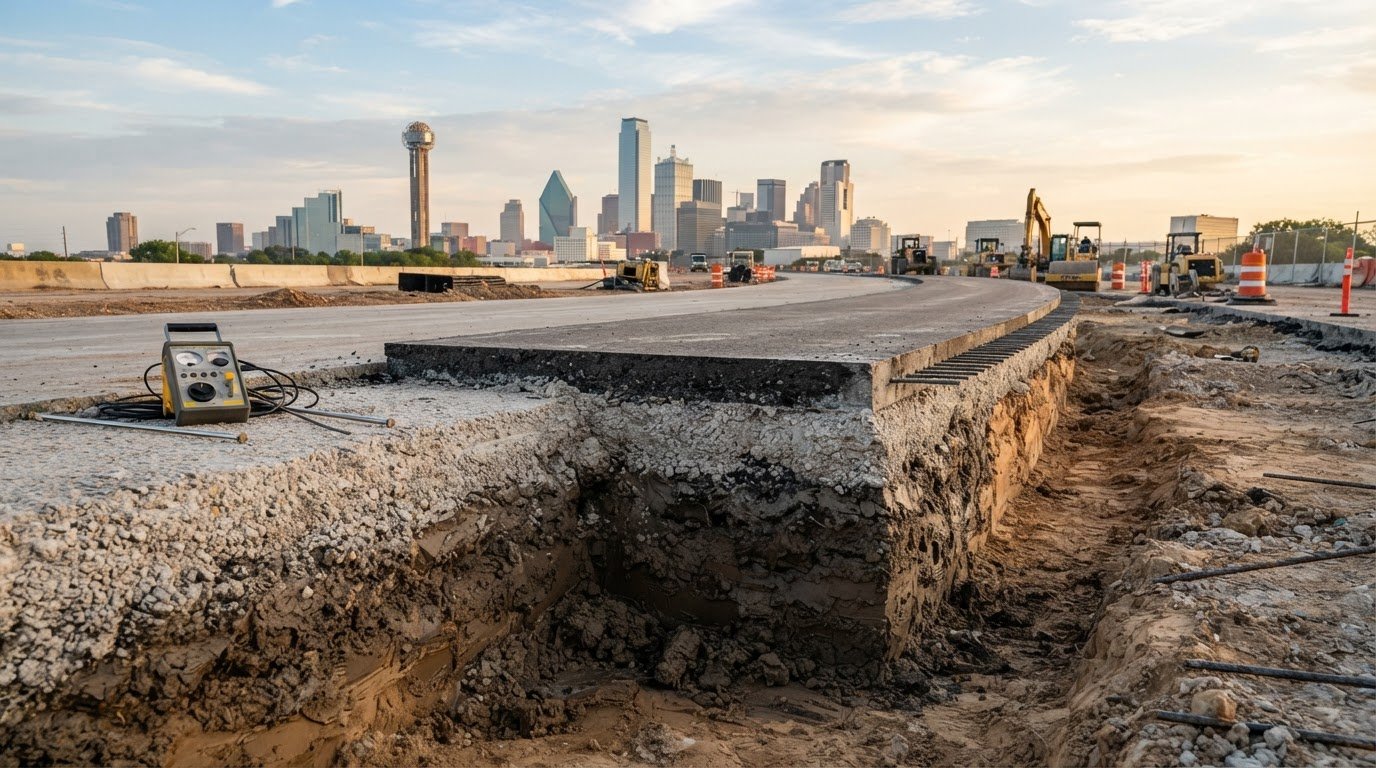
On commercial clay sites, the choice is often between improving weak soil in place and removing it for replacement. Stabilization changes the soil’s physical behavior through compaction, blending, or chemical treatment. Excavation removes the unsuitable layer, which is then replaced and compacted. The practical choice depends on the weak soil’s extent and depth, and whether it can be treated effectively.
In-place treatment can preserve usable soil and reduce the volume that needs removal. Chemical soil stabilization can save about a third of the cost compared with removing and replacing wet, weak soil. That does not make treatment suitable for every site. High organic content can interfere with lime or cement reactions, while sulfate-related expansion makes testing essential before chemical treatment. These conditions may shift the balance between treating and removing material.
Excavation and replacement can make sense when weak soil is localized, accessible, or unsuitable for a planned treatment. For example, crews may remove a soft pocket beneath a proposed slab while retaining stronger surrounding soil. Replacement material must then be placed and compacted to suit the project. A broad layer of wet clay presents a different challenge: removing it may require more excavation and replacement than treating viable soil in place.
Depth matters. Stabilization treatment depths can range from 6 to 18 inches, with 12 inches described as typical. If weak soil extends below the intended treatment zone, surface mixing alone won’t address the deeper material. Excavation may expose the full weak layer, while deeper treatment requires an approach suited to subsurface conditions. A site investigation helps map those changes before crews choose a method.
Compare the options against the actual site conditions:
- Soil suitability: Testing identifies whether clay responds to the selected chemical treatment or needs removal.
- Extent and depth: A shallow, isolated soft spot differs from widespread weak soil beneath a building pad.
- Water conditions: Wet material may be treatable, but ongoing water movement can affect construction and soil behavior.
- Construction sequence: Stabilization involves mixing and compaction; replacement requires excavation, material placement, and compaction.
Compare treatment with replacement for the mapped weak areas rather than assuming the whole site has the same conditions. If testing shows treatable clay at a manageable depth, in-place stabilization can reduce removal. If the soil is unsuitable or extends beyond the effective treatment zone, excavation and replacement may be more direct. The selected approach should address the full weak layer beneath the planned surface, not just its visible condition.
How much lime or cement is needed per cubic yard of clay soil?
There is no fixed quantity of lime or cement that suits every cubic yard of clay. Stabilization design uses laboratory mix-design testing to select the agent and dosage for the specific soil. Volume alone cannot establish the required additive mass: the calculation also depends on the soil’s dry mass within that volume and the tested dosage. A general pounds-per-cubic-yard figure can therefore mislead commercial project planning.
A cited study tested clay soils treated with 3% and 5% lime or portland cement. Those figures describe the mixes examined, not a universal field prescription. The right dosage depends on how the tested soil responds to each agent and the performance required for the planned work. Lime commonly suits high-plasticity clay, while cement is generally most effective in granular, coarse-grained soil with a plasticity index of 10 or less.
To estimate treatment for a cubic yard, the design team needs the dry soil mass represented by that volume and the dosage basis selected in the laboratory. The dosage is then applied to the corresponding soil quantity. Moisture content also matters during construction because it affects mixing and compaction. The same cubic yard can therefore require a different treatment when its composition or condition changes.
A practical mix-design process connects the field sample to the construction specification:
- Collect representative clay samples from the areas and depths planned for treatment.
- Test candidate lime or cement mixes in the laboratory, using dosage rates suited to the soil.
- Compare the treated samples against the project’s required soil behavior and compaction criteria.
- Use the selected dosage and treatment depth to calculate the additive quantity for the measured work area.
- Control field mixing and compaction so construction follows the tested design.
The calculation should distinguish treated volume from additive quantity. A cubic yard describes space; dosage is based on a measured soil quantity and the mix-design basis. A change in treatment depth also changes the volume. For example, a larger footprint or deeper layer contains more soil, so the specified additive quantity must reflect the expanded treatment volume. Do not transfer a dosage from one site area to another without accounting for differences in soil conditions.
Laboratory testing also helps compare lime with portland cement rather than assuming either agent will work equally well in every soil. Clay plasticity, moisture, and the intended construction use all influence the choice. Field execution then requires consistent spreading, mixing, and compaction across the treated area. These controls connect the tested dosage to the actual soil layer beneath a commercial project.
To see how soil decisions connect with completed commercial construction, explore commercial construction projects.
Born Integrated Construction: Concrete Paving
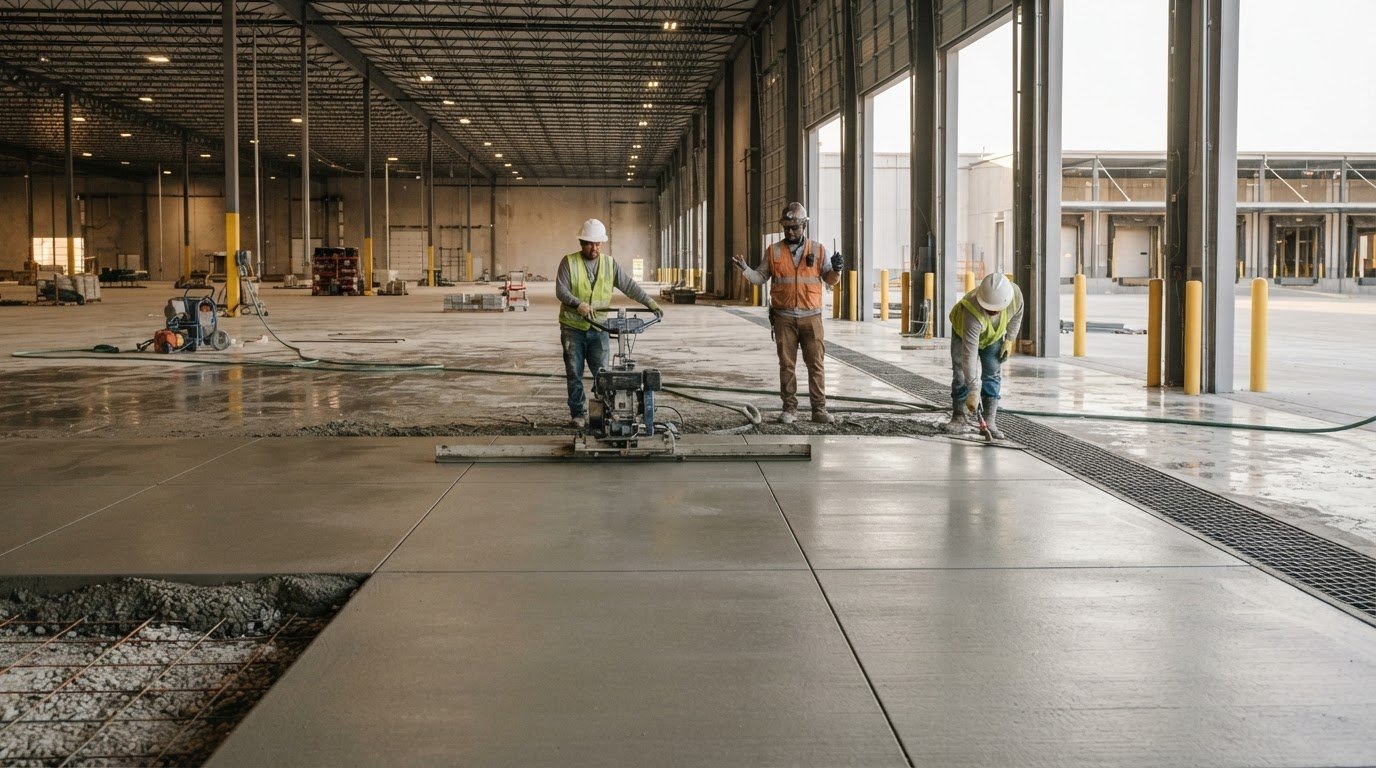
Born Integrated Construction provides Concrete Paving for commercial projects where prepared subgrade will support a finished paved surface. Soil testing and stabilization inform ground preparation; concrete construction follows as part of the wider site work. Moving from subgrade preparation to paving requires attention to project requirements and construction sequencing.
For projects involving building floors or elevated structures, Born Integrated Construction also provides Slab on Grade, Podium Slabs, and CIP Garages. Each offering addresses different construction needs, so the appropriate scope depends on the planned project and its design. Coordinating ground preparation with concrete work helps align construction with the intended use of each area.
For commercial concrete paving or related construction needs, contact Born Integrated Construction to discuss your project.
Carry the soil decision into construction planning
Use soil decisions to coordinate the next phase of your commercial project. Align geotechnical findings, site preparation, and the construction sequence so the selected approach supports the work planned above it. This connects soil conditions to practical decisions about access, scheduling, and how prepared areas will be used.
Selecting the best soil stabilization methods for clay is part of a sound project plan, not an isolated technical choice. Keep the reasoning for treatment or replacement clear as plans advance. This gives the project team a practical basis for coordinating ground preparation with the construction scope.
For the next step, discuss how your commercial concrete work fits the project’s requirements and site conditions. Contact Born Integrated Construction to discuss your project. A deliberate plan helps carry site decisions forward with clarity and confidence.
Frequently Asked Questions
What is clay soil?
Clay soil contains fine particles that can become plastic and soft as moisture increases. Its behavior changes with water content: the same ground may be firm when dry and difficult to work when wet. The plasticity index helps describe how clayey a soil is. On a commercial site, this property helps explain possible changes in workability and support beneath foundations, slabs, and paved areas.
What soil stabilization methods work best for clay soils?
The best soil stabilization methods for clay depend on soil properties and project performance needs. Lime is commonly selected for high-plasticity clay, while cement generally suits coarse-grained soils with lower plasticity. Compaction or blending with more stable material can also improve load-bearing capacity. If soil is unsuitable for treatment, excavation and replacement may be considered. Testing helps distinguish between these options for a particular site.
How do lime and cement stabilization compare for clay soil?
Lime is commonly selected for high-plasticity clay because it reduces plasticity and can help manage wet soil. Cement is generally better suited to granular, coarse-grained soils with lower plasticity, where it can bind suitable material into soil cement. Applying cement to higher-plasticity clay can require an elevated dose. The distinction matters when the soil’s response, mixing requirements, and intended use must align.
How do soil type, plasticity index, and moisture affect method selection?
Choosing the best soil stabilization methods for clay means considering soil type, plasticity index, and moisture together. Soil type indicates whether the ground is clay-rich or more granular, while the plasticity index describes its behavior. Moisture affects workability and compaction, so construction conditions matter. Wet, high-plasticity clay, for example, may call for a different treatment than lower-plasticity granular soil. Drainage and weak-soil depth also inform treatment or replacement decisions.
What local building codes or engineering tests apply to clay soil stabilization?
Applicable requirements depend on project location and governing specifications; do not assume one code requirement applies to every site. Engineering evaluation may include Atterberg limits, sulfate and organic-content testing, laboratory mix design, and field density checks. For Texas projects, requirements can vary across Houston, Austin, San Antonio, Dallas, Fort Worth, San Marcos, New Braunfels, Boerne, Beaumont, Conroe, Woodlands, and Arlington. Follow the project’s adopted criteria when planning testing and construction.