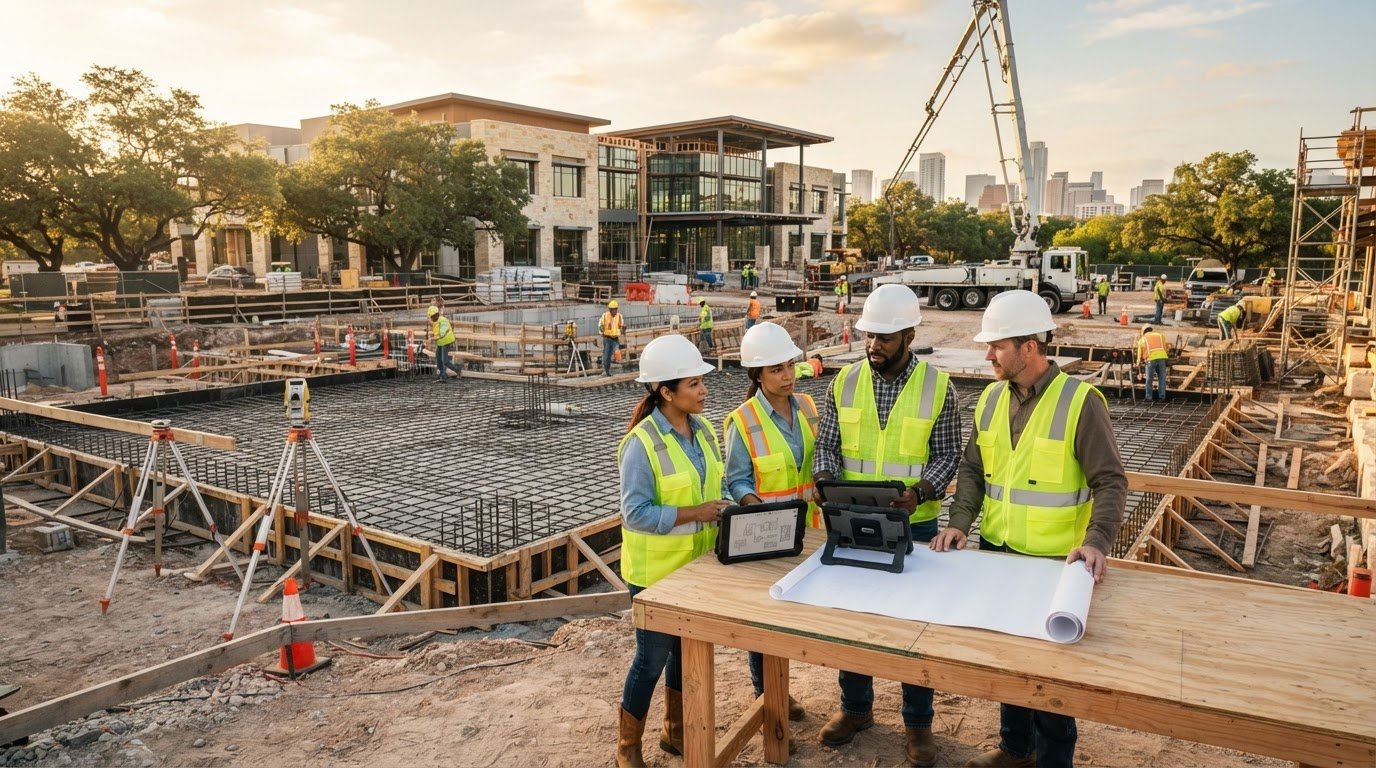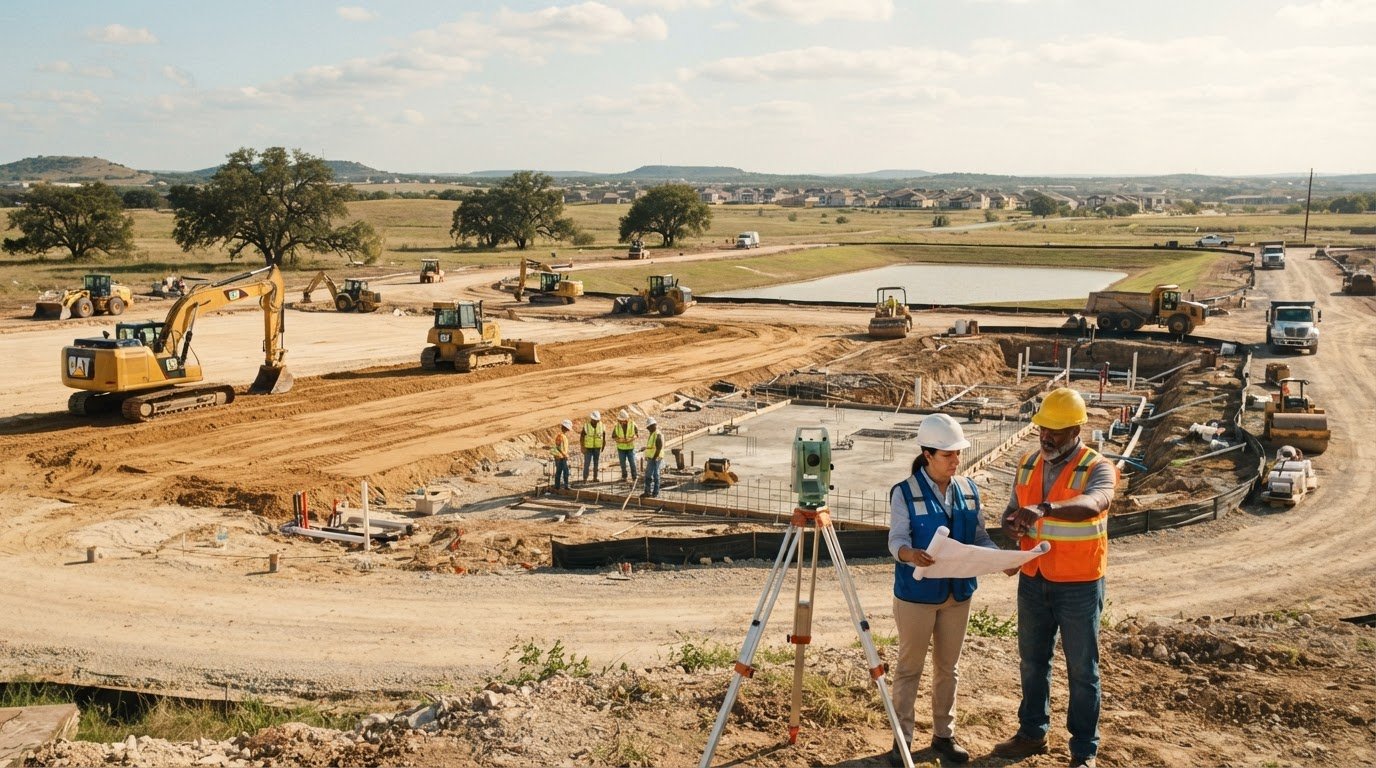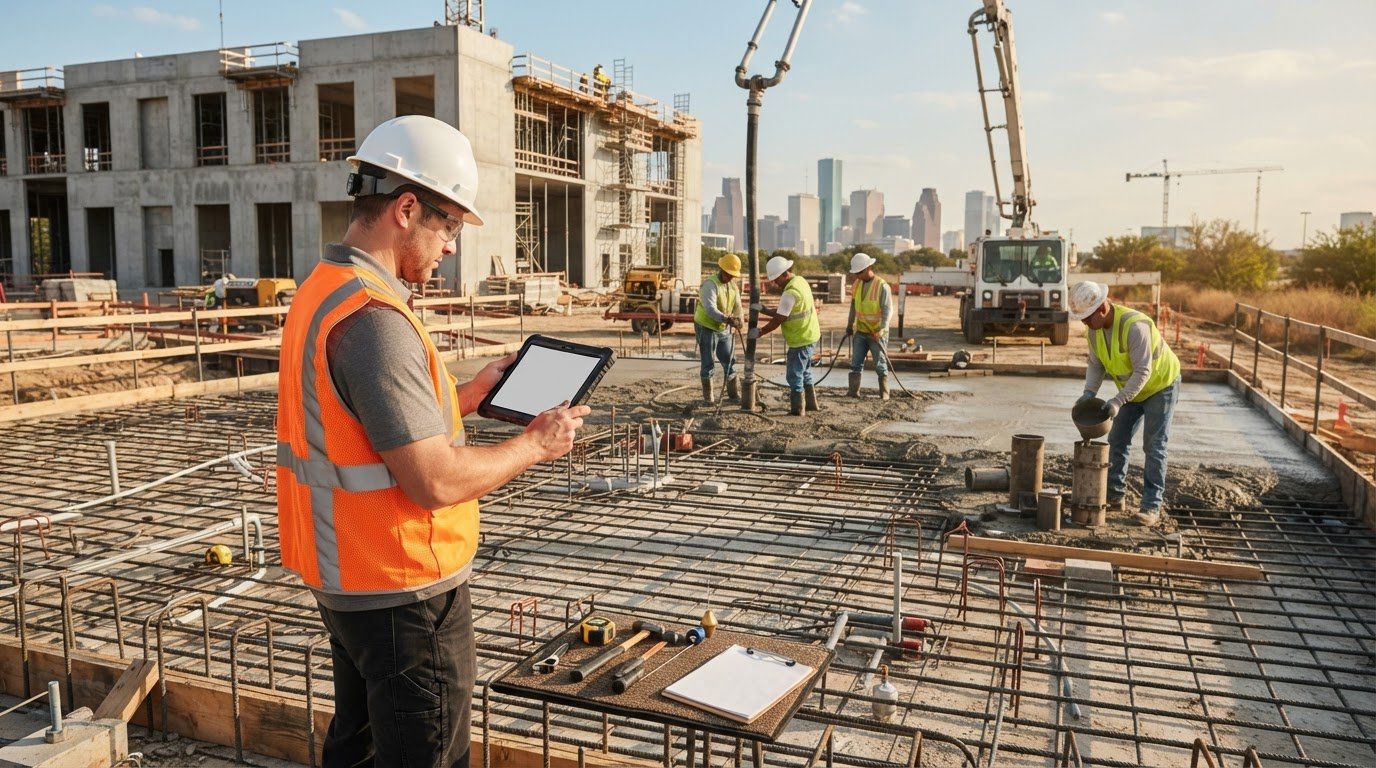
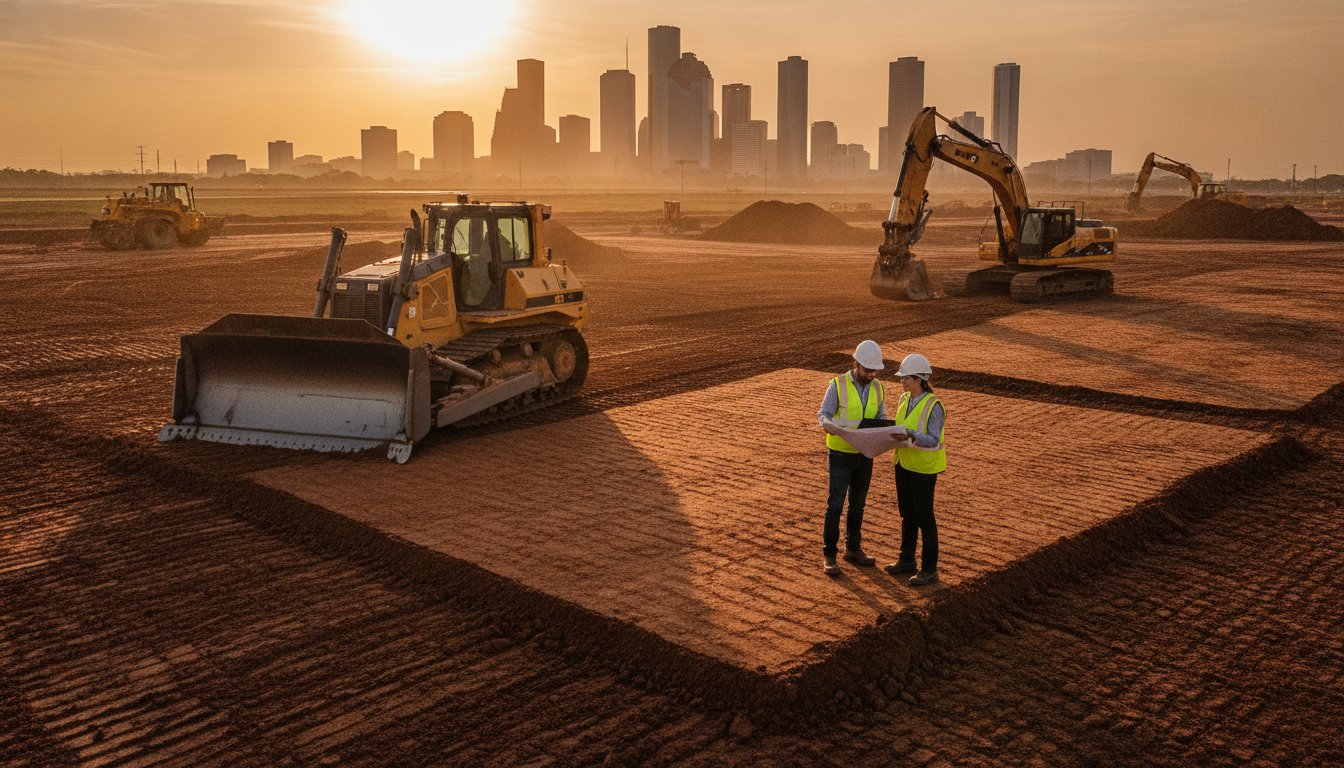
In Houston, the success of a multi-million dollar commercial development often depends on a few feet of highly unpredictable clay. You understand that the region's expansive soil is a constant threat, capable of causing structural cracks and drainage failures if it isn't managed with technical precision. Securing professional commercial earthwork services Houston is the most critical step in mitigating these risks before the first yard of concrete is poured. With 28.7 million square feet of industrial space currently under construction across the city, the demand for stable, buildable sites has never been higher.
This article provides a clear path to protecting your investment through integrated mass excavation, soil stabilization, and advanced stormwater management. We'll explore how modern site preparation techniques align with the 2021 International Building Code standards recently adopted by the city. You'll learn how a turnkey approach to earthwork ensures a seamless transition from raw dirt to a finished slab, preventing the costly delays that often occur between separate contractors. By the end, you'll have a thorough understanding of how to establish a resilient foundation that withstands the unique challenges of the Gulf Coast landscape.
Key Takeaways
- Understand the mechanical properties of Houston’s expansive clay and why specialized stabilization is mandatory to prevent structural foundation failure.
- Identify how professional commercial earthwork services Houston utilize precision mass excavation to prepare sites for complex high-rise and mid-rise developments.
- Learn how integrated detention ponds and paving stabilization techniques mitigate regional flood risks and protect your parking infrastructure from premature degradation.
- Evaluate the importance of an earthwork partner’s equipment fleet and safety protocols in maintaining strict project schedules and ensuring operational reliability.
- Discover the advantages of a turnkey civil approach that bridges the technical gap between initial site preparation and finished structural concrete.
Understanding the Challenges of Houston’s Expansive Soil
Houston's construction environment is defined by a specific geological challenge known as "black gumbo." This term describes the highly expansive clay soils found throughout the region. Unlike stable sandy soils, black gumbo is chemically reactive to moisture. It expands significantly when wet and contracts as it dries. This volumetric change exerts immense upward and downward pressure on structural foundations. For developers, ignoring these mechanics during the initial phase of site preparation is a high-stakes gamble that often leads to shifted slabs or severe masonry cracks.
Standard grading might suffice for minor residential projects, but heavy-duty commercial developments require a more rigorous engineering approach. Professional commercial earthwork services Houston focus on neutralizing these soil movements before the first yard of concrete is poured. Without a stable subgrade, even the most robust post-tension slabs or CIP garages are vulnerable to the relentless cycle of soil movement. The financial consequences of subgrade failure are severe. Remediation costs for a failed foundation often exceed the cost of the original earthwork by a factor of ten, making precision site prep a non-negotiable insurance policy for your capital.
The Impact of Moisture on Gulf Coast Foundations
The Gulf Coast’s seasonal rain cycles create a volatile environment for commercial foundations. During periods of heavy precipitation, the clay beneath a project site can heave upward, lifting entire sections of a slab. Conversely, during the hot Texas summers, the soil subsides as it loses moisture. This constant movement causes un-stabilized parking lots and sidewalks to buckle and fail. Effective earthwork manages these risks by implementing moisture control barriers and chemical stabilization to create a consistent, predictable foundation that doesn't react to the weather.
Regulatory Standards for Houston Site Preparation
As of 2026, the City of Houston has adopted the 2021 International Building Code with local amendments, placing greater emphasis on site readiness and soil integrity. Geotechnical reports are the essential roadmap for every mass soil excavation project. These reports dictate the required compaction levels and specific stabilization methods needed to meet current safety standards. Adhering to these rigorous codes ensures that your commercial investment remains structurally sound and compliant with municipal regulations for decades to come. It’s a disciplined process that values long-term stability over short-term speed.
Comprehensive Mass Soil Excavation for Structural Foundations
Mass soil excavation is the heavy-lifting phase where a project's structural integrity begins to take physical shape. In high-density areas of Houston, this process requires more than just moving dirt; it demands a disciplined logistical strategy. Large-scale commercial earthwork services Houston must manage the continuous cycle of soil haul-off while maintaining the stability of adjacent structures. This is particularly critical when digging deep foundations for mid-rise and high-rise developments where the margin for error is non-existent. We utilize a methodical approach to ensure that every cubic yard removed aligns with the structural engineer’s load-bearing requirements.
Precision is the hallmark of professional excavation. When preparing for CIP (Cast-in-Place) garages or multi-level structures, the excavation must be perfectly integrated with temporary shoring and retaining walls. This prevents soil sloughing and protects the work zone. During these early phases, we often begin the rough cuts for essential site infrastructure. Adhering to the HCFCD detention basin design guidelines from the first scoop of earth ensures that the project remains compliant with Harris County's strict flood mitigation standards. Proper planning at this stage prevents the need for costly re-digging later in the schedule.
Excavation for Multi-Story and High-Rise Structures
High-rise projects in the Texas Medical Center or Uptown corridors present unique challenges regarding depth and soil pressure. Deep-foundation preparation involves heavy equipment capable of reaching significant depths while maintaining vertical precision. Our teams work in lockstep with structural engineers to verify that the sub-grade meets the specific density required for structural concrete. This coordination is vital for the long-term viability of the building. Relying on a partner who understands the transition from raw earth to complex structural systems is the best way to secure your project's timeline.
Site Readiness for CIP and Precast Garages
Parking structures require specialized foundation prep due to the immense concentrated loads of multi-level concrete. Whether you're working with an expert podium slab contractor in Houston or preparing for a precast garage foundation, the sub-grade must be perfectly level and stabilized. CIP foundations typically demand more intricate trenching for grade beams, while precast structures focus on massive, level pads for column footings. We ensure that every square foot of the footprint is prepared to receive structural concrete without risk of differential settlement. This meticulous attention to detail at the dirt level creates the reliable platform necessary for high-performance parking facilities.
Essential Site Infrastructure: Detention Ponds and Paving Stabilization
Houston’s heavy rainfall requires a sophisticated approach to civil infrastructure that goes beyond simple dirt moving. For any large-scale development, managing stormwater is a primary regulatory and functional requirement. Professional commercial earthwork services Houston prioritize the construction of detention ponds as a core structural component of the site plan. These basins aren't merely decorative landscape features; they're engineered systems designed to protect the project and the surrounding community from flooding during Gulf Coast storm events. A failure in pond design can lead to site-wide flooding and significant municipal penalties.
Effective detention pond construction involves mass excavation to achieve precise retention volumes. Long-term integrity depends on meticulous slope stabilization and, in many cases, specific lining materials to prevent erosion or seepage. We ensure every basin meets the City of Houston’s stringent requirements for stormwater management, providing a reliable solution that functions correctly from the first rainfall. This methodical approach to water management is what separates a disciplined earthwork partner from a standard excavation contractor.
Detention Pond Engineering and Construction
Mass excavation for stormwater retention requires a deep understanding of local hydrology and soil stability. Our teams focus on creating basins with stable slopes that won't slough or collapse over time. By following the established engineering specifications for depth and volume, we provide the necessary capacity to manage high-velocity runoff. This phase of the project is vital for ensuring that the entire development remains compliant with regional flood control standards while protecting the structural assets on the site.
The Mechanics of Soil Stabilization
While water is managed on the surface, the soil beneath your parking lots and access roads requires a chemical intervention to ensure longevity. Standard mechanical compaction is rarely enough to support heavy commercial traffic on Houston's clay. Stabilization techniques modify the soil's properties, typically through the introduction of lime or fly ash. This process turns volatile clay into a rigid, predictable foundation that won't heave or subside with moisture changes.
This stabilized layer acts as a structural bridge for commercial concrete paving in Conroe and the Greater Houston area. By neutralizing the soil's expansive nature, we prevent the sub-grade from shifting, which is the leading cause of premature paving failure. Verification is a critical part of our workflow. We utilize rigorous testing protocols, including proof rolling with heavy machinery, to confirm that the sub-grade has reached the necessary strength. This ensures that the commercial earthwork services Houston we provide result in a site that's ready for heavy-duty operational use.
Earthwork is also the most efficient phase for installing critical underground utility systems. Coordinating the placement of storm drains, sanitary sewers, and water lines while heavy machinery is already on-site minimizes schedule disruptions. This integrated approach ensures that the site's hidden infrastructure is as durable and well-executed as the visible structures above ground.

Evaluating Earthwork Partners for Houston Commercial Developments
Selecting a partner for heavy civil work requires looking beyond the initial bid price. In the high-stakes environment of 2026 commercial development, the size and age of an equipment fleet are direct indicators of a contractor's reliability. Older machinery is prone to mechanical failure, which can stall a project for days. A dependable provider of commercial earthwork services Houston maintains a modern fleet to ensure that mass excavation and soil stabilization stay on schedule. Beyond equipment, a partner must demonstrate a deep understanding of local site logistics, particularly in dense corridors where traffic control and soil haul-off require meticulous planning.
Experience with Houston’s specific regulatory framework is equally vital. Navigating the requirements of the Public Works department and managing the Sediment and Erosion Control (SEC) fees requires a disciplined administrative approach. A partner who understands these nuances prevents the administrative bottlenecks that often derail commercial projects before they even reach the paving stage. This level of expertise ensures that every phase of the site preparation is compliant with current municipal standards.
The Risks of Fragmented Site Subcontracting
One of the most significant risks in commercial development is the fragmentation of site subcontractors. When the earthwork and concrete teams operate as separate entities, communication gaps are inevitable. It's common for a concrete contractor to arrive on-site only to find that the subgrade does not meet their specific requirements. This leads to the "finger-pointing" problem, where neither party takes responsibility for delays or foundation issues. Choosing a single-source civil and concrete partner eliminates this friction. By integrating these services, you ensure a seamless transition from dirt to slab, with a single point of accountability for the site’s structural integrity.
Safety and Integrity in Earthwork Operations
Safety is a core pillar of professional heavy civil work. Rigorous OSHA compliance for trenching and excavation is a minimum requirement, but a true partner fosters a comprehensive safety-first culture. This commitment protects workers and minimizes the legal and financial risks for developers. In 2026, environmental considerations such as dust control and runoff management are also under increased scrutiny. A reputable contractor provides the necessary insurance and bonding to handle large-scale Texas projects, offering you the security that your investment is in disciplined hands. If you are ready to partner with a team that prioritizes operational precision, you can contact our civil experts today to discuss your project requirements.
Born Integrated Construction: Turnkey Civil and Earthwork Solutions
Born Integrated Construction operates on a foundational principle that civil site work and structural concrete are inseparable components of a single, continuous timeline. For developers seeking commercial earthwork services Houston, this integrated approach provides a level of operational continuity that traditional, fragmented models cannot match. We've spent decades refining this process across Houston, Austin, and San Antonio, establishing a reputation for technical proficiency and professional stability. Our expertise encompasses the full scope of site preparation, from precision mass excavation to the complex engineering of detention ponds and chemical soil stabilization.
Our commitment to long-term structural viability means we treat the sub-grade with the same meticulous care as the finished slab. By managing the transition from raw earth to structural concrete internally, we ensure that every compaction test and stabilization treatment is performed to the exact specifications required for the following concrete phase. This disciplined management of details minimizes risk and ensures that the enduring nature of our work remains a constant for the life of the development. We value substance over style, focusing on the acts of establishing and maintaining the high standards our clients expect.
Why Integration Leads to Better Project ROI
Financial efficiency in 2026 commercial construction depends on the elimination of scheduling gaps. When a single partner manages both site prep and paving, the transition is seamless. There's no downtime waiting for a separate dirt crew to demobilize or a concrete crew to arrive. This streamlining provides a single point of accountability, removing the communication barriers that often lead to project delays. Precise sub-grade preparation directly translates to a more efficient concrete pour, reducing material waste and ensuring that structural slab-on-grade foundations are built on an optimized platform.
Getting Started with Your Houston Development
Every successful project begins with a thorough analysis of site-specific data. We meticulously review geotechnical reports to identify the optimal soil stabilization and mass excavation strategy for your property. Whether you're developing a high-density retail center, a sprawling industrial warehouse, or a multi-family residential complex, our solutions are customized to meet the unique demands of the site. We invite you to contact Born Integrated Construction for a project consultation to learn how our seasoned team can bring technical precision and unwavering consistency to your next development. Our goal is to deliver a site that's not just ready for construction, but engineered for long-term excellence.
Securing the Future of Your Houston Commercial Investment
Houston's construction landscape in 2026 demands a disciplined approach to site preparation. We've explored how neutralizing expansive clay through chemical stabilization and precision excavation establishes the necessary foundation for structural success. By prioritizing integrated detention pond engineering and modern equipment management, developers can effectively mitigate the environmental and logistical risks inherent to the Gulf Coast. Selecting professional commercial earthwork services Houston ensures that your project transitions seamlessly from raw land to a finished structural slab without the friction of fragmented subcontracting.
Born Integrated Construction provides a dependable partnership built on specialized expertise in CIP and structural concrete. Serving Houston, Austin, and Dallas-Fort Worth, we implement integrated safety and quality management systems to protect every phase of your build. Our turnkey model is designed for professionals who value substance, operational precision, and enduring craftsmanship. We invite you to Request a Turnkey Civil Site Work Quote from Born Integrated Construction. Let's establish a site that's prepared for the rigors of the Texas environment and the long-term demands of your business.
Frequently Asked Questions
What exactly are commercial earthwork services?
Commercial earthwork services encompass the technical preparation of a site to support heavy duty structures. This includes mass soil excavation, paving stabilization, and the construction of essential site infrastructure like detention ponds. These services are the first step in establishing a stable platform for structural concrete. They ensure the land is physically capable of supporting the intended commercial load without risk of failure.
Why is soil stabilization so important in Houston?
Soil stabilization is critical in Houston because of the region's prevalent "black gumbo" expansive clay. This soil type expands and contracts with moisture changes, which can lead to foundation cracks and paving failure. Professional commercial earthwork services Houston utilize chemical agents like lime to modify the soil's properties. This creates a rigid, non-reactive subgrade that protects your structural investment from the Gulf Coast’s volatile weather cycles.
How much does mass soil excavation typically cost for a commercial site?
Costs for mass soil excavation are determined by several technical variables, including total cubic yardage and the depth of the foundation. Soil composition and the distance required for material haul-off also play significant roles in determining the final project budget. Since each site has unique geotechnical needs, we focus on providing a precise scope of work based on your specific project engineering and logistical requirements.
Can you handle detention pond construction and underground utilities together?
Integrating detention pond construction with underground utility installation is a standard practice for efficient site preparation. Coordinating storm drains, sanitary sewers, and water lines during the mass excavation phase minimizes schedule disruptions. This approach ensures that the site's water management systems and utility infrastructure are installed with structural precision before the paving phase begins, creating a more cohesive site infrastructure.
What is the difference between grading and mass excavation?
Grading is the process of leveling the surface to provide proper drainage and a flat work area for immediate construction. Mass excavation involves moving large volumes of soil to significant depths, often for structural foundations, CIP garages, or detention basins. While grading prepares the top layer, mass excavation establishes the deep-seated structural integrity required for multi-story commercial buildings and heavy infrastructure.
How long does the earthwork phase take for a mid-rise development?
The timeline for the earthwork phase depends on the project's scale, soil conditions, and the complexity of the site logistics. A typical mid-rise development may require several weeks of intensive work to complete mass excavation and soil stabilization. Factors such as seasonal rain cycles and the efficiency of soil haul-off can influence the overall schedule. We prioritize a methodical pace to ensure every layer meets compaction standards.
Is Born Integrated Construction licensed for work in Harris and Montgomery Counties?
Our operations are conducted in full compliance with the building codes and regulatory requirements of Harris and Montgomery Counties. We manage the necessary street cut permits and excavation filings required by local Public Works departments. Our experience in these jurisdictions ensures that your project remains compliant with the 2021 International Building Code and local municipal amendments, providing a secure and legal construction process.
Do you provide turnkey civil site work including both earthwork and concrete?
We provide comprehensive turnkey civil site work that integrates both earthwork and structural concrete construction. This "Born Integrated" approach eliminates the communication gaps that often occur between separate dirt and concrete contractors. We manage the entire transition from raw excavation to finished slabs on grade, CIP garages, and podium decks, providing a single point of accountability for the site’s structural integrity.