A commercial concrete proposal is strongest when it defines the work, pricing structure, assumptions, exclusions, schedule, payment milestones, and change process. A commercial concrete bid proposal example for a retail foundation should separate the base scope from optional work and state the commercial terms clearly. The proposal is not a construction contract. Work should begin only after both parties execute a contract or another legally binding agreement that incorporates the accepted proposal.
Price matters, but a bid must also show what the price covers and how the work will be managed. This guide explains what to include, how to set payment and change terms, and how to apply them to a retail foundation package. Use a commercial concrete bid proposal example to organize the scope, pricing, assumptions, and agreement terms, then tailor them to the project so they are clear and easy to review.
Key Takeaways
- Define the foundation scope with project specifications, estimated quantities, assumptions, exclusions, and any separately priced alternates.
- Set out payment milestones and explain how changes to the agreed scope will be documented and priced.
- Separate the proposal from the contract, and establish responsibilities, schedule expectations, and applicable project requirements in the agreement.
- Present bidder information and relevant project experience clearly so the proposal shows how the work will be managed, not only what it costs.
- Apply the proposal structure to a retail foundation package by tying each scope item and quantity to the project documents and stated assumptions.
Deposits, payment schedules, and change charges
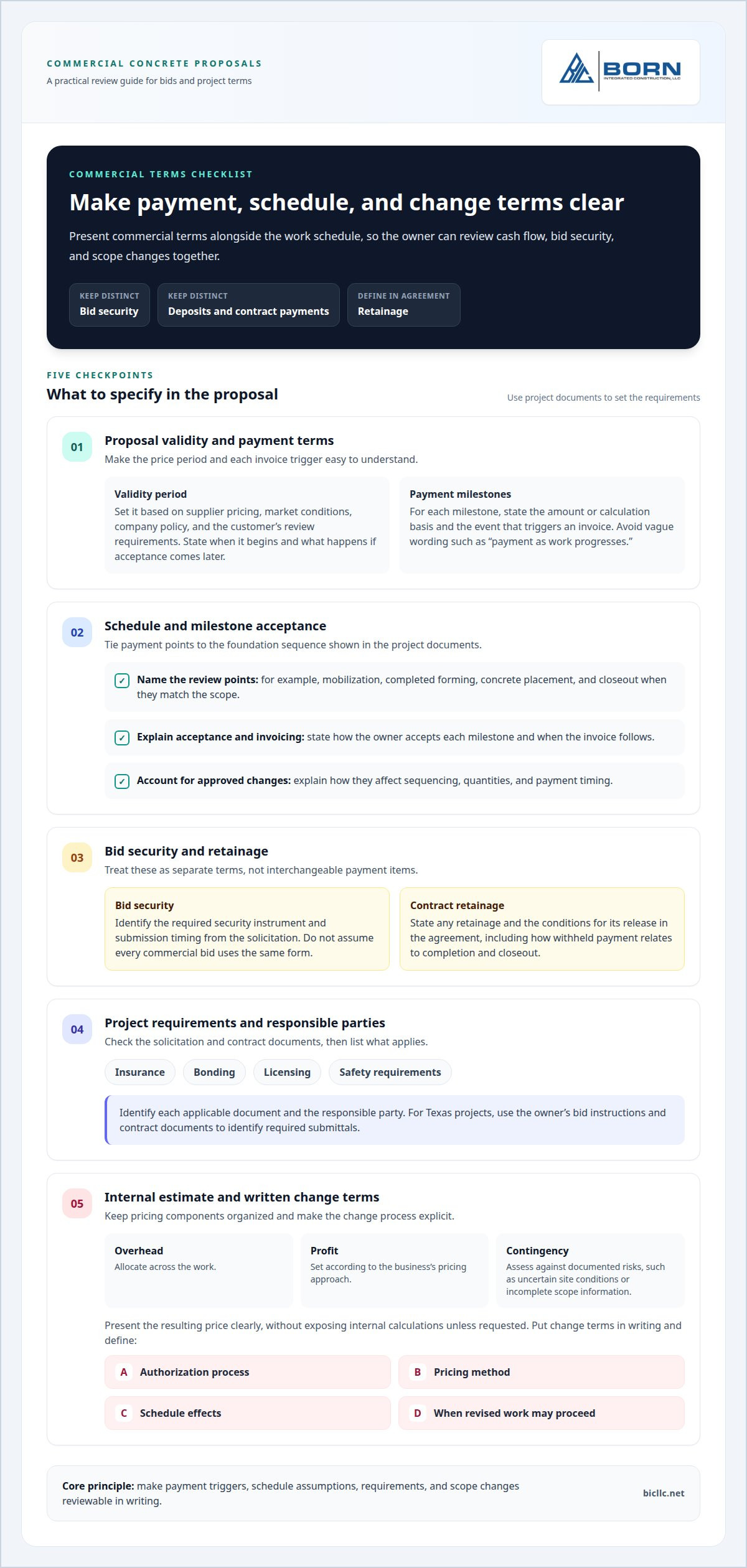
Present commercial terms alongside the work schedule so the owner can assess cash flow, bid security, and scope changes together. Keep bid security distinct from contract payments, deposits, and retainage.
State Proposal Validity and Payment Terms
Set a proposal validity period based on supplier pricing, market conditions, company policy, and the customer’s review requirements. State when the period begins and what happens if acceptance comes later. For each payment milestone, specify the amount or calculation basis and the event that triggers an invoice. Avoid vague terms such as “payment as work progresses.” Link payment to defined work stages and project timelines.
- Build the schedule around the foundation sequence shown in the project documents. For example, identify mobilization, completed forming, concrete placement, and closeout as separate review points when they match the scope. Explain how the owner accepts each milestone and when an invoice follows. Contractors should state how approved changes affect sequencing, quantities, and payment timing. This makes the schedule usable during project administration.
Address Bid Security and Retainage
Keep bid security separate from deposits and contract payments. Identify the required security instrument and submission timing in the solicitation, rather than assuming every commercial bid uses the same form. State any contract retainage and the conditions for its release in the agreement, so the owner and contractor understand how withheld payment relates to completion and closeout.
- Review the solicitation for insurance, bonding, licensing, and safety requirements, then list each applicable document and the responsible party. Requirements depend on the project documents and contracting conditions, so reflect the stated requirements rather than assuming one universal package. For Texas projects, use the owner’s bid instructions and contract documents to identify the required submittals.
- In the internal estimate, keep overhead, profit, and contingency distinct. Allocate overhead across the work, set profit according to the business’s pricing approach, and assess contingency against documented risks, such as uncertain site conditions or incomplete scope information. Present the resulting price clearly, without exposing internal calculations unless requested. Put change terms in writing: define authorization, pricing method, schedule effects, and when revised work may proceed.
What is included in this concrete proposal template?
A PDF template can provide a consistent layout, but its value depends on project-specific scope, quantities, and assumptions. Use the steps below to turn drawings and specifications into a detailed estimate the owner can review.
-
Define the Project Scope and Specifications
Match each foundation component to the drawings and written specifications. Record the building footprint, foundation elements, concrete requirements, reinforcement details, and estimated quantities. Show square footage alongside measured work, and identify the drawing or specification section that supports each item. A commercial concrete bid proposal example should make every quantity traceable. Separate included work from exclusions so the owner can see the estimate’s boundaries. Do not present a preliminary quantity as a final field measurement.
-
Identify the Project Type and Use Case
Name the concrete project type and its intended function, such as a retail building foundation that supports the planned structure. Describe whether the bid covers a slab-on-grade foundation, footings, foundation walls, or a combination shown in the plans. Link each scope item to its purpose instead of grouping different work under a general “concrete” line. This helps the reviewer compare proposals on a consistent basis.
-
Set the Duration and Schedule Assumptions
Set out the expected sequence using project milestones, such as site readiness, foundation preparation, placement, and completion. Identify dependencies that affect the sequence, including access, preceding trade work, approved drawings, and site conditions. State schedule assumptions clearly, and distinguish the contractor’s work duration from the overall construction timeline. Avoid promising dates that depend on conditions outside the stated scope. Align the schedule with the proposal’s validity period and review process.
-
Price Materials and Concrete Work
Break the estimate into traceable cost categories for concrete materials, pumping, finishing, and reinforcement. Base quantities on the takeoff, then apply relevant supplier quotes, placement requirements, and labor assumptions. Keep categories distinct so revisions can be traced to the affected work. Document waste or access constraints as estimating assumptions, not hidden additions. Present the price in the format required for bidding, such as a lump sum or itemized schedule. Use a commercial concrete bid proposal example to check that the categories are clear, then adapt them to the actual plans.
- Assemble the proposal in a reviewable order: project identification, scope, specifications, estimated quantities, pricing, schedule, assumptions, exclusions, and acceptance terms. Include drawing references and identify the estimate’s date or revision so the owner can distinguish it from earlier versions. A reusable proposal template should make these sections easy to update without carrying old quantities into a new bid. For a practical look at concrete work in context, review commercial concrete project examples.
Agreement terms and contractor responsibilities
Present agreement terms alongside the technical scope so responsibilities, exclusions, and acceptance conditions remain clear. Use the steps below to create an accurate record for contract review.
-
Set Contract Terms and Exclusions
Identify the documents that will govern the work, including the accepted proposal and any incorporated contract terms. A bid proposal is not itself a construction contract. Work should begin only after both parties execute a contract or another legally binding agreement that incorporates the accepted proposal. State how conflicts between the proposal, drawings, and contract documents will be resolved.
List exclusions in specific language. For example, distinguish concrete placement from work outside the agreed scope, such as site preparation or utility relocation, when those items are excluded. Define the change process, payment obligations, schedule effects, and any required written approvals. Avoid broad phrases such as “all other work excluded,” which leave the owner unable to identify the scope boundary.
-
Assign Contractor Responsibilities and Signatures
Name the contractor’s responsibilities for the specified work, then identify the owner’s responsibilities that affect performance. These may include access, approved drawings, coordination with other trades, and timely decisions, where applicable. Assign subcontractor coordination to a named role or party, and state how field instructions will be documented as changes rather than treated as informal additions.
Provide signature lines for authorized representatives, including printed names, titles, and dates. Identify the proposal version being accepted so the signatures apply to the same scope and terms. If the client issues a separate contract, reconcile its terms with the proposal before execution. A signature should record acceptance of defined documents, not an unclear collection of revisions.
- Record project-specific requirements in a compliance schedule, naming the responsible party and required evidence. According to the Ohio Legislature, the Springfield Township project requires contractors and labor subcontractors to participate in Ohio's Drug-Free Workplace Program or a comparable program approved by the Ohio Bureau of Worker’s Compensation under Ohio Revised Code §153.03. Keep this Springfield Township requirement distinct from general commercial terms.
For each project, organize required insurance, bonding, safety, and licensing documents around the owner’s solicitation and contract. Identify submission timing and responsibility without treating one project’s conditions as universal. This format helps the owner see which documents accompany the bid and which obligations apply after award.
- Before presenting the agreement for signature, compare the proposal’s scope, exclusions, schedule assumptions, payment conditions, and change procedure against the contract documents. Resolve conflicting terms in writing, identify the controlling version, and attach referenced exhibits. This helps keep the accepted price connected to the conditions that define the work.
Keep signed copies with the final proposal and its referenced documents. Record later amendments as dated written changes approved by the parties. This gives the contractor, owner, and subcontractors a shared basis for managing responsibilities throughout the project.
Bidder and company information
Present bidder details and relevant experience consistently. A clear company profile lets the reviewer identify who prepared the bid and assess its fit.
-
Enter Bidder and Company Details
Start with the legal business name, business address, proposal contact, and authorized representative. Match each field to the solicitation’s requested format, then check spelling against the company’s formal records. Add the project name and bid reference so the proposal remains identifiable when separated from its attachments. Do not use a personal contact as the only company identifier.
-
Describe Company Profile and Experience
Summarize the company’s concrete construction work in terms relevant to the bid. For a retail foundation, describe comparable foundation or structural concrete experience, then state the contractor’s role and scope. Name project types rather than making broad claims. Include completion examples only when accurate and supported by company records. Keep the profile focused on evidence the reviewer can connect to the proposed work.
- Outline the proposed project team and its responsibilities. Identify the bid contact, project lead, field supervision, and relevant subcontractors by role, adding names where confirmed. Explain how the team will coordinate submittals, site communication, and progress documentation. This gives the owner a practical view of who is responsible for execution, rather than a list of titles without project context.
- Use Google Sheets to organize bidder information and supporting schedules when the bid team needs a shared working document. Create separate tabs for company details, project experience, key personnel, and attachments. Use consistent labels, clear units, and a revision field. Check formulas and formatting after edits, then export or submit the final version in the solicitation’s required format.
- Prepare a concise cover letter that identifies the project, bidder, submitted proposal, and primary contact. Outline the enclosed sections and note any requested forms or supporting documents. Keep commitments consistent with the proposal’s scope and timeline. Before submission, compare the letter, company profile, and bid form to ensure names, project references, and authorized signatory details match.
- Close the company-information section with verifiable project references or completion records when the bid instructions request them. For each example, identify the project type, work performed, and company’s role. Describe completed work accurately and distinguish it from current assignments. A focused record helps the reviewer evaluate relevant experience without unsupported claims or unrelated credentials.
Construction example for a retail foundation package
Apply the proposal structure to a retail project by linking each scope item to the drawings. The example below shows how to make the bid easy to review without inventing quantities or specifications.
- Identify the package as the retail building foundation scope, then cite the plan sheets and specification sections used for pricing. State whether the bid covers footings, foundation walls, slab work, or only the elements shown in the assigned scope. This prevents the phrase “complete foundation” from implying work assigned elsewhere in the drawings.
- Build a scope-of-work list from the project documents. For each foundation element, record its location, relevant detail reference, estimated quantity, and unit of measurement. If the drawings show multiple footing types, list them separately by designation instead of combining them. Keep each quantity traceable to the takeoff, and flag drawing conflicts as bid clarifications.
- Connect each priced line to a construction activity. A retail package might separate layout-related coordination, reinforcement placement, concrete supply, placement, and finishing when those tasks are within the bid scope. Use the specifications to define the required work. Do not assume an activity is included just because it commonly accompanies foundation construction.
- State the estimate’s basis beside the relevant items. Identify the drawing revision used, access assumptions, and dependencies on site readiness or preceding trades. If a detail remains unresolved in the bid documents, state the assumption clearly and describe its pricing effect without presenting it as an approved design change.
- Present the base bid separately from optional work or alternate methods. For example, show an alternate on its own line, with a short description and its effect on the scope. Keep the base proposal intact so the owner can compare bids consistently. Add a schedule note that ties planned foundation work to the project sequence, not to an unsupported completion date.
- Finish with a review trail: identify the proposal version, list included attachments, and state how written clarifications become part of the accepted documents. Before submission, compare the scope, quantities, assumptions, and exclusions against the same retail plan set. For a practical reference to completed concrete construction work, review concrete project examples.
Born Integrated Construction: Concrete Paving
Born Integrated Construction provides Concrete Paving for commercial projects that need a clearly defined concrete scope. If your project includes a retail foundation, discuss how the foundation package connects with adjacent paving and site construction. The proposal principles above help establish scope boundaries, quantities, assumptions, and acceptance terms before work proceeds.
For projects centered on a building slab, Born Integrated Construction also provides Slab on Grade. Podium Slabs and CIP Garages address other structural concrete needs. The right scope depends on the project documents and required work, so a proposal should distinguish each package rather than combine unrelated activities.
When planning commercial concrete work, contact Born Integrated Construction to discuss your project scope and proposal requirements.
Put the Proposal to Work on Your Next Project
A well-prepared bid is a working document, not just a price presentation. Use it to establish a clear basis for coordination from review through execution, and keep its assumptions aligned with the project as decisions develop. A commercial concrete bid proposal example can help organize the process, but the final document should reflect the actual drawings, scope, and commercial terms.
For a project involving site paving, a building slab, or a podium structure, match the concrete scope to the construction package. Born Integrated Construction provides Concrete Paving, Slab on Grade, and Podium Slabs for projects with those requirements. The next step is to discuss how the concrete work fits your project’s needs and documentation.
Contact Born Integrated Construction to discuss your commercial concrete project. A clear conversation can help you move from bid preparation toward a defined project scope.
Frequently Asked Questions
How does the bidding process work?
The bidding process moves from reviewing the solicitation to submitting a complete, comparable offer. First, note the bid deadline, required forms, drawing revisions, and instructions for questions. Then prepare the estimate and supporting documents, resolve discrepancies through the stated clarification process, and submit the package in the required format. After bids are received, the owner evaluates them against the solicitation and communicates its selection and next steps.
What is a bid proposal?
A bid proposal is a contractor’s formal offer to perform defined work under stated commercial conditions. It gives the owner a basis for evaluating the price, scope, schedule, and qualifications. For example, a retail project offer can identify the specific foundation package being priced and distinguish it from adjacent construction. The proposal should be internally consistent, with its price and commitments corresponding to the same documented work.
Who Should Use This Template?
Commercial concrete contractors, estimators, and preconstruction teams can use a template to organize repeatable bid information. It can also help a subcontractor present a defined package to a general contractor. For Texas projects in Houston, Austin, San Antonio, Dallas, Fort Worth, San Marcos, New Braunfels, Boerne, Beaumont, Conroe, The Woodlands, or Arlington, adapt the document to the solicitation and project requirements rather than reusing an unchanged file.
What should a commercial concrete bid proposal include?
Include enough detail for reviewers to trace the offer to its supporting documents. In the final review, check that the project identifier matches across the cover, bid form, and attachments; each alternate is distinct from the base offer; and all referenced drawings use the same revision. Also identify who is authorized to answer bid questions. These checks help prevent a complete package from being evaluated against mismatched documents.
What payment terms and schedule should a commercial concrete proposal specify?
Use payment milestones that correspond to observable progress and the project’s work sequence. State what documentation supports each invoice, how the owner reviews completed milestones, and how approved scope changes affect billing. For example, an invoice package might reference the relevant work area and completed activity rather than rely on a general progress description. Ensure the payment schedule aligns with the contract documents and does not conflict with required owner forms.
What exclusions and assumptions should be listed in a concrete bid proposal?
List an exclusion when a task falls outside the priced package, and state an assumption when the price depends on a defined condition. For example, identify responsibility for temporary access separately from an assumption that the work area will be accessible. Do not combine both under a broad note. This distinction helps the reviewer understand what the contractor priced and which conditions could affect execution.
What insurance, bonding, licensing, and safety requirements apply to commercial concrete bids?
Requirements depend on the solicitation and contract documents. Identify each applicable insurance, bonding, licensing, and safety submittal, along with the party responsible for it.
How to calculate overhead, profit, and contingency for a concrete contractor bid
Allocate overhead across the work, set profit according to your business’s pricing approach, and assess contingency against documented risks, such as uncertain site conditions or incomplete scope information. Present the resulting price clearly, without disclosing internal calculations unless requested.