
Texas heat changes concrete placement conditions before it changes the mix on paper. Hot-weather concreting is associated with ambient temperatures above 90°F, concrete temperatures above 77°F, relative humidity below 50%, or wind speeds above 10 mph. A concrete mix design for Texas climate must account for these conditions alongside the strength and performance needs of the residential slab or foundation.
Strength matters, but it does not determine on its own whether a concrete mix suits a project. This guide explains how Texas heat and placement temperatures affect workability, why local materials matter, and how admixtures and supplementary cementitious materials influence performance. It also covers residential slab and foundation considerations, so you can see how climate, soil, placement, and curing come together in mix design.
Key Takeaways
- Hot-weather conditions can involve high ambient or concrete temperatures, low humidity, and wind, so placement planning matters as much as the mix itself.
- Concrete temperature and water additions affect workability and strength; avoid treating extra water as a simple fix for a stiff load.
- Residential slab and foundation mixes should reflect the project’s strength needs, soil conditions, placement method, and curing plan.
- Local aggregates, admixtures, and supplementary cementitious materials can influence how a mix performs, making their selection part of the overall design.
- Learn how Born Integrated Construction’s Slab on Grade and other concrete construction work can support projects where dependable placement and execution are essential.
Concrete temperature and water addition during placement
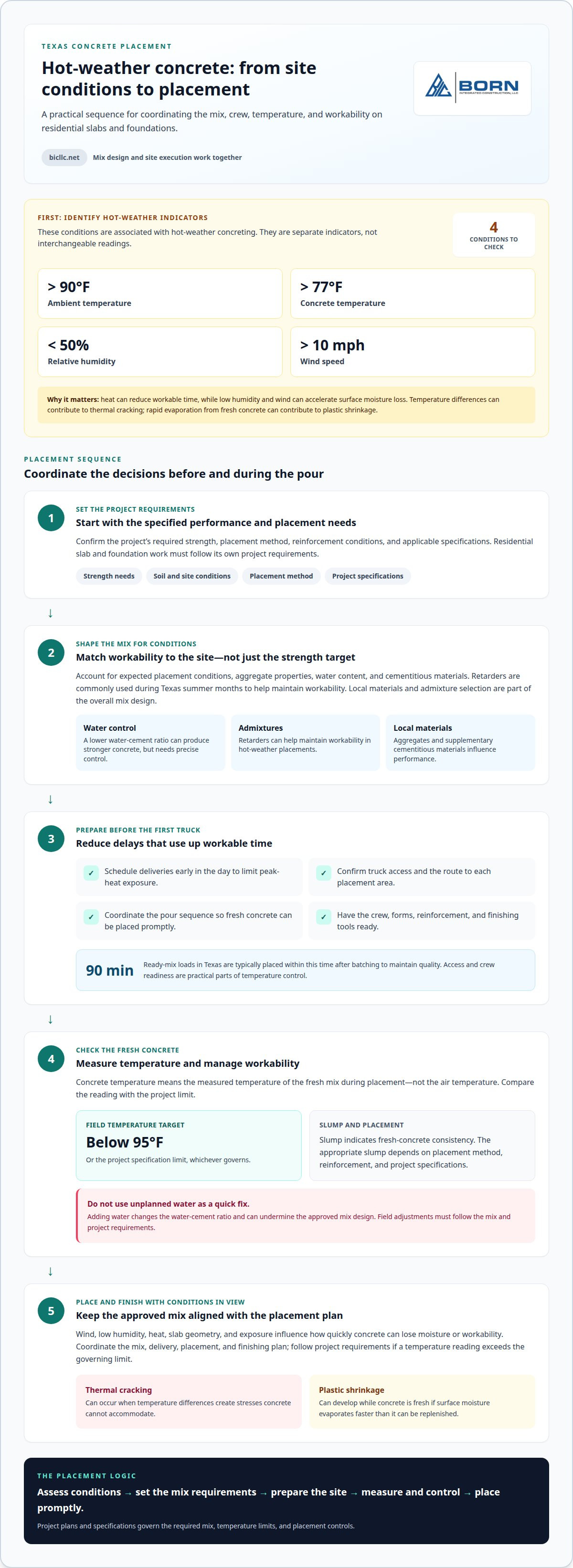
For Texas placements, concrete temperature and water control affect workability and strength. The field target is below 95°F or the project specification limit, whichever governs.
Texas Department of Transportation concrete requirements depend on the applicable project plans and specifications. Those documents set the required mix and placement controls. Residential slab and foundation work must follow its own project requirements.
Concrete Temperature and Water Control
Concrete temperature is the measured temperature of the fresh mix during placement, not simply the air temperature. Keeping it below 95°F or the project specification limit helps maintain workable placement conditions.
Adding water at the site changes the mix’s water-cement ratio. A lower ratio can produce stronger concrete, but maintaining workability requires precise control. Unplanned water can undermine the approved mix design, so adjustments must follow the mix and project requirements.
Slump and Placement Needs
Slump measures the consistency of fresh concrete and indicates how readily it can be placed. The appropriate slump depends on the placement method, reinforcement, and project specifications.
A slab with congested reinforcement may need different workability from an open, easily accessed placement. The mix should support consolidation and finishing without relying on extra water. Project plans set the applicable acceptance requirements.
Before the first truck arrives, prepare the placement sequence and access route. Make sure the crew, forms, reinforcement, and finishing tools are ready for the pour. Delays use up workable time, particularly when Texas heat raises concrete temperature.
- Schedule deliveries early in the day to limit exposure to peak heat.
- Confirm truck access and the route to each placement area.
- Coordinate the pour sequence so fresh concrete can be placed promptly.
- Keep the approved mix information available for temperature and water decisions.
Ready-mix loads in Texas are typically placed within 90 minutes of batching to maintain quality. That timing makes access and crew readiness practical parts of temperature control, not administrative details.
Measure concrete temperature during placement and compare it with the project limit. If the reading exceeds 95°F or the specified threshold, the placement decision must follow the governing project requirements. Avoid treating added water as a quick correction: it changes the mix and can affect strength.
For residential slabs and foundations, the goal is consistent workability, controlled water, and timely placement. A project-specific mix gives the crew a defined starting point. Field decisions should preserve the approved design while meeting slump and placement requirements.
Hot-weather conditions in concrete placement
Hot-weather conditions depend on air and concrete temperatures, humidity, and wind. Temperature differences within concrete can lead to thermal cracking, while plastic shrinkage occurs when the exposed surface loses moisture rapidly.
Custom Mixes for Site Conditions
A custom mix accounts for site conditions that affect placement and concrete performance. In Texas, ambient temperatures above 90°F, concrete temperatures above 77°F, relative humidity below 50%, and wind speeds above 10 mph are associated with hot-weather concreting. Each condition can influence how quickly concrete loses workability or moisture.
A windy site with low humidity, for example, calls for different placement planning than a sheltered site. The mix should suit expected placement conditions as well as the specified strength. Coordinating these factors helps crews manage fresh concrete from delivery through finishing.
Mix Design for Hot Weather
A hot-weather mix is proportioned to meet project performance requirements and remain workable under expected placement conditions. Retarders are commonly used during Texas summer months to help maintain workability.
Admixture selection is just one part of mix design. Water content, cementitious materials, aggregate properties, and placement demands also affect performance. Lower water-cement ratios can produce stronger concrete but require precise control. Adding water on site without following the approved mix can change its intended properties.
Thermal Cracking and Plastic Shrinkage Risks
Thermal cracking occurs when temperature differences create stresses that concrete cannot accommodate. Plastic shrinkage develops while concrete is still fresh, when surface moisture evaporates faster than it can be replenished.
Texas heat, low humidity, and wind can accelerate surface moisture loss. Consider a broad slab exposed to sun and moving air: its top may dry while placement and finishing are still underway. Cracking can affect appearance and serviceability, so both mix design and site procedures matter.
Hot-weather indicators are not interchangeable. An air reading above 90°F does not describe the concrete temperature, and wind can increase evaporation even when air temperatures are lower. The combination of conditions shapes the placement challenge.
- Ambient temperature above 90°F
- Concrete temperature above 77°F
- Relative humidity below 50%
- Wind speed above 10 mph
Each threshold identifies a condition associated with hot-weather concreting. Several conditions can occur at once, making coordination of the mix, delivery, placement, and finishing plan especially important.
Mix design should also reflect slab geometry and exposure. A thin, wide placement has more exposed surface relative to its volume than a thick placement. This can change moisture-loss risks and finishing demands, even at the same site.
Before placement, align the specified mix with actual site conditions. Review the weather, exposure, placement sequence, and required finish. This helps the mix support consistent execution without relying on a single temperature reading.
Local aggregates and regional materials
Aggregate selection affects fresh-concrete behavior, proportions, and consistency. A Texas mix design should account for the materials actually delivered to the project rather than assume every source performs the same way.
Coarse aggregate consists of larger particles; fine aggregate fills the spaces between them. Grading, shape, surface texture, and moisture affect the amount of paste the mix needs. For example, a blend with gaps between particle sizes may need different proportions from a well-distributed blend, affecting workability, finishing, and water demand.
Aggregate properties vary by quarry and stockpile, so the source matters. A mix designed for one material may behave differently if the source changes. Differences in particle shape or grading can affect how concrete moves through reinforcement and around forms. Consistent sourcing helps maintain the intended proportions during placement.
Aggregate moisture is another important variable. Dry aggregate can absorb some mix water, while wet aggregate contributes surface moisture. Either condition changes the effective water in the batch. For a residential slab, batch calculations should account for current aggregate moisture rather than assume a fixed water content.
Aggregate temperature also affects fresh-concrete temperature. Sun-heated stockpiles can add heat to the mix, while shaded storage reduces direct solar exposure. Temperature management therefore starts before batching. Consistent stockpile conditions help limit changes between loads.
- Keep aggregate sources consistent where practical.
- Account for stockpile moisture when proportioning batch water.
- Limit direct sun exposure on aggregate storage areas.
- Review grading changes before using a revised material source.
Material handling directly affects mix performance. A change in fine-aggregate moisture, for example, can affect both batch water and slump. If water is adjusted without accounting for aggregate condition, the delivered concrete may differ from the approved proportions.
Evaluate regional materials by their measurable properties, not by assumptions about Texas aggregate as a whole. Mix designers consider grading, absorption, moisture, and temperature alongside placement demands. For a slab with restricted access, aggregate grading and workability should support movement through the available route.
Temperature management should account for aggregate, cementitious materials, and water. Each contributes to the fresh mix, so controlling only one input can overlook their combined effect. Stable stockpiles, accurate moisture corrections, and consistent batching provide a dependable starting point.
When the material source or stockpile condition changes, review the mix proportions to maintain consistency between the design and the materials entering the batch. For Texas projects, good aggregate control starts with identifying the material, tracking its condition, and accounting for it in the proportions.
Mix design adjustments with admixtures and SCMs
Admixtures and supplementary cementitious materials (SCMs) affect concrete mix behavior. Select them to suit placement conditions, strength requirements, and the approved proportions.
Batch Water and Admixture Dosages
Batch water and admixture dosage are coordinated mix inputs, not independent field adjustments. Their balance affects workability, setting behavior, and the designed water-cement ratio.
Wet aggregate, for example, contributes moisture to the batch, so the water calculation must account for it. Admixture dosage also depends on the product and mix design. Changing water or admixture amounts without recalculating the batch can alter intended performance. Consistent proportions help keep loads uniform across a placement.
Admixtures for Hot-Weather Setting
Retarders slow setting and help maintain workability during hot-weather placement. Texas builders commonly use them during summer months.
Retarders support the planned placement window; they do not replace temperature control or a sound sequence. The dosage must suit the materials and project mix. A long placement sequence, for instance, may need a different workability plan from a small slab placed quickly. Consider mix design and field scheduling together.
SCMs are used alongside cement, with the specific combination established by the mix design. Fly ash and ground granulated blast-furnace slag are common examples. They can affect setting, workability, and strength development, so their use should reflect when the structure needs to be placed and perform.
For a Texas slab, the designer considers how the cementitious blend will perform at expected site temperatures. The mix should meet project strength requirements while remaining workable for placement and finishing. SCMs are not interchangeable: both material type and proportion matter.
Begin batch adjustments with the approved proportions and actual material conditions. A useful sequence is:
- Account for aggregate moisture when determining batch water.
- Use the specified admixture and dosage for the mix.
- Keep changes consistent across loads during one placement.
- Record adjustments so the delivered concrete can be evaluated accurately.
This sequence helps distinguish a mix-design issue from a batching variation. If slump changes between loads, review water, aggregate moisture, and admixture dosage together. Adding water may seem to restore workability, but it changes the water-cement ratio and can affect strength.
Coordinate SCM use with finishing and curing plans. Their effects depend on the blend and site conditions, so evaluate the mix as a complete system. For concrete mix design in Texas, controlled proportions and purposeful admixture selection provide a sound basis for hot-weather placement.
What concrete mix design is recommended for Texas hot-weather conditions?
There is no single mix that suits every Texas slab or foundation. For residential slabs, mixes typically use a specified compressive strength of 3,000-4,000 psi. The right design also accounts for soil conditions, structural demands, placement conditions, and the project specifications.
Start with the concrete’s intended use. A residential slab’s specified strength is a practical starting point, but it does not determine every mix proportion. In areas with expansive clay, reinforced or low-shrink mixes can help address foundation movement. The design should suit site and structural requirements, not strength alone.
Hot-weather conditions affect the placement plan as well as the mix. For field placement, keep concrete temperature below 95°F or the project specification limit. Texas summer placements may use retarders to maintain workability. These choices should be part of the planned mix, not improvised additions at the site.
Water control remains central to strength. Lower water-cement ratios can produce stronger concrete, but maintaining workability requires precise handling. The mix should balance the required consistency with the placement method. Adding water without accounting for the approved proportions disrupts that balance.
For a residential foundation on expansive clay, the design discussion should consider the soil-related need for reinforcement or low-shrink properties, alongside specified strength. For a residential slab, the typical 3,000-4,000 psi range gives a reference point, while project requirements determine the final selection. These are different design considerations, not interchangeable mix labels.
- Match specified compressive strength to the project requirements.
- Account for expansive clay when designing a foundation mix.
- Set a temperature and workability plan for hot-weather placement.
- Keep field water adjustments consistent with the approved mix.
Placement and curing complete the design decision. Plan curing for at least three days after placement. For field-cured cylinders, maintain temperatures between 60°F and 80°F. Those controls help make the curing conditions more consistent with the project’s strength evaluation.
Concrete mix design for Texas climate means selecting proportions for the structure and soil, then planning for heat and execution. A residential slab and a foundation may call for different decisions, even on the same property. Project specifications, strength needs, soil conditions, and placement plans together guide mix selection.
Born Integrated Construction
Born Integrated Construction provides concrete construction for projects where mix selection and placement conditions must align with structural requirements. Its services include Slab on Grade, Podium Slabs, and CIP Garages, matching concrete work to project needs.
When planning concrete work, turn to Born Integrated Construction to discuss how Texas heat, site conditions, and placement requirements affect your project. The right approach depends on the work and its specifications, so clear project requirements help define the scope.
Contact Born Integrated Construction to discuss your concrete construction project.
Set the Project Up for a Sound Start
Carry mix-design considerations into the project scope by aligning structural requirements, site conditions, and the placement plan before work begins. This gives the project team a clear basis for coordinating concrete decisions with field execution.
Born Integrated Construction works on concrete projects that include Concrete Paving, Slab on Grade, and Podium Slabs. Its role is to deliver concrete construction suited to the project’s defined scope, with attention to the demands of the work and the conditions on site.
A clear understanding of the intended structure and site provides a sound starting point. For concrete mix design for Texas climate, connect the design to actual placement and construction needs rather than treating the mix as an isolated specification.
Begin planning your concrete project with Born Integrated Construction. With the project scope clearly defined, the next decisions can be made with purpose and care.
Frequently Asked Questions
What Counts As “Hot Weather”?
Hot-weather concreting is associated with ambient temperatures above 90°F, concrete temperatures above 77°F, relative humidity below 50%, or wind speeds above 10 mph. These are separate conditions, and a placement may encounter several at once. In Texas, assess conditions at the placement area and during the planned pour. Sun exposure and wind can vary across one residential site, affecting how crews coordinate placement and finishing.
What water-cement ratio and compressive strength are suitable for Texas residential concrete?
Residential slabs in Texas typically use concrete rated at 3,000-4,000 psi, while the suitable water-cement ratio depends on workability, materials, and project requirements. Lower ratios can increase strength but require careful control during batching and placement. A single ratio doesn’t fit every residential pour. Foundation conditions also matter: expansive clay may call for reinforced or low-shrink characteristics, rather than a change in strength alone.
How does Texas heat affect concrete placement, curing, and setting time?
Texas heat can shorten the practical window for placing and finishing concrete while increasing surface moisture loss. Delivery timing, crew readiness, and curing coordination therefore matter. Setting time depends on the mix, materials, temperature, and admixture selection, not air temperature alone. An exposed slab in windy conditions, for example, may need closer coordination than a sheltered placement with less surface exposure.
What admixtures help concrete perform in Texas heat and drought?
Retarders are used during Texas summer months to help maintain workability in hot conditions. Their use should suit the mix and placement plan; they do not replace curing or careful water control. Supplementary cementitious materials, including fly ash and ground granulated blast-furnace slag, can also affect mix behavior. Dry conditions call for an intentional curing plan, not unplanned changes to batch water.
What aggregate types are commonly used in Texas concrete mixes?
Concrete mixes use coarse and fine aggregates, but those categories do not define a single Texas material recipe. Aggregate source and condition affect grading, moisture, absorption, and batch-water calculations. A change in fine-aggregate moisture, for example, can alter the water available in a batch even when the source stays the same.
How should concrete be cured in hot, dry, and windy Texas weather?
Begin curing as soon as finishing allows, using a method that limits moisture loss across the exposed surface. Maintain consistent coverage; alternating wet and dry areas can create uneven curing conditions. Sun and wind exposure, slab edges, and access for follow-on work all affect the plan. Plan curing after placement and protect field-cured cylinders from temperature extremes.
How do concrete mix designs differ across Texas climate regions and seasons?
Mix design responds to project conditions, materials, and seasonal placement weather, not simply to a city name. A residential pour in Houston may face different site exposure from one in Austin, San Antonio, Dallas, Fort Worth, San Marcos, New Braunfels, Boerne, Beaumont, Conroe, The Woodlands, or Arlington. Designers consider local aggregates, expected temperature, humidity, wind, and placement demands when selecting proportions and admixtures.