In the volatile clay soils of Houston and Dallas, traditional rebar reinforcement is often a compromise rather than a permanent solution for large-scale development. The "Texas soil challenge" requires a foundation that can withstand the swelling and shrinking of expansive clays without sacrificing the project's financial viability. Implementing a post tension slab for multi-family construction is the essential engineering response to these environmental demands, offering a thinner, stronger, and more resilient foundation than standard reinforcement methods.
We recognize the pressure developers face regarding rising material costs and the necessity for long-term structural reliability. You're likely seeking ways to minimize maintenance for parking surfaces while accelerating your delivery timeline. This article explores how post-tensioned concrete provides superior structural integrity, crack control, and significant cost-efficiency for Texas commercial and multi-family projects. We'll examine the technical advantages of reduced slab thickness, adherence to the current ACI/PTI Code-320-25 standards, and the methodologies that ensure your project remains steadfast against the region's unique geological conditions.
Key Takeaways
- Understand the mechanical principles of post-tensioning and how introducing active compressive stress counteracts future tensile loads to ensure long-term structural integrity.
- Discover how a post tension slab for multi-family construction reduces total material volume and costs while enabling flexible, open floor plans with fewer supporting columns.
- Learn why post-tensioned slabs are the preferred engineering solution for mitigating foundation damage caused by the expansive clay soils found across Houston and Dallas.
- Gain insight into the critical installation and stressing phases where precision in tendon layout and anchor placement determines the slab's final performance and durability.
- Identify the essential criteria for selecting a specialized contractor who maintains rigorous safety standards and follows the latest Post-Tensioning Institute guidelines.
What is Post Tension Concrete and How Does It Work?
Post-tensioning is a sophisticated method of reinforcing cast-in-place concrete by applying internal stress through high-strength steel tendons. Unlike traditional methods that rely solely on the concrete's own strength and passive steel, this technique introduces a deliberate state of compression into the structure. This structural philosophy is essential when designing a post tension slab for multi-family construction, as it allows for thinner slabs and greater resilience against environmental factors. It's a precise engineering solution that transforms concrete from a brittle material into a high-performance structural element.
The mechanical principle relies on counteracting the natural tensile loads that concrete typically struggles to manage. By tensioning the steel after the concrete has reached a specific level of cured strength, the system creates a permanent "squeezing" effect. For a deeper technical overview of these mechanics, one can explore What is Post-Tensioned Concrete? to understand how these internal forces are calculated. This active stress allows the concrete to remain crack-free under loads that would normally cause failure in a standard reinforced slab. The result is a foundation that behaves as a single, rigid unit.
A complete post-tensioning system consists of several critical components: high-carbon steel tendons, anchors, protective sheathing, and specialized grout. While pre-tensioning involves stressing the steel in a factory setting before the concrete is even poured, post-tensioning is executed entirely on-site. This field-based approach provides the flexibility required for complex architectural layouts and large-scale Texas developments. It allows our teams to adapt to the specific geometry of the project while maintaining the highest standards of structural integrity.
The Role of Steel Tendons in Structural Integrity
Steel tendons provide the necessary tensile strength that concrete lacks on its own. These high-carbon strands are housed within a plastic sheathing in unbonded systems to prevent corrosion and allow the steel to move independently of the concrete during the stressing process. Engineers design these tendons to follow precise parabolic profiles. By varying the depth of the tendon throughout the slab, we can balance the specific loads expected in different areas of the building. This meticulous placement ensures the slab remains stable and level over its entire lifespan.
Active vs. Passive Reinforcement
Traditional rebar is considered passive reinforcement because it only begins to work after the concrete has already started to crack and stretch. In contrast, post-tensioning is an active system. It keeps the entire slab in a constant state of compression from the moment of stressing. This proactive approach to structural integrity significantly enhances the long-term durability of the foundation. It's particularly effective for a post tension slab for multi-family construction where the slab must remain rigid despite the shifting soil conditions common in Dallas and Houston.
Advantages of Post-Tensioned Slabs for Multi-Family Construction
Utilizing a post tension slab for multi-family construction is a strategic decision that directly addresses the economic and structural demands of the 2026 development cycle. This engineering approach allows for a significant reduction in the total volume of concrete and steel required, often lowering material usage by 20% to 30% compared to traditional reinforced slabs. Because the concrete is kept under constant compression, the slab can be designed with a much thinner profile without compromising its load-bearing capacity. These thinner slabs don't just save on raw materials; they also reduce the overall height of the building, which can lead to substantial savings on exterior cladding and vertical utility runs.
Design Flexibility and Longer Spans
One of the primary benefits for mid-rise and high-rise developments is the ability to achieve much longer spans between supporting columns. This flexibility is particularly valuable for Expert Podium Slab Contractor in Houston: Structural CIP Solutions for 2026 Developments, where mixed-use retail on the ground floor requires open layouts that aren't obstructed by a dense grid of pillars. Post-tensioning reduces the need for interior load-bearing walls, allowing developers to maximize the usable square footage and create more versatile floor plans. In parking structures, these longer spans create a safer and more navigable environment for residents by eliminating the blind spots typically caused by frequent column placements.
Material Efficiency and Cost Savings
In regions like Houston, where deep foundations are often necessary, reducing the building's dead load is a critical concern. Thinner post-tensioned slabs weigh significantly less than standard reinforced concrete, which lessens the burden on the entire foundation system and may reduce the required number of piers or piles. This reduction in mass also translates to less mass soil excavation on-site, a factor that is vital when Solving the Texas Soil Challenge in areas with high moisture content. Our commitment to operational precision ensures that these material efficiencies are realized through meticulous planning and execution.
Durability remains a hallmark of our professional output. Post-tensioned systems offer superior crack control and water resistance, which are essential for the long-term maintenance of multi-family parking structures. By minimizing the width and frequency of cracks, we protect the internal steel from corrosive elements, ensuring the structure remains steadfast for decades. Furthermore, the ability to strip formwork faster than traditional methods accelerates the construction schedule, allowing for a more efficient turnover of units. If you're planning a large-scale development, partnering with an established structural concrete specialist can help you navigate these technical complexities while maintaining a focus on high standards and long-term viability.
Solving the Texas Soil Challenge: PT Slabs in Houston and Dallas
Texas developers face a unique geological adversary in expansive clay soils. These soils, particularly the "Houston gumbo" and the Blackland Prairie clays of Dallas, undergo significant volume changes based on moisture levels. When these clays swell during wet seasons and shrink during droughts, they exert immense pressure on foundations. A standard reinforced slab often lacks the rigidity to withstand these differential movements, which leads to structural cracking and costly long-term maintenance. This geological volatility makes the engineering of a post tension slab for multi-family construction a necessity for project longevity.
The internal compressive forces of a post-tensioned system allow the entire foundation to act as a rigid, monolithic unit. This structural unity enables the slab to bridge areas of soil settlement or heave without the catastrophic failure points seen in traditional rebar systems. The system manages stress distribution so that the slab can "flex" slightly under extreme conditions while maintaining its overall integrity. This resilience is a primary reason why post-tensioning is the preferred choice for multi-family foundations in San Antonio and other regions prone to soil movement.
Managing Expansive Clay in North and South Texas
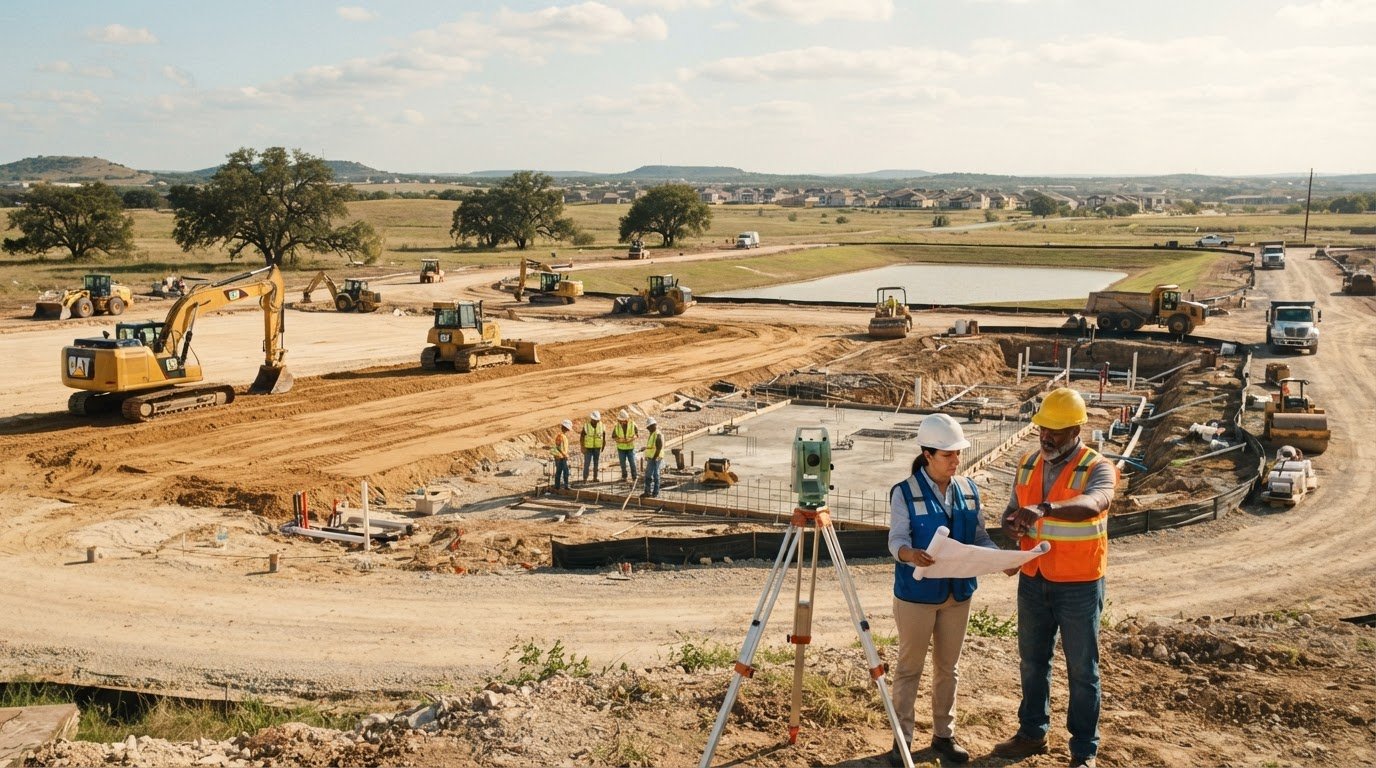
In North Texas, the clay is characterized by high plasticity, while Gulf Coast soils present unique drainage challenges. A well-engineered PT system distributes loads more evenly across these shifting subgrades, preventing the localized stress points that compromise traditional concrete. We often integrate these designs with comprehensive site civil work, including detention ponds and paving stabilization, to manage water runoff and protect the structural integrity of the slab. Many of the Advantages of Post-Tensioned Slabs lie in their ability to maintain level surfaces despite the inherent instability of the Texas landscape.
PT Paving for Heavy-Duty Multi-Family Use
The benefits of post-tensioning extend beyond the building's footprint into the surrounding infrastructure. For large-scale residential centers in Conroe and The Woodlands, PT concrete paving is becoming a standard for parking areas and access roads. This method significantly reduces the number of expansion joints required. Because joints are typically the first points of failure in heavy-duty pavement, minimizing them decreases long-term maintenance requirements and improves the driving surface for residents. For more information on infrastructure solutions, see our guide on Commercial Concrete Paving in Conroe: Engineering Heavy-Duty Roads for 2026. Our focus remains on delivering consistent value through the meticulous management of these technical details.

The Installation and Stressing Process: Precision in Execution
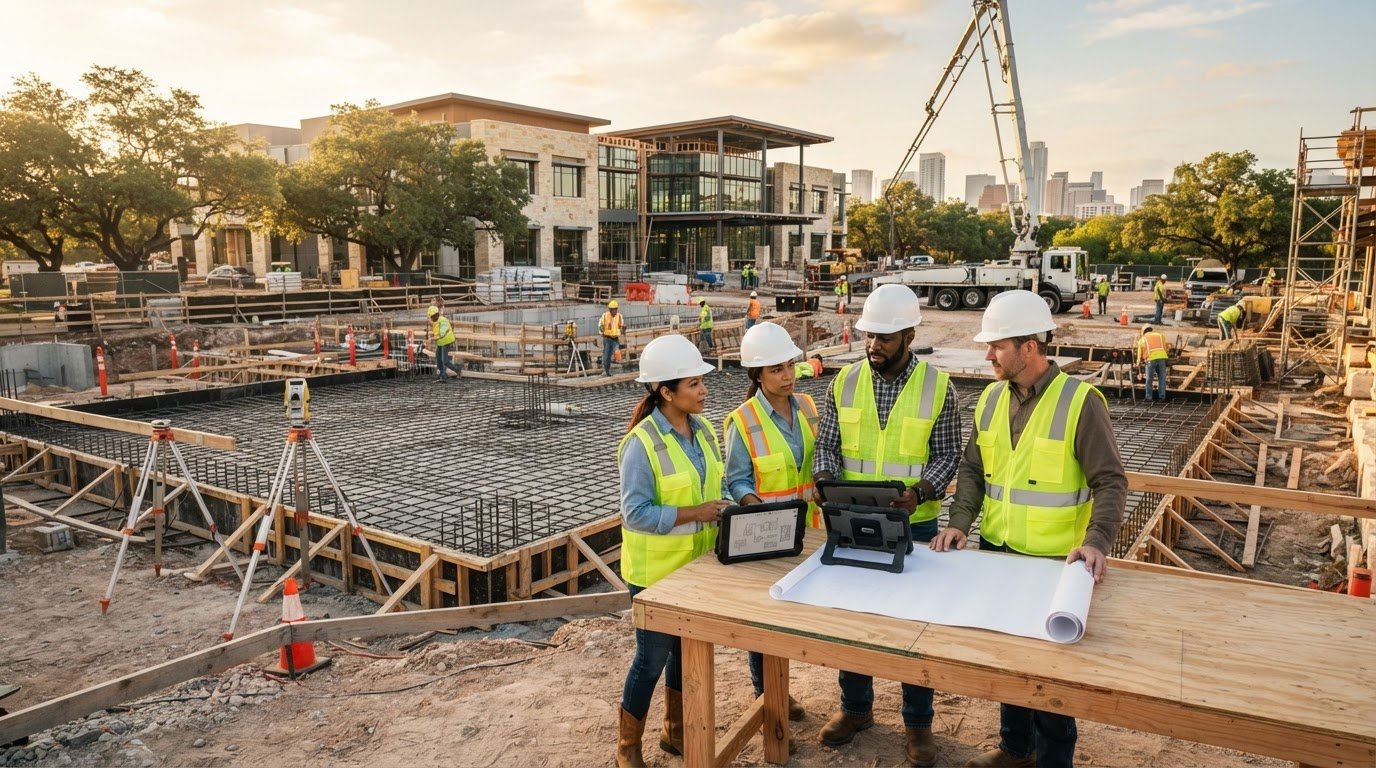
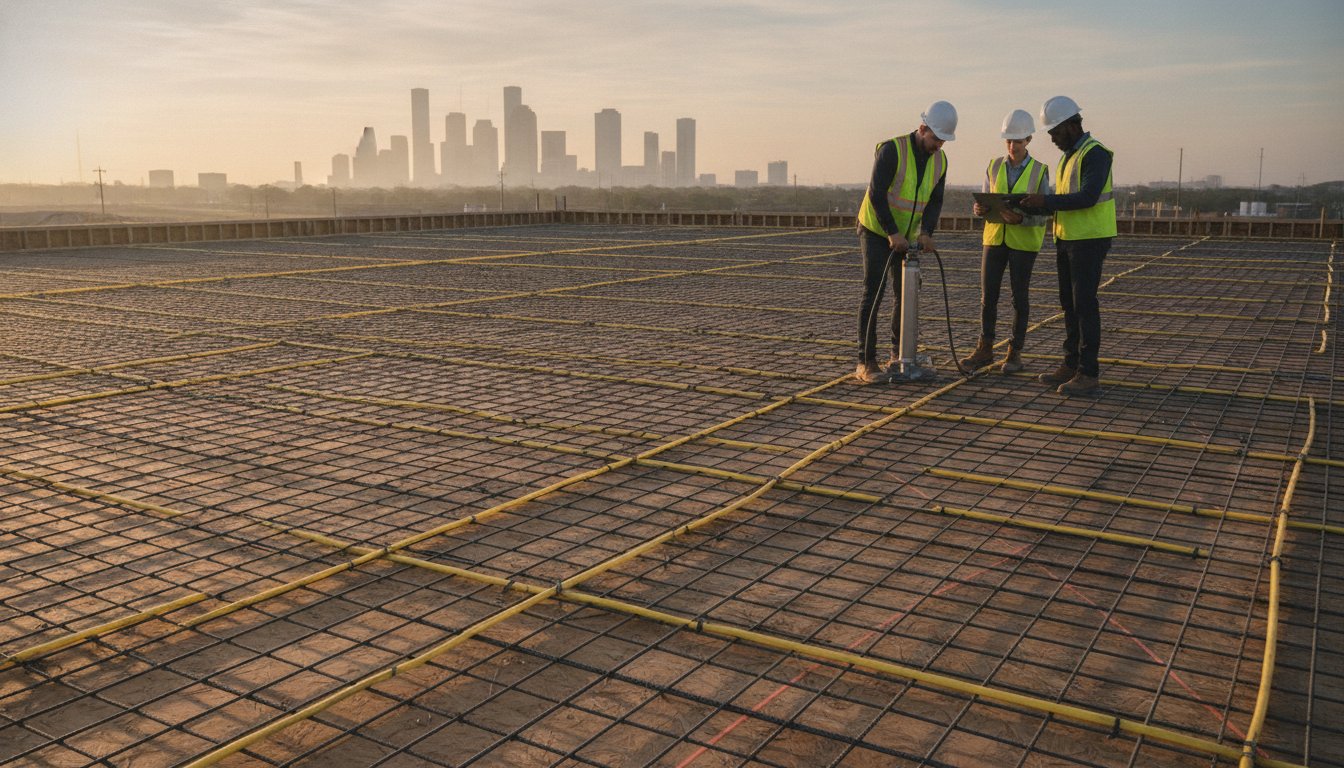
The successful implementation of a post tension slab for multi-family construction depends entirely on the meticulous execution of the installation and stressing phases. This is a highly sequenced operation where each step must be verified before the next begins. The process starts with a precise tendon layout that follows the structural engineer’s shop drawings. Every strand must be placed at the correct height and profile to ensure the internal forces align with the building's design. Once the layout is set, our crews secure the anchors and verify that there's proper clearance from the slab edges to prevent future corrosion or structural weakness.
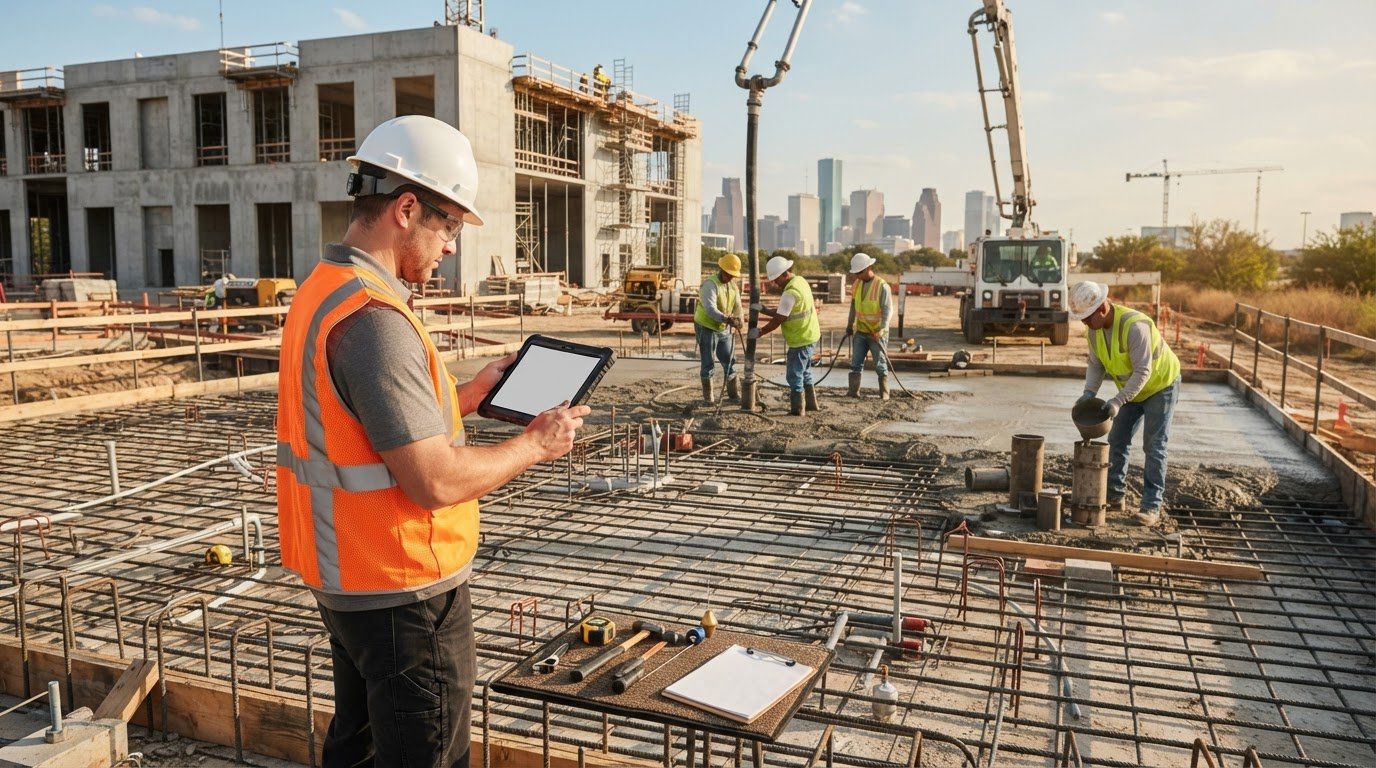
Concrete placement requires constant vigilance. We use internal vibration to ensure the mix flows completely around the tendons and anchors, which eliminates any potential voids that could compromise the system. After the pour, the concrete must cure until it reaches a specific compressive strength, typically 3,000 PSI, before the stressing phase can commence. This stage involves applying hydraulic force to the tendons using calibrated equipment, effectively "activating" the slab's internal reinforcement and creating the necessary compressive stress.
The Critical Stressing Phase
Timing is the most vital factor during the tensioning process. We monitor concrete strength through field-cured cylinder breaks to ensure the material can handle the immense compressive forces introduced by the hydraulic jacks. During these high-tension operations, we enforce strict safety protocols to protect personnel on-site. Calibrated hydraulic jacks are utilized to apply precise force, ensuring each tendon is pulled to the exact specifications required by the structural design. This disciplined approach ensures the enduring nature of the professional output we deliver to our partners.
Quality Control and Elongation Records
Quality control is maintained through rigorous documentation and third-party inspections. We measure the actual elongation of each tendon and compare it to the theoretical design calculations. For a post tension slab for multi-family construction, the actual elongation must typically match the design within a tolerance of ±7%. These elongation logs serve as the permanent "birth certificate" of the slab, providing a verifiable record of its structural integrity for the life of the building. If you require a partner who prioritizes this level of operational precision, contact our structural concrete construction team to discuss the requirements of your next Texas development.
Selecting a Post Tension Concrete Contractor in Texas
Choosing the right partner for a post tension slab for multi-family construction is a decision that impacts the long-term viability and safety of the entire development. Specialized expertise in cast-in-place (CIP) garages and high-rise structures is mandatory because of the high stakes involved in post-tensioning. A contractor must demonstrate a deep-rooted commitment to PTI (Post-Tensioning Institute) standards and maintain an impeccable safety record. At Born Integrated Construction, we prioritize reliability and professional stability, ensuring that every project is executed with the meticulous management of details that our clients expect.
One of the most significant advantages we offer is an integrated approach that bridges the gap between civil work and structural concrete. Many projects suffer from coordination failures when earthwork, mass soil excavation, and the structural slab are handled by separate entities. By managing the process from initial paving stabilization to the final stressing of the slab, we eliminate these friction points. This synergy ensures that the foundation is built on a properly prepared subgrade, which is essential for the performance of a post tension slab for multi-family construction in volatile Texas soils.
Integrity and Safety in Structural Concrete
Our team manages complex PT layouts for multi-level garages in high-density areas like Austin and Dallas with a focus on consistent performance. Whether we're working in San Marcos, Boerne, or Beaumont, our commitment to high standards remains unwavering. We maintain strong vendor relationships to secure high-quality PT materials, ensuring that every tendon and anchor meets our rigorous specifications. This established network allows us to deliver consistent value even when supply chains are challenged, providing our partners with a sense of security and confidence in the end result.
Partnering for Long-Term Project Success
We believe that true craftsmanship begins long before the first yard of concrete is poured. Our experts collaborate with developers from the earliest stages of pre-construction planning through to the final elongation verification. This proactive engagement allows us to identify potential structural challenges early, reducing project risk and keeping construction cycles on schedule. We invite you to Partner with Born Integrated Construction for your next structural project to experience a level of discipline and thoroughness that sets the foundation for lasting success.
Engineering Resilient Foundations for Future Growth
The implementation of a post tension slab for multi-family construction is more than a design choice; it's a strategic investment in the structural integrity and long-term viability of your project. By utilizing active compressive stress to counteract tensile loads, developers can achieve significant material efficiencies while successfully mitigating the risks posed by expansive Texas soils. This methodology provides the strength and flexibility necessary for high-performance podium slabs and structured parking garages that must endure for decades.
Our team brings specialized expertise in CIP garages and high-rise foundations to every site, ensuring that each pour meets the highest PTI standards. We serve the metropolitan areas of Houston, Dallas, Austin, and San Antonio with a steadfast commitment to safety and operational precision. When you're ready to secure the future of your development, Request a Consultation for Your Texas Structural Concrete Project. We look forward to establishing a foundation built on proven results and unwavering consistency.
Frequently Asked Questions
What is the primary benefit of post tension concrete over traditional rebar?
The primary advantage is the introduction of active compressive stress, which allows the concrete to resist tensile loads before they cause cracking. Unlike traditional rebar that only functions after the concrete begins to fail, post-tensioning keeps the entire structure in a state of compression. This proactive engineering is essential for maintaining structural integrity in regions where environmental factors exert constant pressure on the foundation.
Is post tension concrete more expensive than standard reinforced concrete?
Post-tensioning is often more cost-efficient for large-scale developments because it reduces the total volume of concrete and steel reinforcement required. While the specialized tendons and labor involve a specific investment, the ability to design thinner slabs leads to significant savings in material costs and building height. These efficiencies make the post tension slab for multi-family construction a financially viable solution for high-density residential projects.
How long does it take to stress a post-tensioned slab after pouring?
Stressing typically occurs once the concrete reaches a specific compressive strength, which is generally 3,000 PSI. Depending on the mix design and environmental conditions, this milestone is often achieved within three to seven days after the initial pour. Meticulous monitoring of field-cured cylinders ensures that the tensioning process begins only when the material can safely withstand the immense internal forces applied by hydraulic jacks.
Can post tension slabs be repaired if a tendon is accidentally damaged?
Accidental damage to a tendon can be repaired through specialized splicing and re-tensioning procedures. This process involves exposing the damaged strand, installing a coupler, and applying hydraulic force to restore the original design tension. Because these systems are under high tension, repairs must be conducted by professionals who adhere to strict safety protocols and PTI standards to ensure the slab's long-term viability remains intact.
What types of commercial buildings benefit most from PT construction?
Structural concrete parking garages, high-rise residential buildings, and podium decks benefit most from this construction method. Projects that require long spans with fewer supporting columns rely on post-tensioning to create open, versatile floor plans. It's particularly valuable for mixed-use developments where the ground floor must accommodate retail spaces while supporting several stories of residential units above the structural slab.
Is post-tensioning safe for multi-family residential foundations in Texas?
Post-tensioning is widely considered the safest and most reliable foundation method for managing the expansive clay soils found in major Texas metropolitan areas. By creating a rigid, monolithic unit, a post tension slab for multi-family construction can bridge shifting subgrades without the catastrophic failure points common in traditional foundations. This steadfast performance provides developers and residents with a high degree of confidence in the building's long-term stability.
How does post-tensioning affect the overall thickness of a concrete slab?
Post-tensioning significantly reduces the overall thickness of a concrete slab, often by 20% to 30% compared to a conventionally reinforced structure. This reduction is possible because the internal compressive forces allow the slab to carry the same loads with less mass. Thinner slabs contribute to lower building weights and reduced foundation requirements, which can simplify the mass soil excavation phase and lower the total project dead load.
What certifications should a post tension contractor hold in Texas?
A qualified contractor in Texas should hold certifications from the Post-Tensioning Institute (PTI) and operate under the guidance of a licensed professional engineer. These certifications verify that the team understands the technical complexities of tendon layout, stressing procedures, and quality control documentation. Professional stability and a proven safety record are also critical indicators of a contractor's ability to deliver a high-performance structural slab.