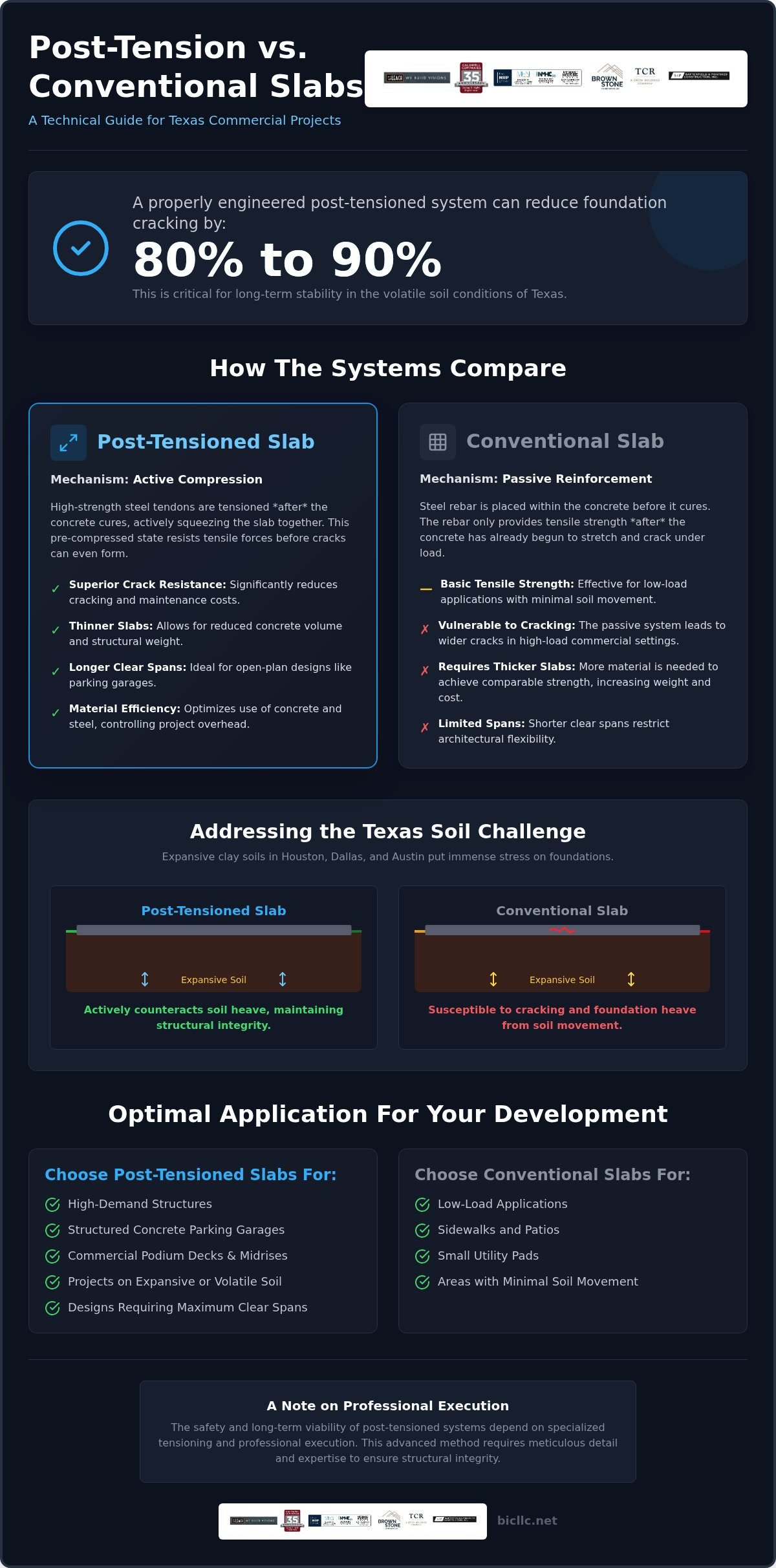
A properly engineered post-tensioned system can reduce foundation cracking by 80% to 90% compared to traditional reinforcement methods. In the volatile soil conditions of Houston and Dallas, where expansive clay frequently compromises structural integrity, this statistic represents more than just a technical advantage; it's a matter of long-term operational stability. You understand that the foundation is the most critical component of any commercial project, yet balancing immediate material costs with the necessity for a durable, crack-resistant surface remains a complex challenge. Choosing between a post tension slab vs conventional slab requires a disciplined evaluation of soil mechanics, architectural requirements, and project timelines.
This 2026 Texas guide provides a methodical comparison of these two systems to help you determine the most reliable path for your next development. You will learn how specialized tensioning techniques allow for thinner slabs and maximum clear spans in parking garages and midrise structures. We also examine how current building codes and material efficiency trends impact your project overhead. By the end of this analysis, you'll have the technical clarity needed to establish a foundation that withstands the unique demands of the Texas landscape while maintaining rigorous professional standards.
Key Takeaways
- Understand the technical distinction between the active compression of post-tensioned systems and the passive reinforcement utilized in traditional rebar foundations.
- Evaluate how a post tension slab vs conventional slab performs against Texas’s expansive clay soils to mitigate the risk of structural cracking and foundation heave.
- Identify opportunities to reduce concrete volume and achieve maximum clear spans for high-demand structures like parking garages and commercial podium decks.
- Determine the optimal application for each method by balancing upfront labor requirements with the long-term structural integrity of your commercial development.
- Recognize the necessity of professional execution and specialized tensioning to ensure the safety and viability of complex structural concrete projects.
Understanding the Fundamentals: Post-Tensioned vs. Conventional Concrete Slabs
Reliability in structural engineering begins with a deep commitment to high standards and long-term viability. In the Texas market, the choice between a post tension slab vs conventional slab is a strategic decision that affects structural integrity for decades. While both systems utilize concrete, they manage internal forces through different mechanical principles. One relies on passive reinforcement, while the other utilizes active compression to achieve superior performance. Selecting the appropriate foundation dictates the entire structural lifespan of a commercial building, making this decision a pillar of professional craftsmanship.
Historically, Texas developers relied on traditional rebar for most foundation work. As metropolitan areas like Houston and Dallas expanded into regions with volatile soil, the industry shifted toward more sophisticated engineering. This evolution was driven by the necessity to minimize maintenance and ensure that high-value assets like parking garages remained sound. Modern commercial developments now prioritize systems that can withstand the unique stresses of the Texas landscape. A disciplined evaluation of these methods is essential for establishing a lasting foundation that serves as a dependable partner to the structure above.
The Conventional Reinforcement Method
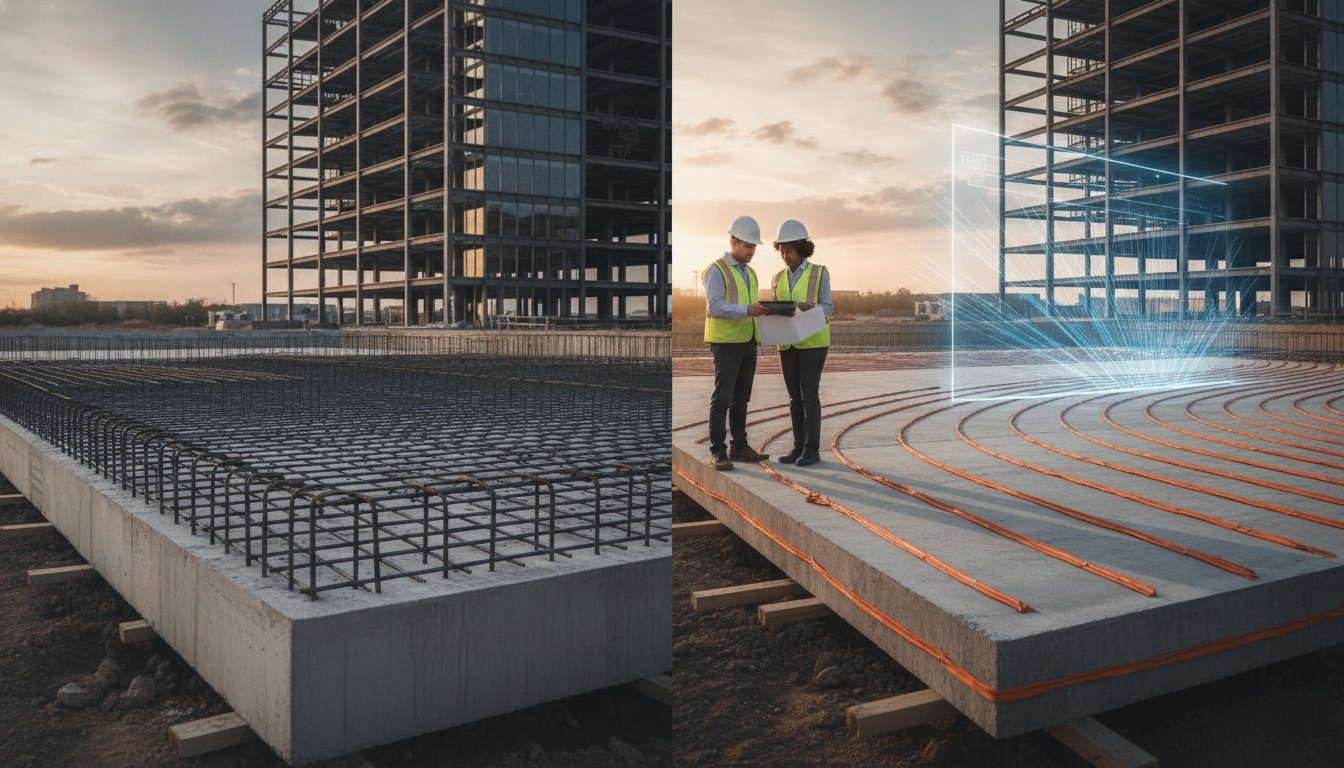
Conventional slabs utilize a passive reinforcement system where steel rebar is placed before the pour. Once the concrete cures, the rebar provides tensile strength, but it only functions after the concrete has started to stretch. This method is effective for low-load applications such as sidewalks or small utility pads where soil movement is minimal. However, in high-load commercial environments, this passive approach often leads to wider cracks and increased maintenance costs.
The Post-Tensioning Innovation
Post-tensioning is an advanced application of Prestressed concrete that introduces active compression. High-strength steel tendons are tensioned after the concrete reaches specific strength, squeezing the slab together to resist tensile forces. This pre-compressed state prevents cracks and allows for thinner slabs and longer clear spans. Protective sheathing is critical, as it ensures tendon longevity by preventing corrosion and maintaining structural integrity over time.
The decision between a post tension slab vs conventional slab isn't just a technical preference; it's a commitment to the enduring nature of the work. By choosing the right reinforcement method, you establish a foundation that reflects a focus on execution, safety, and meticulous detail. This approach ensures that the structural concrete provides consistent value throughout its operational life.
Structural Mechanics: How Reinforcement Differs Between PT and Traditional Slabs
Structural performance is defined by how a foundation handles internal stress. In a conventional slab, steel reinforcement remains dormant until the concrete begins to crack or deflect under load. This passive management contrasts sharply with the active force found in a post-tensioned system. By applying high-tension forces to steel tendons after the pour, the concrete's placed into a state of permanent compression. This pre-compressed state allows the post tension slab vs conventional slab to counteract tensile stresses in real-time, effectively neutralizing potential points of failure before they manifest as visible damage.
This mechanical advantage directly influences the architectural design of the building. Because the concrete's actively compressed, it possesses higher effective strength, allowing engineers to specify thinner slab profiles. Thinner slabs translate to reduced structural weight, which lowers the load requirements for columns and footings. For projects such as structured concrete parking garages, this weight reduction is a critical factor in optimizing material usage and controlling overall project overhead. It's a methodical approach to construction that prioritizes efficiency without compromising the integrity of the build.
Tendon vs. Rebar Performance
Material selection plays a pivotal role in these mechanics. Standard reinforcement typically uses Grade 60 rebar, while post-tensioning utilizes high-strength steel strands with significantly higher tensile capacities. These tendons are strategically "draped" in a parabolic profile to follow the anticipated stress zones of the span. By following this specific geometry, the tendons create an upward lift that directly counteracts gravity loads and reduces slab deflection. This precision is a core principle emphasized by the Post-Tensioning Institute to ensure long-term structural reliability.
Safety and Integrity in Tensioning
The integrity of a PT system depends entirely on the execution of the stressing phase. Unlike conventional rebar, which is simply tied in place, PT tendons require a rigorous tensioning process once the concrete reaches a predetermined compressive strength. Technicians must meticulously monitor elongation measurements and gauge pressures to verify that the design force's been accurately transferred to the slab. Comparing a post tension slab vs conventional slab reveals that the former's safety relies heavily on the precision of the installation crew. Professional expertise isn't just a recommendation; it's a requirement for operational safety. A disciplined approach to these technical details ensures the long-term stability of the entire development.
The Economic and Performance Comparison: Cost, Speed, and Durability
A disciplined evaluation of project overhead requires looking beyond the initial invoice. When analyzing a post tension slab vs conventional slab, the primary economic shift involves trading material volume for specialized technical execution. With the current 2026 steel and concrete pricing trends in Texas, reducing material volume has become a strategic priority for maintaining project viability. Post-tensioned designs can reduce the volume of concrete required by up to 20% in large-scale commercial developments. This reduction in mass isn't merely about material savings; it lowers the dead load of the structure, which can simplify the requirements for the supporting foundation and vertical columns.
Labor considerations also differ significantly. While a conventional slab utilizes a general concrete crew, post-tensioning demands certified installers to manage the layout, anchoring, and stressing phases. This specialized expertise introduces a higher labor rate, but it's often offset by the accelerated construction speed. In multi-story developments, PT systems allow for faster floor-to-floor cycles because the active compression enables earlier formwork removal. This methodical approach to scheduling is a vital factor for projects in high-demand Texas markets like Houston and Dallas, where meeting tight deadlines is a priority.
Upfront Investment vs. Long-Term Value
The reduction in rebar tonnage is one of the most immediate benefits of choosing a post-tensioned system. By replacing dense grids of traditional reinforcement with high-strength tendons, developers can optimize material usage while achieving longer clear spans. A comprehensive structural and field comparison highlights that conventional slabs often carry hidden costs, such as the need for more frequent expansion joints. These joints are prone to shrinkage and require ongoing maintenance, whereas a PT slab functions as a more cohesive, monolithic unit with fewer points of potential failure.
Durability in High-Traffic Environments
Durability remains a cornerstone of professional stability, especially in high-stakes structures like CIP parking garages. These environments are subject to constant heavy loads and exposure to the elements. Post-tensioning provides superior resistance to water penetration because the active compression keeps the concrete tightly bound. Data indicates that properly installed PT systems can reduce cracking by 80% to 90% compared to traditional reinforcement. By minimizing the number of expansion joints, jointless PT slabs drastically reduce the long-term maintenance requirements for heavy-duty paving and commercial floors. This focus on enduring quality ensures the structure remains a reliable asset for its entire operational life.
Addressing the Texas Soil Challenge: Why Slab Design Matters in Houston and Austin
Texas soil is notoriously volatile. Expansive clay, such as the "Houston gumbo" and the Blackland Prairie clay found in Dallas and Austin, presents a constant threat to structural integrity. These soils swell when saturated and shrink during dry spells, creating immense pressure on foundations. When evaluating a post tension slab vs conventional slab, the primary driver for many Texas engineers is the ability of the post-tensioned system to act as a rigid, monolithic unit. This rigidity allows the slab to resist the differential movement caused by shifting soils, whereas a traditional rebar slab may struggle to bridge the resulting voids or resist foundation heave.
Success begins well below the concrete surface. Proper paving stabilization is often required to support structural slabs in high-traffic areas and expansive soil zones. By treating the subgrade, we create a more predictable environment for the foundation. Research indicates that expansive clay soils can add 15% to 25% to the material cost of a foundation compared to builds on stable soil. Mitigating these risks through integrated earthwork and structural design is a hallmark of professional stability and a commitment to long-term viability.
Expansive Soil Mitigation Strategies
In the Blackland Prairie regions, conventional slabs often fall short because they lack the active compression needed to counteract aggressive soil heave. Post-tensioning allows the structure to essentially float over minor subgrade inconsistencies. Before any concrete is poured, mass soil excavation must be performed with precision to replace or treat the most volatile layers. This systematic approach ensures that the finished product meets high standards for durability. It's a disciplined process that prioritizes substance over style.
Case Study Perspective: Houston vs. Dallas
Houston presents a unique challenge with its high water table and coastal moisture. Soil saturation leads to a loss of bearing capacity, making the thinner, lighter profile of a post-tensioned slab highly advantageous for midrise developments and CIP garages. In contrast, Dallas projects often face deeper layers of active clay that require more aggressive stabilization and thicker moisture barriers. BIC integrates civil site work with structural execution to ensure every foundation is prepared for these specific regional demands. If you require a partner with deep-rooted expertise in these conditions, consider our turnkey structural concrete services to secure your next project.
Choosing between a post tension slab vs conventional slab in Texas is rarely just about the concrete itself. It's about how that concrete interacts with the shifting ground beneath it. By focusing on execution, safety, and the meticulous management of site details, we deliver foundations that stand the test of time despite the challenges of the Texas landscape.
Strategic Implementation: Selecting the Right Slab for Your Commercial Development
The final determination for any commercial foundation involves a careful balance of structural necessity and operational efficiency. While previous sections detailed the mechanical and economic differences, the choice between a post tension slab vs conventional slab ultimately depends on the specific use case of the development. Conventional slabs remain the standard for low-load flatwork, sidewalks, and small utility pads. In these applications, the passive reinforcement provided by rebar is sufficient to manage the minimal tensile stresses encountered, provided the subgrade's been properly stabilized. Using a more complex system for a simple sidewalk would be an unnecessary expenditure of resources.
High-performance environments require a more robust approach. For multi-story developments, expansive warehouses, and podium decks, the active compression of a post-tensioned system is essential. This method provides the structural capacity needed to support significant loads while maintaining a thinner profile. Some projects may even benefit from a hybrid approach, combining cast-in-place (CIP) elements with precast components to optimize the construction schedule. Partnering with a firm that offers turnkey civil services ensures that the transition from mass soil excavation to final slab placement is handled with unwavering consistency.
Application-Specific Recommendations
Retail centers and single-story commercial pads often find success with traditional slab-on-grade designs. However, as soon as a project requires architectural freedom, such as longer clear spans or reduced column interference, post-tensioning becomes the superior choice. It's currently the gold standard for CIP parking structures and mixed-use podiums where maximizing usable space is a priority. By reducing the number of required support columns, developers can increase the efficiency of their floor plans and improve the overall value of the asset.
Partnering for Structural Success
Selecting a contractor with a proven track record in structural concrete is a matter of professional safety. The complexity of tensioning tendons requires a disciplined professional who values substance over style. An integrated partner like BIC reduces risk by managing both the site preparation and the structural execution, preventing the communication gaps that often lead to foundation failures. Before finalizing your foundation strategy, consider this checklist to ensure long-term viability:
- Soil Volatility: Has a geotechnical report confirmed the Plasticity Index (PI) of the clay?
- Span Requirements: Does the architectural design require clear spans exceeding 30 feet?
- Schedule Demands: Will the faster floor-to-floor cycles of a PT system offset the specialized labor costs?
- Maintenance Budget: Is the project located in an area where joint reduction is critical for preventing water infiltration?
- Safety Standards: Does the installer possess the necessary certifications for high-pressure tensioning?
By following this methodical evaluation, you can establish a foundation that's as organized and reliable as your physical operations. Whether you select a post tension slab vs conventional slab, the focus must remain on execution, safety, and the meticulous management of technical details to ensure the enduring nature of your professional output.
Securing Structural Integrity for Your Next Texas Development
Navigating the technical complexities of a post tension slab vs conventional slab requires a disciplined approach to both engineering and site conditions. You’ve seen how active compression provides a critical advantage against the expansive clay soils of Houston and Dallas. While conventional methods remain appropriate for simpler, low-load applications, the decision you make today dictates the structural lifespan and maintenance requirements of your development for decades. Establishing a foundation that withstands the unique demands of the Texas landscape is a matter of professional stability and long-term viability.
Born Integrated Construction (BIC) brings over a decade of structural expertise to every build. We provide integrated civil and concrete solutions that maximize efficiency by managing the project from mass excavation to final structural tensioning. Our safety-first approach to complex post-tensioning ensures that your foundation is built with meticulous attention to detail and operational precision. Request a structural concrete consultation for your next Texas project to ensure your development is built on a foundation of reliability. We look forward to delivering the consistent value and craftsmanship your project deserves.
Frequently Asked Questions
Which is more expensive, a post tension slab or a conventional slab?
A conventional slab typically carries a lower initial material cost per square foot for smaller projects. However, when evaluating a post tension slab vs conventional slab for large-scale commercial developments, the post-tensioned system can be more cost-effective. This is due to the significant reduction in concrete and rebar volume required, though these savings are balanced against the need for specialized labor and engineering oversight.
Can a post tension slab be repaired if a tendon is cut?
Yes, a cut tendon can be repaired by a certified structural concrete specialist. The process involves excavating the concrete around the damaged area, installing a specialized splice, and re-tensioning the strand to its original design force. It's critical to identify tendon locations before any slab penetration to avoid the safety risks and costs associated with these specialized repairs.
How long does it take for a post tension slab to be stressed?
Stressing typically occurs three to seven days after the concrete pour. The exact timing depends on the concrete reaching a specific compressive strength, usually around 3,000 psi, as verified by field-cured cylinder tests. Once the strength is confirmed, the tensioning process is completed methodically to ensure the active compression is transferred safely and accurately to the structure.
Why is post tensioning popular in Texas commercial construction?
Post-tensioning is favored in Texas due to its superior performance in the expansive clay soils found in Houston, Dallas, and Austin. The system creates a monolithic unit that resists differential soil movement more effectively than traditional reinforcement. It also allows for thinner slabs and longer clear spans, which are essential for the architectural requirements of modern parking garages and high-rise developments.
Is a post tension slab better for expansive clay soils?
When comparing a post tension slab vs conventional slab for expansive clay, the post-tensioned system is widely considered the most effective solution. By placing the slab under constant compression, the system minimizes the risk of structural cracking caused by soil heave or shrinkage. This active force management provides a level of durability that passive rebar systems cannot match in volatile soil environments.
What are the main disadvantages of a conventional rebar slab?
The primary disadvantage of a conventional slab is its reliance on passive reinforcement, which only functions after the concrete has already begun to crack. These slabs are also more susceptible to moisture penetration through the higher number of required expansion joints. In high-load commercial settings, the increased slab thickness and rebar density can lead to higher material waste and increased structural weight.
Can I use a post tension slab for a residential driveway?
While technically possible, post-tensioning is rarely utilized for residential driveways because the cost of specialized labor and equipment is difficult to justify. Traditional concrete paving or reinforced slab-on-grade methods are generally more practical for these low-load applications. Post-tensioning is better reserved for high-stakes structural projects where the performance benefits justify the technical complexity.
How does slab thickness differ between PT and conventional designs?
Post-tensioned slabs are typically 20% to 30% thinner than conventional rebar-reinforced slabs designed for the same load capacity. Because the active compression increases the effective strength of the concrete, engineers can reduce the overall mass of the structure. This reduction in thickness is a primary factor in optimizing material usage and lowering the total dead load on the supporting foundation and columns.