Commercial pavement is only as dependable as the ground supporting it. A weak or moisture-sensitive subgrade can make construction more difficult and leave the finished surface vulnerable to movement or distress. Soil stabilization for commercial paving addresses conditions below the pavement, helping project teams prepare a more reliable base before concrete placement begins.
For owners and contractors planning parking areas, access roads, and other commercial surfaces, the practical questions are whether the soil needs treatment and which approach suits the site. The answers depend on soil composition, moisture behavior, and the demands the pavement must carry. Choosing a treatment without considering those conditions can add unnecessary work or leave the underlying issue unresolved.
This article explains the role of stabilization beneath commercial pavement, the site factors that guide treatment decisions, and how the work fits into a coordinated Texas project. Born Integrated Construction provides paving stabilization, mass soil excavation, civil site work, and commercial concrete paving. Understanding how these activities connect helps teams coordinate earthwork and paving, reduce avoidable rework, and prepare a foundation suited to the planned surface.
Key Takeaways
- Assess subgrade conditions and construction needs before deciding whether treatment is appropriate.
- Soil stabilization for commercial paving depends on site conditions and pavement demands, not a one-size-fits-all approach.
- Understand how site assessment, earthwork, treatment, and preparation fit into the sequence before paving begins.
- Coordinate stabilization and concrete paving as connected project activities to help reduce avoidable rework.
- Born Integrated Construction provides paving stabilization, mass soil excavation, and civil site work for commercial paving projects in Texas.
Why Soil Stabilization Matters Before Commercial Paving in Texas
Commercial paving starts before concrete is placed. The soil beneath it must support the planned pavement section and provide a workable platform for construction. Soil stabilization improves the properties of in-place soil so it can better serve those purposes. Depending on site findings, preparation may involve changing how the soil is processed or incorporating a suitable stabilizing material. The right approach depends on site conditions and project needs, not on a treatment assumed to suit every location.
Subgrade condition affects both construction and the pavement that follows. Equipment needs to move across the prepared area, and the ground must support that work without becoming difficult to handle. After paving, the subgrade remains part of the system supporting the pavement in use. If the soil is unsuitable for the planned section, soft areas, uneven support, or movement may complicate construction or contribute to pavement distress over time. Stabilization can address some soil concerns, but it does not replace sound planning for the entire site and pavement section.
Reliable commercial paving starts with subgrade conditions suited to construction activity and the pavement’s intended demands.
For Texas project teams, soil stabilization for commercial paving is a site-specific decision. Soil composition and moisture affect how the ground behaves and what preparation may be appropriate. General stabilization approaches vary, as outlined in this Soil Stabilization Overview, but a general description of a method cannot establish whether it fits a particular commercial paving project.
What role does subgrade play beneath commercial paving?
The subgrade is the prepared ground beneath the pavement layers. It is not the concrete surface or the materials placed directly above it. It supports construction activity and remains part of the pavement’s foundation system after paving. If the ground is difficult to work or provides inconsistent support, crews may face access and preparation challenges, and the finished pavement may be more vulnerable to uneven movement or distress.
Why can Texas site conditions vary from project to project?
A nearby site can provide context, but it cannot establish the soil or moisture conditions at another project. Conditions can differ across a property and between locations, affecting how the ground responds to equipment and the planned pavement section. Assessing the work area helps teams understand the actual conditions and make treatment decisions accordingly, instead of carrying assumptions from another project into the construction plan.
Assessment also helps teams coordinate the work. Considering ground preparation alongside construction access and paving requirements makes it easier to plan the sequence and identify potential issues early. The goal is not to stabilize soil by default. It is to determine whether existing conditions suit the work ahead and, where treatment is warranted, prepare a subgrade that supports a smooth transition from earthwork to commercial paving.
How Soil Stabilization Builds a Reliable Paving Subgrade
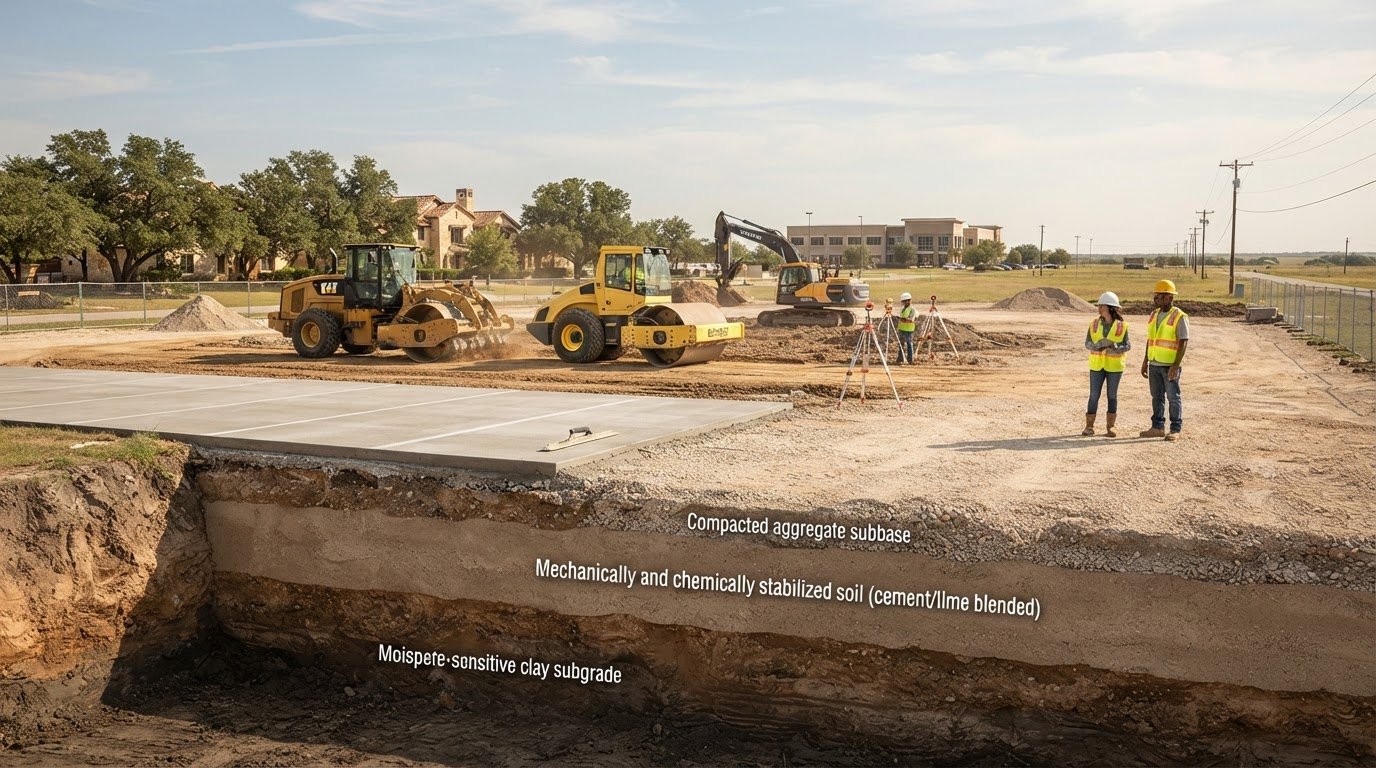
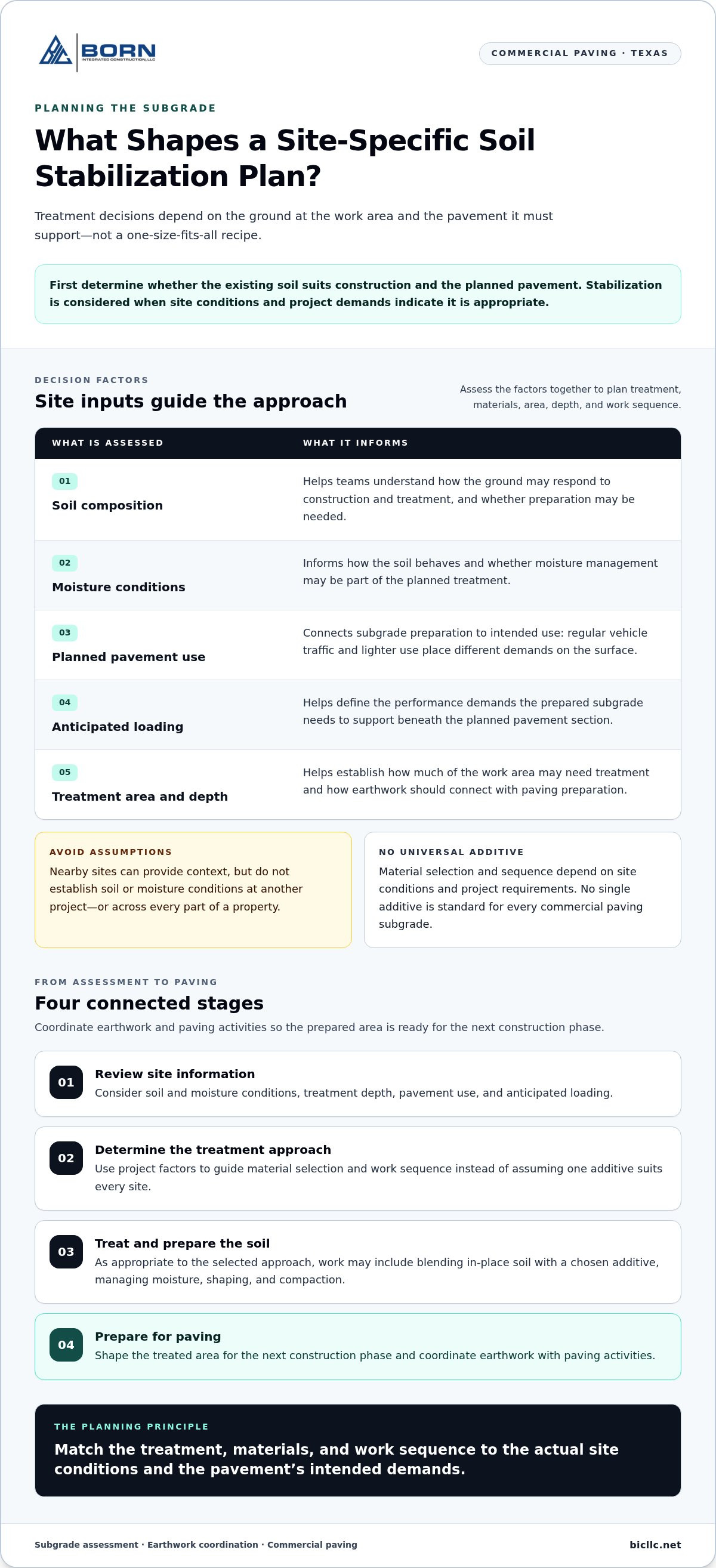
Stabilization should be planned for the site, not selected from a one-size-fits-all recipe. The process begins with available site information and an assessment of the soil in the area to be paved. Teams consider those findings alongside the pavement’s intended use, anticipated loading, and the depth of soil that may need treatment. Together, these factors help determine whether treatment is appropriate and what preparation the subgrade needs before paving.
Effective stabilization matches the treatment, materials, and work sequence to the conditions and demands of the specific site.
How do assessment and testing inform the work?
Information about soil composition and moisture helps teams understand how the ground may respond to construction and treatment. The planned pavement use matters, too. A surface intended for regular vehicle traffic has different performance demands from one intended for lighter use. Teams consider these factors together to plan the treatment, including the area and depth involved, rather than relying on assumptions from another site.
What happens during treatment and preparation?
Once the approach is established, crews prepare the work area and carry out the selected treatment. Depending on the project, that may involve blending in-place soil with a chosen additive, managing moisture, shaping the treated area, and compacting it for the next phase. The material and sequence depend on site conditions and project requirements. No single additive is standard for every commercial paving subgrade.
In general, the work moves through connected stages:
- Review site information. Consider soil and moisture conditions, treatment depth, pavement use, and anticipated loading.
- Determine the treatment approach. Use project factors to guide material selection and the work sequence instead of assuming a particular additive suits every site.
- Treat and prepare the soil. Carry out the planned blending, moisture management, shaping, and compaction as appropriate for the selected approach.
- Prepare for paving. Shape the treated area for the next construction phase and coordinate earthwork with paving activities.
These stages are connected, but they are not interchangeable. Treatment depth affects how much soil is addressed, while moisture conditions influence preparation and handling. The intended pavement use informs the performance requirements the subgrade must support. Considering these factors together keeps the treatment decision tied to the finished surface instead of treating stabilization as an isolated task.
Technical references can help explain how different methods are applied. The Caltrans Soil Stabilization Guidelines discuss approaches such as lime stabilization. They provide general reference material, not project-specific requirements for Texas sites. For Texas commercial work, the treatment plan should reflect the actual site and paving scope. Coordinating preparation with paving stabilization and concrete paving helps create a clear handoff from subgrade work to the next phase. Born Integrated Construction brings these related civil and paving needs into the project scope.
Does Every Commercial Paving Project Need Soil Stabilization?
No. Commercial paving sites do not all require the same treatment, and stabilization is not automatically necessary because a project is in Texas. The decision should follow observed subgrade conditions and the performance needs of the planned pavement. Treating suitable ground without a project-specific reason can add unnecessary scope. Overlooking weak or inconsistent areas can leave construction and pavement performance concerns unresolved.
A practical review considers more than whether the ground appears firm during one visit. Soil conditions can vary across a site, and moisture can affect how an area responds to equipment and preparation. The intended use of the paved area matters as well. Teams weigh these factors together to decide whether the existing conditions appear suitable or warrant further evaluation and treatment.
Which site conditions may prompt stabilization review?
Weak, variable, or moisture-affected subgrade may prompt closer review, but one observation does not establish a diagnosis. Teams also consider whether equipment can access and work across the area as planned, along with the demands of the finished pavement. These factors help identify where more information is needed before deciding whether stabilization belongs in the project scope.
When might a project proceed without additional treatment?
If the existing subgrade suits construction and the planned pavement’s performance needs, additional stabilization may not be warranted. That decision should still be based on conditions documented for the site, not an assumption that treatment is unnecessary. A project-specific scope should address identified needs and avoid work that has no clear role in supporting construction or the finished surface.
The guide below helps organize the decision. It is a starting point for review, not a substitute for site-specific assessment or a treatment requirement on its own.
| Condition to assess | Project implication | Information needed |
|---|---|---|
| Weak or inconsistent areas | May affect equipment access or the support available beneath the planned pavement. | Where the condition occurs and how it relates to the paving area and intended use. |
| Moisture-affected ground | May influence workability and the ground’s response during construction. | Observed site conditions and how they vary across the work area. |
| Subgrade that appears suitable | May allow the project to proceed without additional stabilization. | Evidence that conditions align with construction needs and pavement performance requirements. |
Use the table to support disciplined scope decisions. For example, a soft spot may call for further review, but its presence alone does not determine the extent or type of treatment needed. Likewise, ground that seems firm under one set of conditions may still need to be considered in light of construction access, moisture, and planned use.
For soil stabilization for commercial paving, the sound decision is neither to treat every site by default nor to dismiss treatment before reviewing the evidence. Connect documented site conditions to the pavement’s intended demands, then define the scope accordingly. This keeps stabilization tied to a clear purpose and aligns earthwork decisions with the needs of the paving phase.
How Texas Commercial Paving Teams Plan and Execute Stabilization
A well-coordinated paving project treats stabilization as part of the construction sequence, alongside earthwork and concrete placement. For Texas project teams, planning should account for the site’s actual moisture and working conditions, which can affect how crews prepare and move through the work. The sequence should connect site review, ground preparation, stabilization where required, and a clear handoff to paving.
How does stabilization fit into the commercial paving sequence?
Stabilization planning begins with the site and paving requirements, then informs preparation and the transition to pavement construction. Each phase should leave conditions suited to the next. The sequence may vary by project, but the handoff matters: earthwork and treatment should align with the paving plan so crews can move from prepared ground to the planned concrete surface without avoidable disruption.
A practical sequence for coordinating the work is:
- Review the site and project requirements. Align available site information, intended pavement use, work limits, and construction access needs.
- Plan earthwork and stabilization. Set the preparation approach in relation to observed site conditions and the paving scope.
- Complete the planned ground preparation. Carry out earthwork and any required treatment in a sequence suited to site conditions and working needs.
- Review the prepared area. Confirm that the work is ready to transition to the next phase and communicate relevant conditions to the paving team.
- Proceed with pavement construction. Coordinate concrete paving with the status and readiness of the prepared subgrade.
These steps are a planning framework, not a fixed schedule. Moisture and working conditions can influence how the work proceeds, so teams should coordinate around what they observe rather than assume every project will advance in the same way. Soil stabilization for commercial paving is most useful when it is part of a plan that connects treatment decisions to the pavement construction that follows.
How are quality and project handoffs managed?
A deliberate handoff gives civil site work and concrete paving teams a shared understanding of what is complete and what comes next. Reviewing the prepared area before paving begins can identify unfinished work or changing conditions that need attention. Clear communication helps teams coordinate access, work limits, and readiness without relying on assumptions.
Consistency supports quality: the work performed should correspond with the project plan, and the teams responsible for each phase should understand the transition between them. If site conditions change, communicating that change helps the team consider its effect on the planned sequence. Not every condition can be anticipated, but the handoff should still be treated as part of the work, not an administrative afterthought.
Commercial paving projects benefit when earthwork, stabilization, and concrete placement are coordinated as connected responsibilities. Born Integrated Construction provides civil site work, paving stabilization, and concrete paving for Texas projects.
Integrating Soil Stabilization and Commercial Paving with Born Integrated Construction
Ground preparation and pavement construction are connected parts of a commercial site project. Born Integrated Construction provides paving stabilization and commercial concrete paving, so teams can consider how these scopes relate during project planning. Where site conditions call for substantial ground removal, mass soil excavation may also be part of the work. Its role depends on the project, rather than being an automatic part of every paving scope.
Coordinating these activities helps clarify how site preparation supports the planned pavement and how one phase hands off to the next. Earthwork decisions can affect access, work limits, and readiness for paving. Keeping those considerations in view helps teams plan a coherent sequence and address actual site requirements without assuming that every location needs the same treatment.
How does integrated civil and paving scope support project coordination?
Considering civil site work and concrete paving together helps teams align preparation with the needs of the finished surface. Born Integrated Construction provides paving stabilization alongside concrete paving and related site work. Mass soil excavation can be coordinated with paving when existing ground conditions or the project plan make excavation relevant. The site and project requirements determine how these activities fit together.
This coordination matters before crews move from ground preparation to pavement construction. Planning can account for work boundaries, construction access, and what the paving phase needs from the prepared area. Clear communication between the teams responsible for these activities supports an orderly transition. It also gives the project team a practical opportunity to review whether the planned work remains aligned with observed site conditions.
Born Integrated Construction prioritizes safety, integrity, efficiency, and quality. These principles guide coordination between civil and paving work, while the specific scope reflects project needs. The company serves commercial projects across Texas, where site conditions and working requirements vary. A coordinated approach keeps decisions tied to the paving project rather than relying on a generic treatment plan.
What should project teams take away from the decision process?
Stabilization decisions should reflect soil conditions in the work area and the pavement’s intended use. Not every project requires additional treatment, and no single approach applies everywhere. Teams can keep the process grounded by connecting site information, earthwork planning, and paving requirements, then communicating clearly as work moves between phases. This supports sound coordination without promising a particular project outcome.
For owners and project teams, the central consideration is fit: preparation should respond to the ground and support the construction plan for the pavement above. Coordinating civil site work and concrete paving helps bring these related responsibilities into one project scope. The decision remains specific to the site and the work being planned.
To explore relevant commercial paving project examples and learn more about Born Integrated Construction’s approach, review the company’s project experience and background.
Build the Next Project on a Clear Plan
Before moving a commercial paving project forward, include the ground beneath it in the planning conversation. A measured approach to soil stabilization for commercial paving connects site conditions with the surface the team intends to build and keeps treatment decisions grounded in the project’s actual needs.
Planning can also create a clearer handoff between site preparation and paving. When responsibilities and sequence are considered early, project teams can better understand how the work fits together. Bring those considerations into the broader civil and construction plan so decisions align with the scope at hand.
Born Integrated Construction approaches its work with safety, integrity, efficiency, and quality as guiding priorities. Explore commercial paving and site work to discuss how the company’s capabilities can support your Texas project.
Frequently Asked Questions
Is soil stabilization necessary for every commercial paving project?
No. Stabilization is considered when site conditions or pavement requirements indicate that the existing ground may need treatment. For example, areas that respond differently under construction equipment may prompt closer review, but that variation alone does not determine the final scope. Across Texas, including Houston, Austin, San Antonio, Dallas, Fort Worth, San Marcos, New Braunfels, Boerne, Beaumont, Conroe, The Woodlands, and Arlington, decisions should reflect evidence from the project site.
Can soil stabilization support concrete paving as well as asphalt paving?
Yes. Stabilization can be relevant beneath different pavement types, including commercial concrete paving, because the prepared ground supports the pavement section above it. The details should suit the pavement being built. A method or example developed for asphalt should not automatically be applied to concrete work. For a concrete parking area, for instance, ground preparation should be considered alongside intended use and the project’s construction plan.
What happens if the subgrade is too weak for commercial paving?
Weak subgrade may make construction access more difficult or raise concerns about support beneath the planned pavement. It does not mean that a particular failure will occur. Document where the concern appears and consider its relationship to the work area, construction activity, and planned use. The project team can then determine whether to adjust the ground preparation scope, including whether stabilization is appropriate.
Is cement always used for soil stabilization?
No. Cement should not be assumed to be the standard additive for every site. Material selection depends on the soil, moisture conditions, treatment needs, and performance requirements for the planned work. Soil conditions in one part of a site may differ from those elsewhere, so a blanket material choice may not suit the project. The treatment plan should rely on site-specific information, not a general recipe.
How does moisture affect soil stabilization for paving?
Moisture can influence soil workability and how the ground behaves during preparation and treatment. Its effect depends on the soil and the planned work, so a visible wet area alone does not establish what treatment is needed. Project teams consider current conditions when planning the sequence. If conditions change during site preparation, communicating that information helps guide coordination without assuming a fixed schedule or outcome.
Does soil stabilization eliminate the need to assess the site?
No. Assessment remains necessary because stabilization responds to site conditions; it does not replace understanding them. Teams need to consider the ground, moisture, intended pavement use, and relevant project requirements before choosing how to prepare the area. A treatment suitable for one section of a commercial site may not fit another. Decisions grounded in site information help keep preparation aligned with the planned work.