A commercial sidewalk in Montgomery County is only as durable as the stabilized soil beneath it. For developers managing new projects in 2026, the challenge isn't just pouring cement; it's navigating the region's expansive clay and a shifting regulatory environment. You've likely dealt with the frustration of unreliable timelines or the risk of non-compliance with the latest ADA and City of Conroe standards. Securing high-performance commercial concrete flatwork Conroe developments require means finding a partner who treats site preparation and paving as a single, disciplined operation.
This article outlines the technical specifications and local requirements necessary to maintain project viability in our rapidly growing corridor. You'll discover how integrated civil strategies and strict adherence to the 2012 International Building Code prevent the structural failures that plague less rigorous builds. We'll also preview the logistical steps for the OpenGov permitting process, the updated 2025 fee schedules, and the specific soil stabilization techniques that ensure your development's infrastructure remains a professional asset for decades.
Key Takeaways
- Identify the essential components of horizontal infrastructure, including sidewalks, curbs, and dumpster pads, that support Montgomery County’s commercial expansion.
- Understand why mass soil excavation and engineered stabilization are the fundamental prerequisites for enduring results in Conroe’s expansive clay.
- Navigate the 2026 Texas Accessibility Standards (TAS) and ADA requirements to ensure full compliance and mitigate liability for your development.
- Evaluate the operational efficiency of securing high-performance commercial concrete flatwork Conroe developments require through a single-source partner for civil and concrete work.
- Learn how precise engineering of slopes and drainage systems protects your investment from water runoff and premature structural shifting.
Defining Commercial Concrete Flatwork for Conroe’s Growth
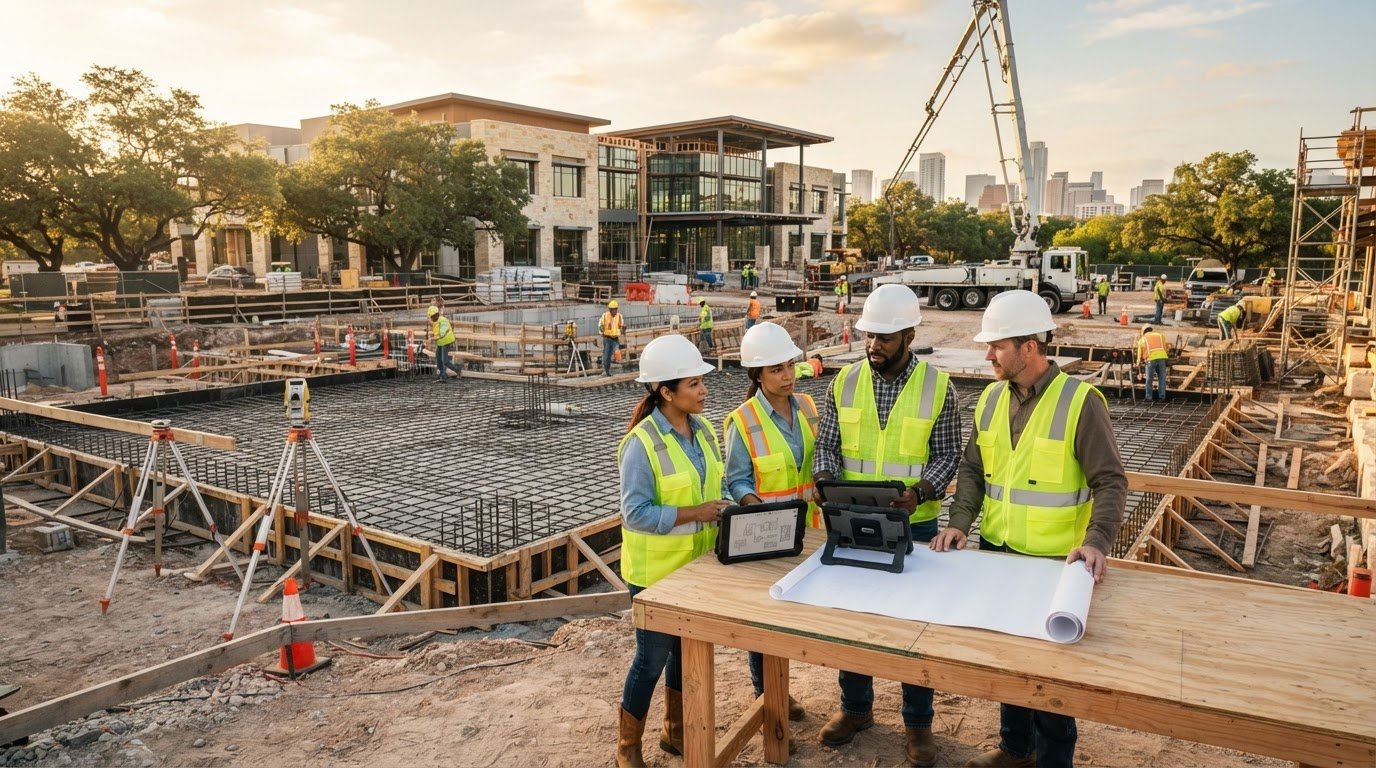
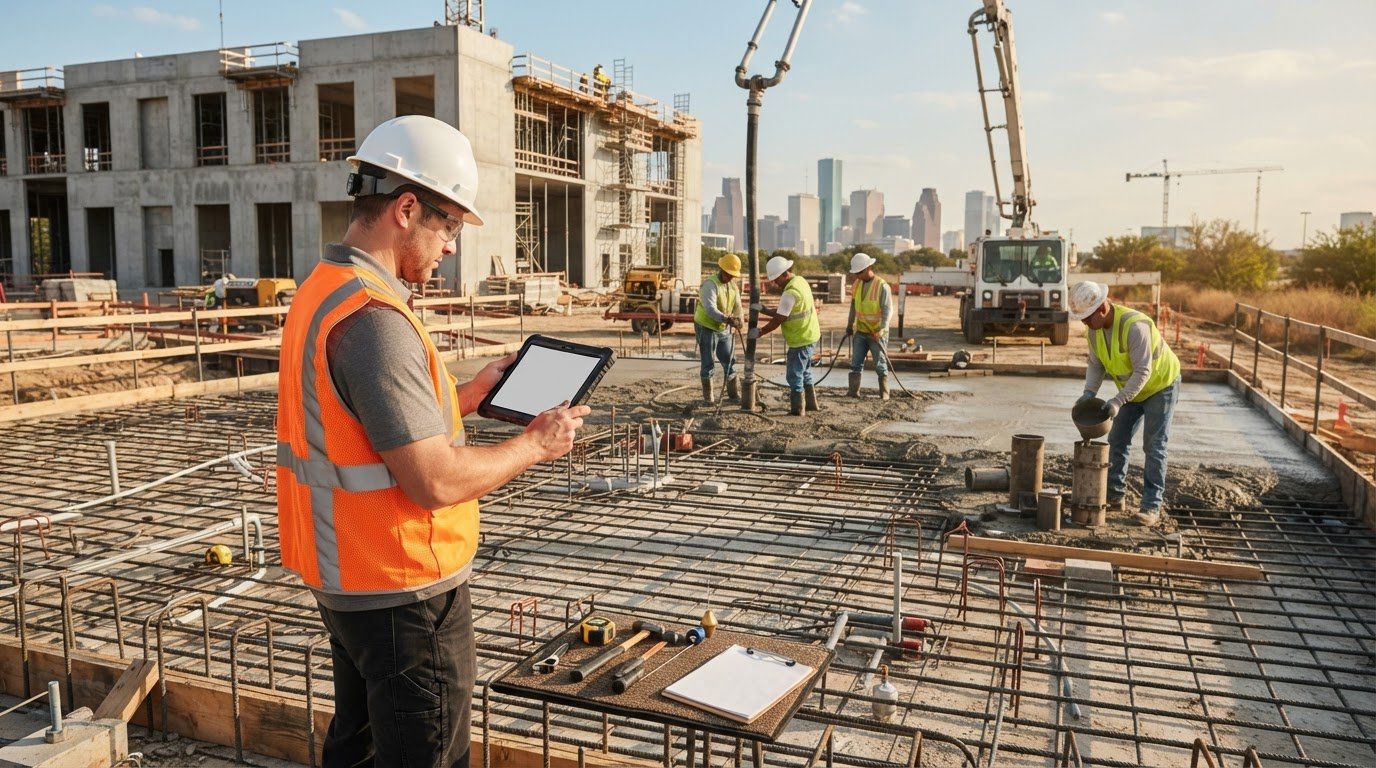
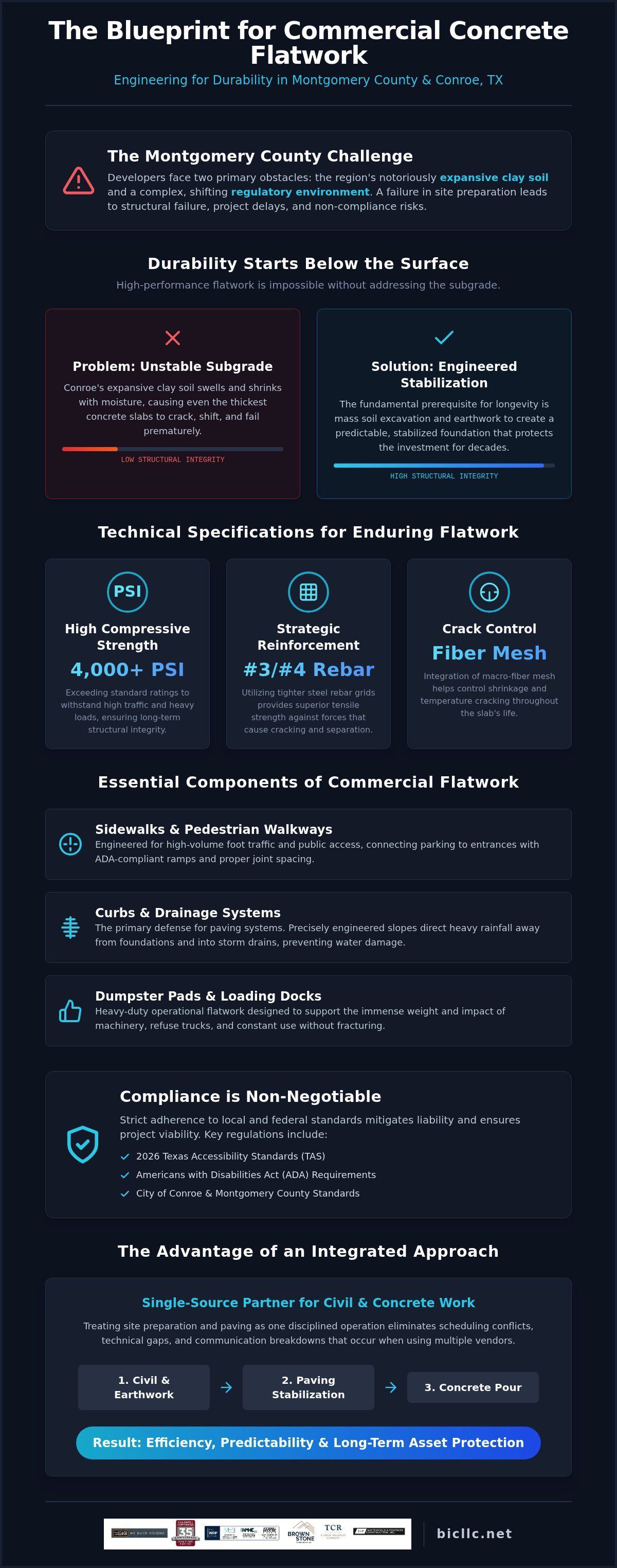
Commercial flatwork serves as the horizontal backbone of any professional development. In its simplest form, it refers to any concrete surface poured along a horizontal plane, including sidewalks, curbs, gutters, and dumpster pads. For a Concrete slab to survive the rigors of a high-traffic environment, it must be engineered with a focus on load distribution and environmental resistance. While residential pours might prioritize speed and cost, commercial concrete flatwork Conroe projects demand higher PSI ratings, often exceeding 4,000 PSI, and strategic reinforcement. This often involves the use of #3 or #4 rebar on a tighter grid or the integration of macro-fiber mesh to control shrinkage and temperature cracking. These technical choices ensure that the concrete doesn't just look good on day one, but remains stable for decades.
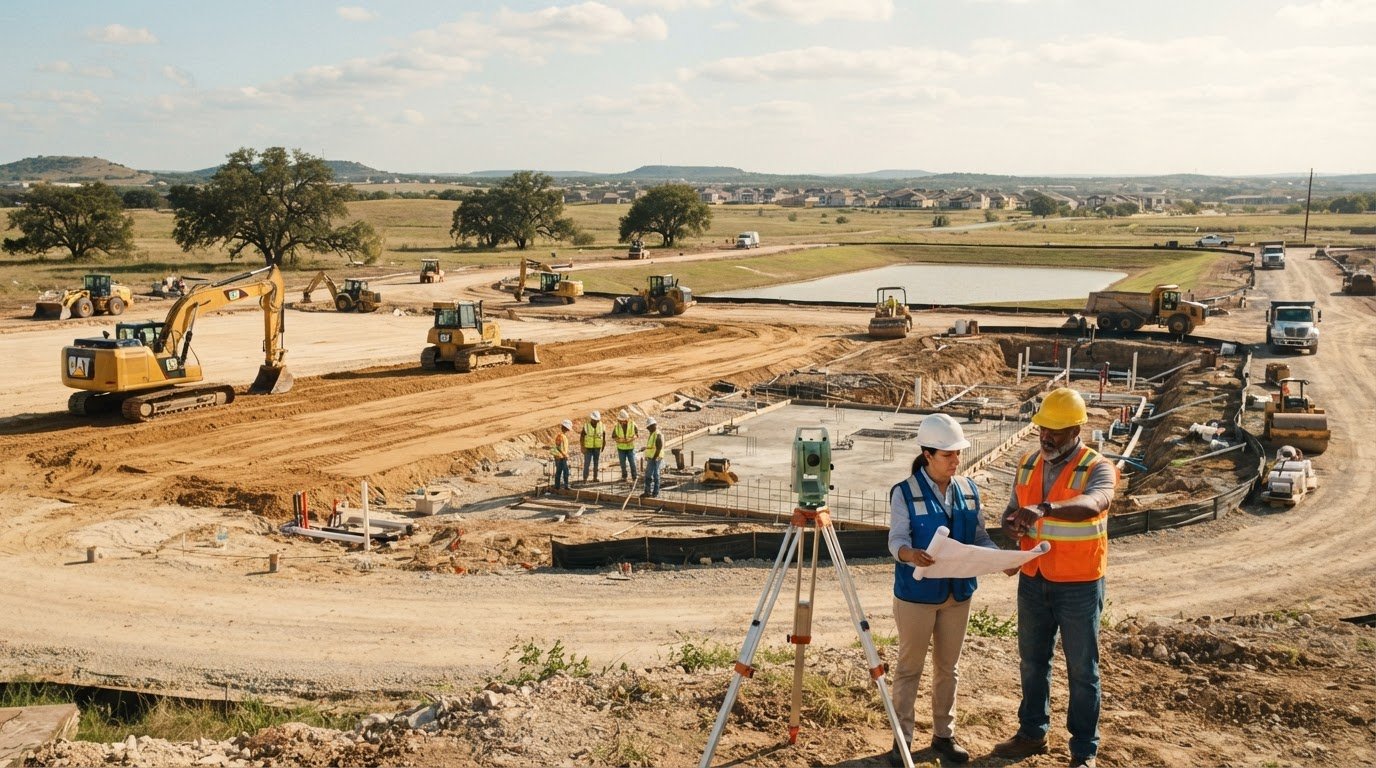
Site readiness is the prerequisite for durability. At BIC, we believe that high-performance flatwork begins with mass soil excavation and earthwork. If the subgrade isn't stabilized against Conroe's expansive clay, even the thickest slab will eventually fail. Our integrated approach treats the civil site work and the final concrete pour as a single, disciplined process. This eliminates the scheduling conflicts and technical gaps that often occur when multiple vendors manage separate stages of a project. By managing the earthwork and paving stabilization in-house, we establish a predictable foundation that protects the long-term viability of the finished product.
The Scope of Flatwork in Modern Developments
Pedestrian infrastructure remains a primary focus for retail and office centers in Montgomery County. This includes ADA-compliant ramps and expansive walkways that connect parking areas to building entrances. Operational flatwork serves a more rugged purpose. Dumpster pads and loading docks must support the weight of heavy machinery without fracturing. These elements require seamless integration with commercial concrete paving in Conroe to ensure that water runoff and vehicular transitions don't compromise the subgrade.
Why Conroe’s Infrastructure Demands Precision
Conroe's rapid expansion, evidenced by the 30.1% population growth in areas like New Caney and Porter between 2020 and 2024, has placed unprecedented stress on local infrastructure. Professional developments in 2026 can't afford the liability of crumbling sidewalks or non-compliant curbs. Precision in flatwork ensures that your site reflects the quality of your brand while meeting strict Montgomery County standards. Every joint and slope must be calculated to manage the high-volume foot traffic and light vehicular runoff typical of the Woodlands area.
Essential Types of Commercial Flatwork for Montgomery County Projects
Every development in the Conroe area relies on a network of horizontal surfaces that must perform under consistent pressure. High-quality commercial concrete flatwork Conroe projects include a diverse range of structures, from standard pedestrian paths to heavy-duty industrial pads. These elements aren't merely additions to a site; they're functional necessities that define property boundaries, manage water runoff, and ensure the safety of every person who visits the development. Professional execution in these areas prevents premature sinking, cracking, and the costly repairs that often follow substandard installations.
Sidewalks and Pedestrian Connectivity
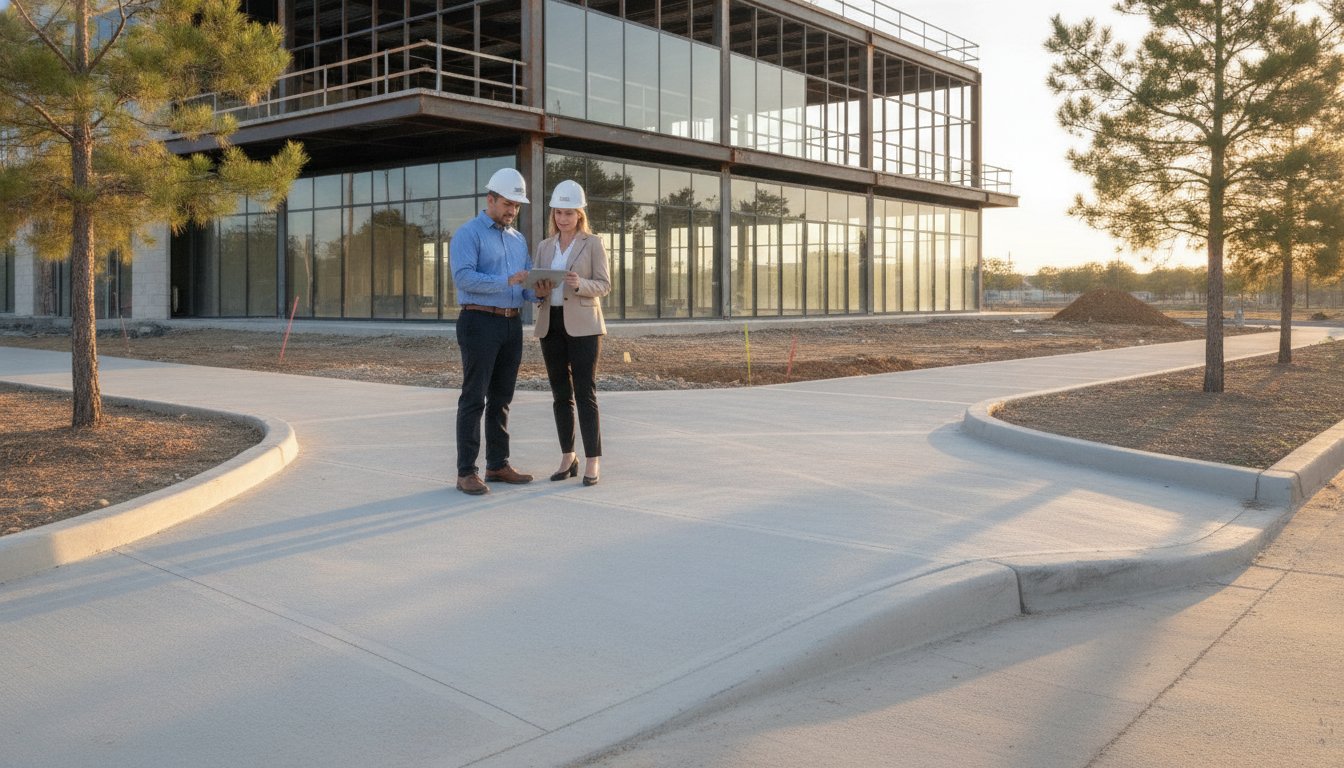
Pedestrian pathways in commercial zones require a disciplined approach to both width and thickness. Standardized Conroe commercial zoning often dictates specific dimensions for public access, typically requiring reinforced slabs that can withstand the occasional weight of maintenance vehicles. Our team integrates these walkways with existing concrete construction services in Texas to maintain a unified aesthetic and structural standard across the entire site. Proper joint spacing and specific finishing techniques are utilized to manage thermal expansion and minimize long-term maintenance costs.
Functional Curbs and Drainage Systems
Curbs and gutters are the primary defense for a site's paving system. They direct Montgomery County's heavy seasonal rainfall away from building foundations and into designated storm drains. Whether a project utilizes extruded curbing for efficiency or hand-formed systems for complex geometries, maintaining the integrity of the flow-line is vital. Precise grading ensures that water doesn't pool, which protects both the concrete and any adjacent asphalt from moisture-related degradation. Establishing these elevations correctly during the civil phase is a hallmark of a dependable partner.
High-stress zones like dumpster pads and loading areas require even greater technical focus. These sections of flatwork face the most significant mechanical strain from heavy trucks and waste management equipment. We reinforce these areas with specialized steel placement or increased slab thickness to prevent the common issues of sinking or "spider-web" fracturing. Without this added structural support, the constant vibration and weight of commercial operations will quickly compromise the concrete.
Compliance with the ADA Standards for Accessible Design is a non-negotiable aspect of modern commercial flatwork. In 2026, regulatory scrutiny remains high, and even a 1% deviation in a ramp's slope can lead to legal complications or inspection failures. We prioritize precision in every transition and landing to ensure full accessibility for all users. Partnering with an expert for integrated civil and concrete solutions ensures these critical details are managed with professional oversight from the initial grade to the final broom finish.
Engineering for Longevity: Soil Stabilization and Site Readiness
Conroe's geological profile presents a significant challenge for any horizontal concrete project. The region is dominated by expansive clay soils that swell when saturated and shrink during dry periods. This constant movement exerts immense pressure on surface structures, leading to the shifting and cracking often seen in poorly planned developments. For commercial concrete flatwork Conroe projects to remain viable over the long term, the engineering must begin well below the finished grade. Stability isn't achieved at the pour; it's established during the initial civil phase through disciplined site preparation.
Mass soil excavation serves as the first line of defense against subgrade failure. By removing unstable organic material and addressing local "soft spots" before any concrete is placed, we create a uniform environment for the foundation. Our integrated civil approach ensures that the earthwork and the flatwork are managed as a single, continuous operation. This coordination is vital in the Piney Woods climate, where sudden moisture fluctuations can quickly compromise an exposed subgrade. When one partner manages both the excavation and the paving stabilization, the risk of technical gaps between crews is virtually eliminated.
Preparing the Subgrade for Heavy-Duty Flatwork
Success in Montgomery County commercial sites requires strict adherence to compaction standards. We utilize rigorous testing protocols to ensure the subgrade reaches the specified density required to support heavy-duty flatwork. During the mass excavation phase, our teams identify and remediate areas of low load-bearing capacity that could lead to future sinking. Moisture control remains a constant priority. We manage the water content of the soil throughout the preparation process to prevent the clay from reaching a state of high plasticity, which is the primary cause of slab displacement.
Soil Stabilization Techniques
Chemical stabilization is often necessary to transform Conroe's volatile clay into a dependable platform. The choice between lime and cement stabilization depends entirely on the soil's plasticity index. Lime is typically preferred for high-plasticity clays, as it initiates a chemical reaction that permanently alters the soil structure, making it less susceptible to moisture-induced volume changes. Paving stabilization in the Texas region is the professional practice of chemically modifying expansive clay soils to create a rigid, non-expansive foundation that protects the structural integrity of curbs, gutters, and sidewalks. This process ensures that your investment in flatwork remains level and functional, regardless of seasonal weather shifts.
Compliance and Safety: ADA Standards and Local Building Codes
Compliance in commercial development is a matter of both legal liability and structural integrity. For any project involving commercial concrete flatwork Conroe officials require strict adherence to the 2012 International Building Code and the 2012 Texas Accessibility Standards (TAS). These regulations ensure that horizontal infrastructure is safe for public use and accessible to all individuals. Navigating these requirements in 2026 demands a partner who understands the nuances of local permitting and the technical precision required for state-level inspections. Failure to meet these benchmarks can result in costly tear-outs, delayed certificates of occupancy, and long-term legal exposure.
Safety protocols during the installation phase are equally vital. Managing a job site in high-traffic areas of Montgomery County requires disciplined coordination to protect both the construction crew and the general public. We implement clear site perimeters and methodical pouring schedules to minimize disruption to existing business operations. This organized approach reflects our commitment to professional stability and ensures that every phase of the flatwork installation meets our internal safety standards and local municipal requirements.
Precision in ADA Ramp Construction
The margin for error in ADA ramp construction is remarkably thin. Federal standards, specifically the 2010 ADA Standards for Accessible Design, mandate a maximum running slope of 1:12 and a cross slope no steeper than 1:48. In practice, a variance of just 1% can render a ramp non-compliant. We utilize laser-leveling technology to detect and correct slope discrepancies before the concrete begins to set. Beyond the slope, we ensure that tactile warning surfaces, such as truncated domes, meet specific visual and tactile contrast requirements. This level of precision mitigates the legal risks associated with non-compliant flatwork and ensures a seamless experience for all users.
Conroe and Woodlands Local Code Specifics
Local permitting in Conroe underwent a significant shift on December 8, 2025, with the mandatory transition to the OpenGov online portal for all building permit applications and inspection requests. Developers must also account for specific Montgomery County drainage requirements, particularly for large flatwork surfaces that impact stormwater runoff. Projects involving curb cuts or entrances within a TxDOT right-of-way (ROW) require additional coordination and specialized permitting. For more complex builds, we often integrate these horizontal elements with podium slab construction to maintain structural continuity in midrise developments. If you need a partner who understands these local complexities, contact BIC today to discuss your project's specific compliance needs.
The Born Integrated Approach: Efficiency in Civil and Concrete
Project efficiency in 2026 is often lost in the technical gap between civil site work and final concrete finishing. When a developer hires separate firms for mass soil excavation, underground utilities, and paving, the risk of miscommunication increases. This fragmentation frequently leads to scheduling delays, subgrade degradation, and costly rework. At Born Integrated Construction (BIC), we eliminate these friction points by serving as a single, dependable partner for the entire civil and horizontal lifecycle. Our integrated model ensures that the commercial concrete flatwork Conroe projects require is executed on a foundation that has been meticulously prepared by the same team responsible for the final pour.
Our commitment to integrity and professional stability means we prioritize substance over style. We understand that a commercial development's success depends on the enduring nature of its infrastructure. By maintaining a steady and predictable cadence from the initial clearing to the final jointing, we instill confidence in our partners. This disciplined approach has proven effective in Conroe's rapid commercial expansion, where meeting tight 2026 delivery timelines is a prerequisite for project viability. We don't just act as a vendor; we function as a seasoned expert focused on the long-term structural health of your site.
Streamlining the Construction Lifecycle
Coordinating underground utilities with surface flatwork is a critical phase where many projects encounter avoidable setbacks. Our teams manage this transition with precision, ensuring that all conduit, drainage, and utility sleeves are perfectly positioned before any concrete is placed. This foresight prevents the need to cut into fresh slabs to correct utility oversights. By maintaining control over the entire process, we provide predictable timelines that keep your overall development schedule on track. A clean and organized site is a hallmark of our operations, reducing safety hazards and allowing other trades to work more effectively alongside our crews.
A Partnership Built on Reliability
Reliability is established through transparency and unwavering professional standards. We provide clear, project-based fee structures and meticulous material management to ensure there are no surprises during the construction phase. Safety remains our highest priority, and our crews follow rigorous protocols to protect the integrity of the work and the well-being of everyone on site. This grounded philosophy allows us to deliver consistent value to developers in the Woodlands and Conroe areas who demand high-register craftsmanship and operational precision. If you are seeking a steadfast partner for your next development, contact Born Integrated Construction for your Conroe project estimate.
Securing the Longevity of Your Montgomery County Development
The rapid expansion of 2026 requires more than standard pouring; it demands a disciplined approach to subgrade preparation and regulatory compliance. You've seen how engineered soil stabilization and integrated civil management prevent the structural failures that often follow poor site readiness. By addressing Conroe's expansive clay and navigating the updated OpenGov permitting system with precision, you protect the long-term value of your investment. High-quality commercial concrete flatwork Conroe projects depend on this level of technical oversight to remain stable and compliant over time.
Born Integrated Construction provides the professional stability necessary for complex horizontal infrastructure. Our integrated project management model eliminates the gap between excavation and paving, ensuring a seamless construction lifecycle. With a steadfast commitment to safety and integrity, we act as a dependable partner focused on delivering results that reflect the quality of your development. We take pride in craftsmanship that stands the test of time and environmental stress.
Partner with Born Integrated Construction for Reliable Conroe Flatwork. We look forward to helping you establish a lasting foundation for your next commercial project.
Frequently Asked Questions
What is the difference between commercial concrete flatwork and paving?
Flatwork refers to any concrete surface poured along a horizontal plane, such as sidewalks, curbs, and dumpster pads. In contrast, concrete paving is specifically engineered to support heavy vehicular loads on roads or parking lots. While paving focuses on mass load distribution, flatwork requires higher precision for pedestrian accessibility and water drainage. Both systems require professional grading to ensure the finished surface performs as intended within the development's broader infrastructure.
How thick should a commercial concrete sidewalk be in Conroe?
A standard commercial sidewalk is typically 4 inches thick, though high-traffic areas or those subject to light vehicular crossing often require 6 inches. We reinforce these slabs with steel rebar or macro-fiber to enhance structural integrity and prevent cracking. Local Conroe building codes and specific zoning requirements may dictate higher standards for public right-of-way sections. It's essential to verify these specifications during the permitting phase to ensure the infrastructure meets all municipal durability expectations.
Why is soil stabilization necessary for flatwork in Montgomery County?
Montgomery County is known for expansive clay soils that swell and shrink as moisture levels fluctuate. Without chemical stabilization, this constant movement will inevitably cause surface concrete to shift, crack, or sink. We utilize lime or cement injection to modify the soil's chemical properties, creating a non-expansive foundation. This process is the most effective way to protect your investment in horizontal infrastructure from the region's volatile geological conditions and seasonal weather shifts.
How does ADA compliance affect my commercial flatwork budget?
ADA compliance requires a high level of technical precision in grading and finishing, which involves specialized labor and materials like truncated domes. While these requirements may increase the initial project scope, they're vital for accessibility and legal protection. Investing in compliant commercial concrete flatwork Conroe developments prevents the significant expense of remediation or legal challenges that arise from non-compliant slopes or trip hazards on the property after the project is completed.
Can BIC handle both the underground utilities and the concrete flatwork?
Our team specializes in providing turnkey civil and concrete solutions, which includes the management of underground utilities alongside surface flatwork. By coordinating these phases internally, we ensure that utility sleeves and drainage systems are perfectly positioned before the pour. This integrated approach eliminates the common scheduling conflicts between separate crews and prevents the need for costly rework or the frustration of cutting into newly finished concrete surfaces to fix utility oversights.
What is the typical timeline for a large-scale commercial flatwork project?
The duration of a project depends on the total square footage and the complexity of the site's civil requirements. A large-scale commercial development typically moves from mass excavation to final flatwork jointing over the course of several weeks. Weather conditions in the Piney Woods region can impact this schedule, but our methodical project management style focuses on maintaining a steady, predictable cadence to meet your 2026 delivery milestones without sacrificing quality.
How do I choose the right commercial concrete contractor in Conroe?
Select a partner who demonstrates a deep understanding of local Montgomery County regulations and soil challenges. It's important to choose a firm that prioritizes substance and safety over low-bid shortcuts that lead to long-term failure. A contractor capable of managing both the civil site work and the final concrete pour offers the highest level of accountability. This single-source responsibility ensures that the finished product remains stable and functional for the life of the development.
What maintenance does commercial concrete flatwork require in the Texas climate?
Commercial flatwork in the Texas climate primarily requires periodic inspections of expansion joints and the sealing of any minor surface cracks. High-performance commercial concrete flatwork Conroe projects are designed for low maintenance, provided the subgrade was stabilized correctly during construction. Preventing water from infiltrating the subgrade through compromised joints is the most effective way to ensure the concrete doesn't shift or settle over decades of consistent use.