A commercial development is only as reliable as the ground upon which it's built, yet in Texas, that ground is often working against you. The state's notorious expansive clay soils can exert enough pressure to crack reinforced pavement and compromise structural foundations within months of completion. Engaging a disciplined earthwork contractor Texas is the only way to mitigate these geological risks through methodical soil stabilization and rigorous site preparation. We recognize the frustration of watching concrete schedules slip because of inaccurate grading or failing to meet strict TCEQ stormwater standards for detention ponds. This article demonstrates how precision earthwork and chemical stabilization create the essential foundation required for durable Texas infrastructure. You'll discover the technical processes that ensure your site is perfectly graded for concrete paving while maintaining full compliance with municipal regulations. By focusing on the seamless transition from mass excavation to structural concrete work, we provide a roadmap for achieving operational excellence and long-term project viability.
Key Takeaways
- Learn why precision soil engineering is the most critical factor in preventing foundation failure and ensuring the long-term structural integrity of Texas commercial projects.
- Discover how advanced GPS and laser-guided grading techniques achieve sub-inch precision to eliminate drainage issues and prepare sites for seamless concrete paving.
- Understand the chemical and mechanical processes a qualified earthwork contractor Texas uses to stabilize expansive clay soils and protect your infrastructure from seasonal shifting.
- Explore the strategic integration of detention ponds and underground utility installation to ensure compliance with TCEQ stormwater regulations and municipal drainage requirements.
- Recognize the operational advantages of an integrated civil partner in reducing management friction and bridging the gap between site preparation and structural concrete schedules.
The Critical Role of Earthwork in Texas Commercial Construction
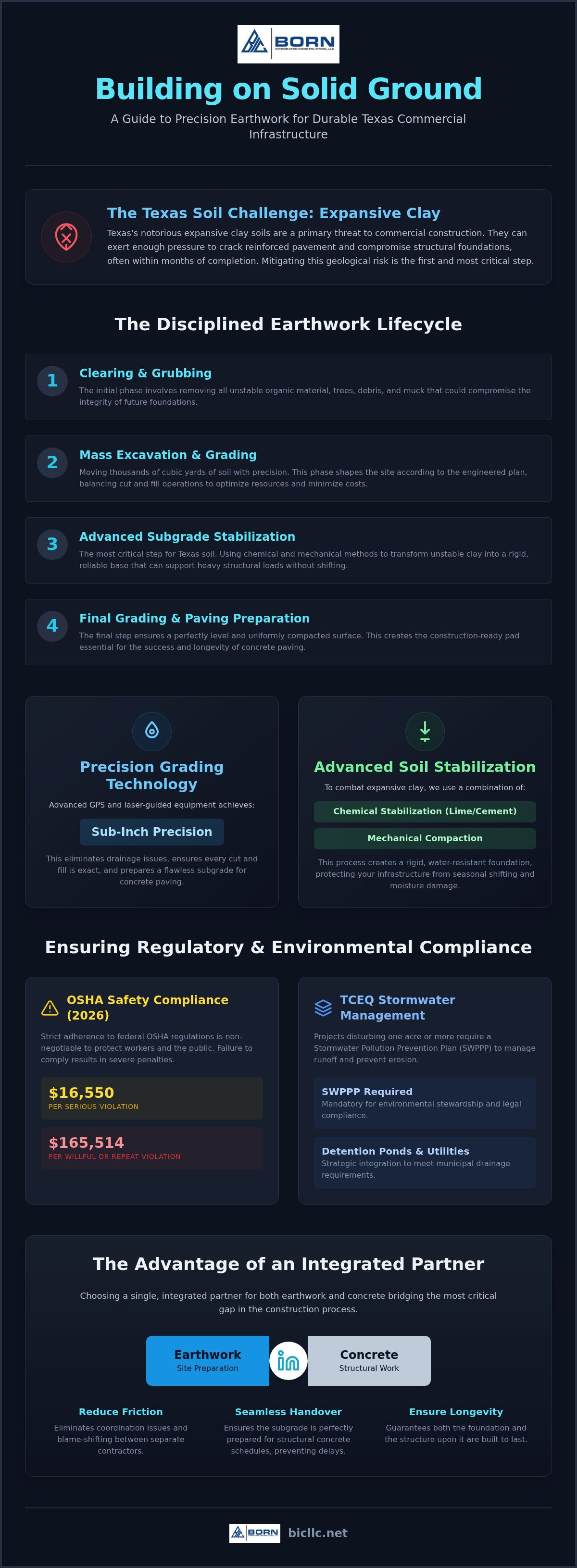
Earthwork is often misunderstood as the simple relocation of soil. In reality, Earthworks represent a sophisticated engineering phase that dictates the long-term stability of every structure built upon it. As a specialized earthwork contractor Texas, we view a site's topography and soil structure as a complex system that must be meticulously managed. The earthwork lifecycle begins with clearing and grubbing, progressing through mass excavation and subgrade stabilization, and concluding with final grading. Every step is a prerequisite for the next. Prioritizing speed over precision leads to settlement issues and drainage failures that often result in expensive pavement cracking or structural shifting. Choosing a partner who understands the relationship between soil density and structural longevity is the only way to ensure a project's viability.
Earthwork as the Foundation for Concrete Paving
The success of commercial concrete paving depends entirely on the quality of the subgrade. Concrete is a rigid material; it doesn't flex. If the soil beneath it shifts or settles unevenly, the concrete will crack under the weight of heavy-duty traffic or structural loads. Proper earthwork ensures uniform soil compaction, which is the physical requirement for effective load-bearing. We transform raw, unpredictable land into a construction-ready pad that provides a stable, level surface for structural concrete work. This transition is the most critical handover in the construction process. Without a perfectly graded and stabilized subgrade, even the highest quality concrete mix will eventually fail.
Navigating Texas Regulatory and Safety Standards
Compliance isn't optional when it comes to site preparation. In Texas, federal OSHA regulations govern all excavation activities to protect workers and the public. The penalties for safety failures are severe. In 2026, a single serious violation can result in a $16,550 fine, while willful or repeat violations can reach $165,514. Beyond safety, environmental stewardship is mandated through the Stormwater Pollution Prevention Plan (SWPPP). A SWPPP is required for any project disturbing one acre or more to manage runoff and prevent erosion. The TCEQ is also currently renewing the TXR050000 permit, which expires on August 14, 2026. Maintaining these standards ensures the project remains legally viable and safe within high-traffic commercial zones. We take pride in our disciplined approach to these regulations, recognizing that safety and compliance are the pillars of professional stability. For more information on our commitment to excellence, you can learn more about our organizational values.
Precision Mass Soil Excavation and Grading Techniques
Mass excavation is the logistical engine of site development. For large-scale commercial projects, moving thousands of cubic yards of soil requires a disciplined approach to equipment deployment and cycle times. A professional earthwork contractor Texas utilizes advanced GPS and laser-guided grading technology to achieve sub-inch precision. This technological integration ensures that every cut and fill operation is performed according to the engineered site plan, which is essential for maintaining the project's budget and timeline. By managing the cut and fill balance on-site, we minimize the expensive need to export soil or import select fill, optimizing the existing resources of the land.
Efficiency in mass excavation is driven by the strategic use of heavy machinery. Scrapers, dozers, and excavators must work in a synchronized rhythm to keep the project on schedule. This methodical management of details is what separates a seasoned expert from a general laborer. To see how these techniques are applied in real-world scenarios, you can view our completed civil projects across the state.
Mass Excavation for Site Readiness
The initial phase of mass excavation involves the thorough removal of unstable organic material, debris, and muck that can compromise future foundations. In the flat, often saturated coastal plains of Houston, this may involve significant dewatering and the removal of heavy silt. Conversely, projects in the Texas Hill Country often require specialized techniques to manage rocky terrain. During this stage, we implement strategic soil stockpiling. By carefully segregating and storing topsoil or usable fill, we preserve materials for future landscaping or structural needs. This foresight reduces waste and supports the overall Stormwater Management plan by minimizing disturbed areas and controlling erosion.
Final Grading and Pad Preparation
Final grading is the precision work that prepares the site for the next phase of construction. Achieving exact elevations is non-negotiable, particularly when preparing a site for a podium slab contractor. These structural concrete elements require a perfectly level and compacted surface to ensure load distribution is consistent across the entire footprint. Beyond the building pad, final grading establishes the slopes necessary for natural drainage. This prevents water from pooling against foundations and ensures that runoff is directed toward detention ponds or municipal systems. We maintain strict moisture control throughout the grading process, as Texas heat can rapidly dehydrate soil and prevent it from reaching the required density for structural stability.
Solving Texas Soil Challenges through Advanced Stabilization
Texas is defined by its geological diversity, but for developers, this diversity presents a significant challenge. The expansive blackland prairie clay found across North and Central Texas is notorious for its high plasticity. This soil swells when wet and shrinks when dry, creating enough force to heave foundations and shatter pavement. In coastal regions like Houston, the challenge shifts to fine silts that lack the cohesion necessary to support heavy structural loads. Addressing these issues requires more than just moving dirt. It demands a specialized earthwork contractor Texas who understands the chemical and mechanical properties of the local environment.
Proactive stabilization is a non-negotiable investment for heavy-duty commercial paving. While the initial cost of chemical additives may seem significant, the return on investment is realized through the avoidance of future repairs. Concrete failure often traces back to subgrade movement. By transforming the soil into a stable, water-resistant platform, we ensure that the infrastructure remains viable for decades rather than years. Effective stabilization provides:
- Reduced soil plasticity and swelling potential
- Increased load-bearing capacity for heavy machinery and traffic
- Improved resistance to moisture penetration and seasonal erosion
Lime vs. Cement Stabilization
The choice between lime and cement stabilization depends entirely on the soil's plasticity index (PI) provided in the geotechnical report. Lime is the preferred solution for high-plasticity clay soils common in the Dallas-Fort Worth and Houston areas. The chemical reaction between lime and clay particles reduces the soil's ability to hold water, effectively "taming" the expansion. Conversely, cement stabilization is utilized for sandy or silty soils that require an increase in load-bearing capacity. In some cases, we utilize fly ash or other specialized additives to match the specific requirements of the site. This data-driven approach ensures that the stabilization method is technically sound and cost-effective. Our disciplined focus on these details is why many partners choose to learn more about our stabilization standards before breaking ground.
Mechanical Stabilization and Compaction
Paving stabilization is the chemical or mechanical modification of soil to increase its load-bearing capacity and water resistance. Mechanical stabilization relies on the precise management of moisture-density relationships, often verified through Proctor tests. To achieve the required PSI for commercial pads, we utilize specialized equipment such as sheepsfoot rollers for deep compaction of cohesive soils and smooth drum rollers for finishing. Maintaining the optimum moisture content is essential; soil that is too dry won't compact, while soil that is too wet will "pump" under the weight of machinery. We maintain a steadfast commitment to these engineering principles to ensure every site is ready for structural concrete work.
Stormwater Management: Detention Ponds and Underground Utilities
Effective site preparation requires a holistic view of the property that extends below the finished grade. While mass excavation and soil stabilization establish the structural platform, the integration of underground utilities and stormwater management systems ensures that the site remains functional and protected from environmental stress. A seasoned earthwork contractor Texas manages this transition by coordinating the installation of essential infrastructure before the final paving begins. This synchronization is vital because water is the primary enemy of structural concrete. Without a robust drainage system and properly installed utility lines, even the most well-stabilized subgrade is at risk of erosion and saturation. Our disciplined approach ensures that every subsurface component is installed to support the long-term viability of the finished structure.
Detention Pond Construction and Basin Design
Detention ponds are a regulatory necessity for most commercial developments in Texas. Projects that disturb one acre or more require a Stormwater Pollution Prevention Plan (SWPPP) to manage runoff, while those disturbing five acres or more must file a Notice of Intent (NOI) with the TCEQ. We don't view detention pond construction as simple excavation; it's a precision engineering task. Meeting municipal volume requirements is the first priority, but long-term viability requires meticulous slope stabilization. We line and stabilize pond slopes to prevent siltation, which can reduce the pond's capacity and lead to non-compliance with local drainage codes. By integrating these basins into the site's natural topography, we ensure they fulfill their hydraulic function while maintaining the overall safety of the commercial zone.
Underground Utility Installation Logistics
The installation of storm sewers, sanitary lines, and domestic water requires disciplined coordination to avoid compromising the integrity of the stabilized subgrade. Trenching must be executed with precision, followed by the placement of proper bedding material to protect the pipes from shifting. One of the most common failures in commercial development is trench settlement, which occurs when backfill is poorly compacted. This leads to sagging pavement and broken utility lines years after the project is completed. We follow rigorous compaction protocols, using specialized equipment to ensure that every layer of backfill reaches the required density. Before any digging begins, we contact Texas 811 at least two business days in advance; this simple step provides a 99% chance of avoiding damage to existing underground utilities. If you are ready to secure your site's infrastructure, request a consultation for turnkey civil services to ensure your project starts on a stable foundation.
Selecting an Integrated Earthwork and Concrete Partner
The traditional siloed approach to construction often creates a problematic gap between the completion of site preparation and the start of paving. In this model, the earthwork crew finishes their scope and departs, leaving the concrete team to inherit a subgrade that may have degraded due to weather or improper handover. Choosing an integrated earthwork contractor Texas eliminates this operational friction by providing a single point of accountability from the first cut of mass soil excavation to the final pour of concrete paving. This integrated model ensures that the person responsible for the subgrade is the same one who must warrant the performance of the concrete slab. It's a method that prioritizes substance over style and guarantees that the engineering standards established during the civil phase are strictly maintained.
The BIC Advantage: Safety, Integrity, and Efficiency
We provide a turn-key civil solution that reduces project management friction and mitigates structural risk. Our approach combines civil site work, underground utility installation, and structural concrete into a single, cohesive workflow. This alignment is increasingly critical as the Texas market shifts toward more collaborative delivery methods; design-build projects now represent over 55% of commercial construction starts in the state as of October 2025. By managing the entire lifecycle of the site preparation, we ensure that safety and precision are never compromised for the sake of a schedule. Our portfolio spans residential, commercial, and infrastructure developments across Houston, Austin, and Dallas, reflecting a deep-rooted commitment to high standards. You can view our completed projects to see how this integrated philosophy translates into durable infrastructure.
When evaluating a potential partner for your development, look for indicators of professional stability and technical proficiency. A seasoned expert should demonstrate:
- In-house GPS and laser-guided grading for sub-inch precision.
- A proven track record of managing expansive Texas clay through chemical stabilization.
- A disciplined safety culture that adheres to federal OSHA standards.
- The ability to seamlessly transition from excavation to structural concrete work.
Next Steps for Your Texas Development
Securing a dependable partner for your next project starts with a methodical review of your site's specific requirements. We recommend preparing your geotechnical reports and engineered site plans before requesting a comprehensive earthwork quote. This preparation allows us to provide a matter-of-fact assessment of your cut and fill balances, stabilization needs, and stormwater management scope. We focus on delivering consistent value through meticulous management of details and a strong sense of duty to our clients. To learn more about our organizational pillars and technical capabilities, please visit our about page. We are ready to help you establish a lasting foundation for your next commercial development.
Establishing a Foundation for Decades of Structural Viability
The success of any commercial development depends on the discipline applied during the initial phase of site preparation. Precision is the engineering prerequisite for long-term stability. We've explored how mass excavation, subgrade stabilization, and integrated stormwater management systems protect your infrastructure from the geological pressures of the Texas landscape. By selecting a specialized earthwork contractor Texas, you ensure that every cut and chemical additive is managed with technical proficiency. Our integrated civil and concrete construction services provide a seamless transition from raw land to finished structural slabs, eliminating the costly gaps that plague multi-vendor projects.
Born Integrated Construction brings specialized expertise in Texas expansive clay stabilization to every project. Whether you're developing in Houston, Austin, San Antonio, or Dallas, we maintain a steadfast commitment to safety and operational precision. We invite you to Partner with Born Integrated Construction for Your Next Texas Project to secure a site foundation built on professional integrity. We look forward to establishing a reliable partnership that supports your vision through every phase of construction.
Frequently Asked Questions
Why is soil stabilization so important for Texas earthwork projects?
Soil stabilization is essential because a significant portion of Texas contains expansive clay soils that swell and shrink with moisture changes. Without chemical or mechanical stabilization, these geological movements exert enough pressure to crack reinforced concrete and compromise structural foundations. A professional earthwork contractor Texas uses stabilization to create a water-resistant, high-density platform that ensures the long-term integrity of the infrastructure it's supporting.
How long does the mass excavation phase typically take for a commercial site?
The duration of mass excavation depends on site acreage, soil composition, and weather conditions. For a standard five-to-ten-acre commercial development, the process generally takes several weeks to a few months. This timeline includes clearing, grubbing, and achieving engineered elevations. Large-scale projects involving significant cut-and-fill balances or rocky terrain in the Hill Country may extend this schedule to ensure methodical compaction and safety standards are met.
What is the difference between a detention pond and a retention pond?
The primary difference lies in the management of water storage over time. A detention pond is designed to temporarily hold stormwater runoff and release it slowly, eventually becoming dry between rain events. Conversely, a retention pond maintains a permanent pool of water throughout the year. Most Texas commercial developments utilize detention ponds to meet municipal drainage requirements and manage peak runoff flow into local stormwater systems.
Can earthwork be performed during the Texas rainy season?
Earthwork can proceed during rainy periods, but it's a process that requires disciplined moisture management and erosion control. Saturated soil cannot be properly compacted to reach the required density for structural pads. We monitor soil moisture levels closely; if the ground becomes too wet, work must pause to allow for drying or require mechanical aeration. Adhering to SWPPP standards is critical during these times to maintain site integrity.
What equipment is typically used by a professional earthwork contractor in Texas?
Professional teams utilize a fleet of heavy machinery including scrapers for mass soil relocation, dozers for rough grading, and excavators for trenching. We also employ specialized rollers, such as sheepsfoot or smooth drum compactors, to achieve specific soil density requirements. Modern earthwork contractor Texas operations integrate GPS and laser-guided technology into this equipment to ensure sub-inch grading precision and strict adherence to the engineered site plan.
Do I need a separate contractor for underground utilities and earthwork?
While you can hire separate firms, utilizing an integrated partner for both earthwork and underground utilities reduces project management friction and structural risk. Coordinating trenching, bedding, and backfilling with the broader site prep schedule prevents the disturbance of stabilized subgrades. It's an approach that ensures utility installation follows the same compaction protocols as the building pad, which is vital for preventing future trench settlement and pavement failure.
How does grading affect the cost of concrete paving?
Inaccurate grading directly increases paving costs by causing inconsistent concrete yields. If the subgrade is too low, the project requires additional concrete to reach the finished elevation; if it's too high, the slab will be too thin and prone to structural failure. Precise grading ensures that the concrete pour matches the engineered volume exactly. This methodical preparation eliminates waste and protects the project's budget during the structural concrete phase.
What is a 'cut and fill' balance in site preparation?
A cut and fill balance is the process of using soil excavated from high areas of the site (the cut) to level out lower areas (the fill). The goal is to match these volumes as closely as possible to minimize the need for importing select fill or exporting excess dirt. Achieving this balance requires expert topographical analysis and precision grading to optimize the existing resources of the land.