An industrial floor in Texas is more than a simple surface. It is a complex engineered system that must remain stable while the expansive clay soils beneath it constantly shift. You likely recognize that a single structural failure or a slab that doesn't meet flatness specifications can halt operations and create significant safety liabilities. Choosing the right industrial concrete slab contractor is the most critical step in ensuring your facility maintains its integrity under high-load demands.
This guide provides the technical clarity needed to evaluate and select a partner capable of delivering durable, high-performance flooring. We'll explore how to address Texas's unique soil challenges through stabilization and the importance of adhering to ACI 318-19 standards. You will also learn how precision finishing and strict PSI requirements contribute to a project that stays on schedule and serves your business for decades with minimal maintenance. By understanding these core engineering principles, you can secure a foundation that supports both your heavy equipment and your long-term professional stability.
Key Takeaways
- Learn how to identify a qualified industrial concrete slab contractor who understands the engineering required for extreme point loads and high-traffic durability.
- Understand why paving stabilization is a non-negotiable requirement for mitigating the structural risks posed by expansive Texas clay soils.
- Discover the functional differences between slab-on-grade and podium architectures to determine the best structural fit for your logistics or mixed-use development.
- Evaluate potential partners based on their self-performance capabilities and use of precision equipment, such as laser screeds, to ensure strict floor flatness requirements.
- Explore the advantages of a turnkey civil approach that integrates mass excavation with structural concrete to maintain project timelines and reduce safety liabilities.
What Defines an Industrial Concrete Slab in 2026?
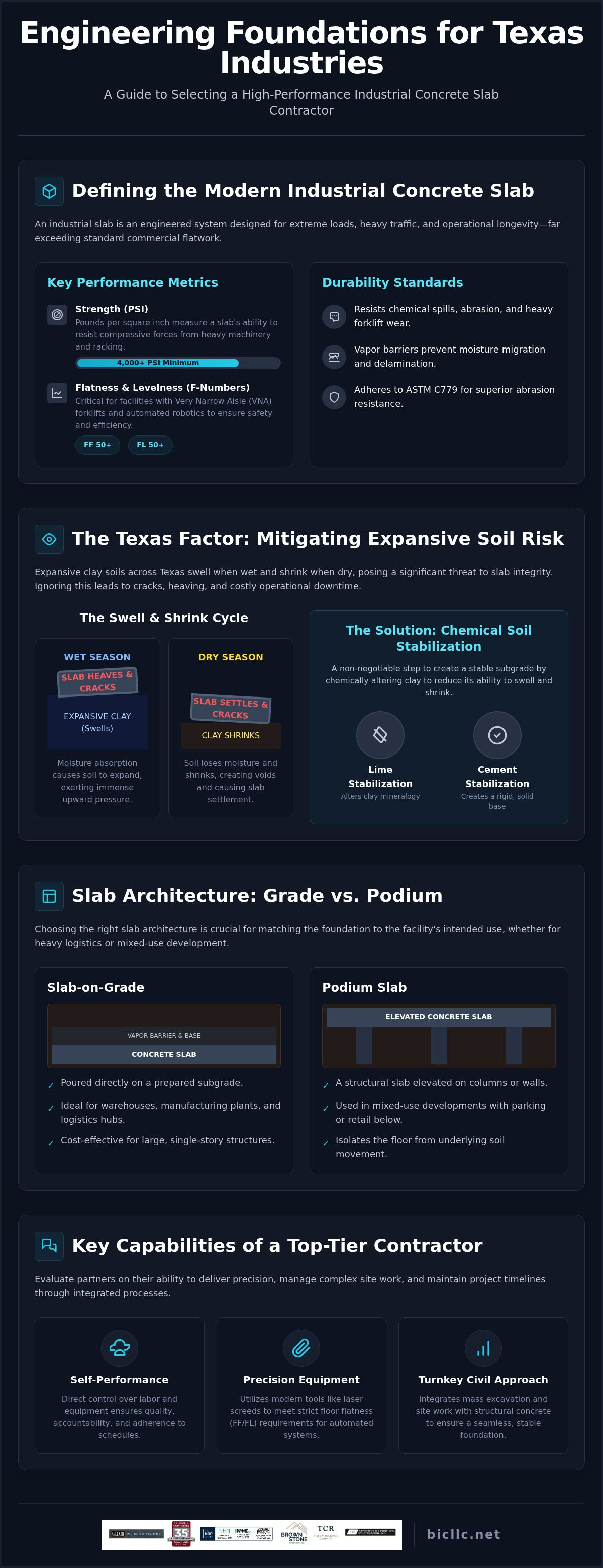
An industrial concrete slab isn't just a surface; it's a high-performance floor system engineered to withstand extreme point loads and constant heavy traffic. While standard commercial flatwork prioritizes aesthetics and foot traffic, industrial-grade slabs are structural components designed for operational longevity. In 2026, the distinction is clearer than ever. A professional industrial concrete slab contractor must account for variables that go far beyond simple thickness, including chemical exposure and the precision required by automated systems. A Concrete slab in a logistics hub or manufacturing plant acts as the foundation of the entire business operation, making its engineering a matter of long-term viability.
For heavy machinery and high-density racking, PSI (pounds per square inch) ratings typically start at 4,000 and may increase based on the specific load requirements of the facility. Strength alone isn't enough in the modern era. Current standards emphasize "F-numbers" for flatness (FF) and levelness (FL). Facilities utilizing Very Narrow Aisle (VNA) forklifts now require FF 50 or higher to ensure safety and equipment efficiency. These specifications aren't suggestions; they're requirements for the safe operation of high-reaching equipment and robotics.
Load-Bearing Capacity and Structural Requirements
Calculating static loads from massive racking systems is only the first step. A qualified industrial concrete slab contractor also accounts for dynamic loads, which are the stresses created by moving machinery and autonomous robotics. Proper slab thickness prevents structural fatigue over decades of use. Without this precision, the slab may develop micro-cracks that eventually lead to full structural failure, especially when supporting heavy-duty racking systems that exert thousands of pounds of pressure on small contact points.
Durability Standards for Modern Facilities
Durability in a high-output facility means resisting chemical spills, abrasion, and the relentless wear of heavy forklift tires. Vapor barriers are a necessity to prevent moisture from migrating through the slab and causing delamination or flooring failures. Industrial concrete durability is defined by its ability to maintain structural integrity under specific environmental and mechanical stresses as outlined in ASTM C779 for abrasion resistance. This steadfast focus on material quality ensures that the floor remains a reliable asset rather than a maintenance liability. Consistent value is delivered through meticulous management of the mix design and finishing process.
The Texas Factor: Soil Stabilization and Structural Integrity
In the Texas construction landscape, the soil is often the primary adversary of long-term structural integrity. Expansive clay soils, such as the notorious "Houston gumbo" or the "Blackland Prairie" clays of the Dallas-Fort Worth metroplex, possess a high plasticity index. These soils swell significantly when wet and shrink during the intense dry seasons typical of the region. For an industrial concrete slab contractor, ignoring these geological realities leads to inevitable slab failure, cracking, and operational downtime. Engineering a floor for high loads requires a strategy that begins several feet below the finish pour.
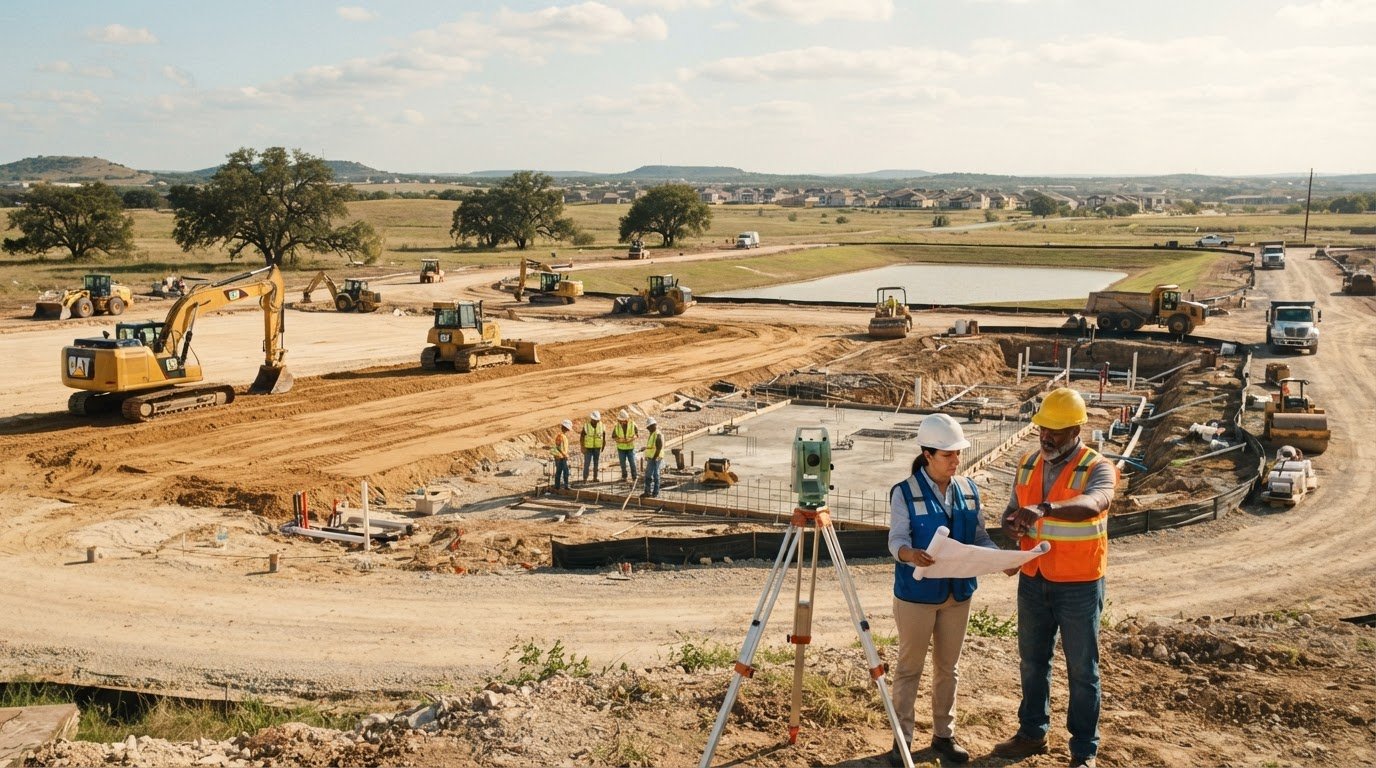
A unified foundational strategy integrates mass soil excavation and detention pond construction with the final concrete placement. Proper site work ensures that water is diverted away from the building envelope, maintaining a consistent moisture profile in the subgrade. When earthwork and concrete teams work in isolation, the risk of miscommunication regarding compaction and grade increases. A steadfast partner who manages both the civil site work and the structural slab ensures that the detention systems and drainage are perfectly synchronized to protect the floor's longevity. This integrated approach is essential for large-scale developments where even minor soil movement can disrupt the precision of automated warehousing equipment.
Addressing Expansive Soil Challenges
Creating a non-expansive subgrade often involves chemical stabilization. Techniques such as lime or cement stabilization are used to alter the chemical properties of the clay, reducing its capacity to hold water and swell. This process creates a rigid, reliable working table for the slab. In Central Texas, where moisture fluctuations are extreme, this step is non-negotiable. You can learn more about these specific methods in our detailed analysis of why paving stabilization is critical for Texas soil. Establishing this foundation is the first act of professional stability on any site.
Reinforcement Strategies: Rebar vs. Post-Tension
The choice between traditional rebar mats and post-tension slabs depends on the specific load requirements and the local soil report. Post-tension slabs are frequently utilized for large-scale industrial footprints because they allow for fewer joints and better resistance to soil movement. However, traditional rebar remains the gold standard for high-impact manufacturing zones where localized point loads are extreme. Adhering to the ACI Guide to Concrete Floor and Slab Construction ensures that joint design and spacing are calculated to control cracking during the thermal expansion of the Texas heat. If you are planning a development that requires this level of operational precision, consider how a Turn Key Civil partner can simplify your project timeline.
Slab on Grade vs. Podium Slabs: Choosing the Right Architecture
Determining the structural architecture of a facility is a decision that dictates its operational capacity for decades. Developers must choose between ground-bearing systems and elevated structural decks based on site constraints and intended use. An experienced industrial concrete slab contractor provides the technical guidance to distinguish which system maintains long-term viability under high-load conditions. While slab on grade remains the standard for expansive logistics hubs, podium slabs are becoming essential for developments in dense urban environments where verticality is required.
The choice between Cast-in-Place (CIP) and precast options for multi-level storage or parking also impacts the project's structural rigidity. CIP structures offer a monolithic connection that often provides superior resistance to the vibrations of heavy machinery. A cost-benefit analysis of structural concrete for mid-rise industrial facilities reveals that while the initial engineering is more complex, the ability to maximize square footage on a limited land parcel offers significant long-term value. This steadfast approach to planning ensures the building remains a stable asset.
Applications for Slab on Grade in Texas
Slab on grade is the primary choice for single-story distribution centers in regions like Conroe and The Woodlands. These facilities rely on massive, uninterrupted floor plates to facilitate rapid movement of goods. Utilizing jointless slab technology allows a contractor to minimize the number of control joints, which are traditionally the weakest points in any floor system. Reducing these joints decreases long-term maintenance requirements and prevents the "joint spalling" often caused by hard-wheeled forklift traffic. Maintaining these grade-level floors requires a disciplined focus on the initial pour to ensure consistent thickness across the entire footprint.
The Rise of Podium and CIP Structural Slabs
In major hubs like Houston, land scarcity is driving industrial developments upward. Podium slabs serve as a structural transfer deck, allowing for heavy industrial or retail loads to be supported above ground-level parking or lower-tier storage. If your project involves these complex multi-level requirements, consulting an Expert Podium Slab Contractor in Houston is vital for ensuring the structural framing meets safety codes. CIP mid-rise industrial builds require meticulous management of formwork and reinforcement to handle the immense weight of elevated inventory. This integrated strategy provides a durable foundation for businesses that need to grow vertically without compromising on load capacity.
Vetting an Industrial Concrete Slab Contractor in Texas
Selecting an industrial concrete slab contractor requires a disciplined evaluation of their internal infrastructure and operational philosophy. Many firms in the Texas market act as brokers, outsourcing critical pours to tiers of subcontractors. This practice introduces significant project risk; it dilutes accountability and complicates communication during the high-pressure window of a concrete pour. A steadfast partner who self-performs their work provides a single point of responsibility. This ensures that the technical standards established during the design phase are strictly maintained from the initial site preparation through the final trowel pass.
Beyond self-performance, a contractor's safety record is a primary indicator of professional stability. You should always review a firm's Experience Modification Rate (EMR). An EMR below 1.0 suggests a disciplined approach to site-specific safety plans, which is essential in heavy industrial environments where liabilities are high. Local experience also remains a critical factor. Because Texas lacks a mandatory statewide building code, your contractor must demonstrate a deep understanding of local adoptions, such as the 2021 International Building Code (IBC) requirements specific to Harris County or Montgomery County. This local proficiency prevents costly delays during the permitting and inspection phases.
Precision Technology and Equipment
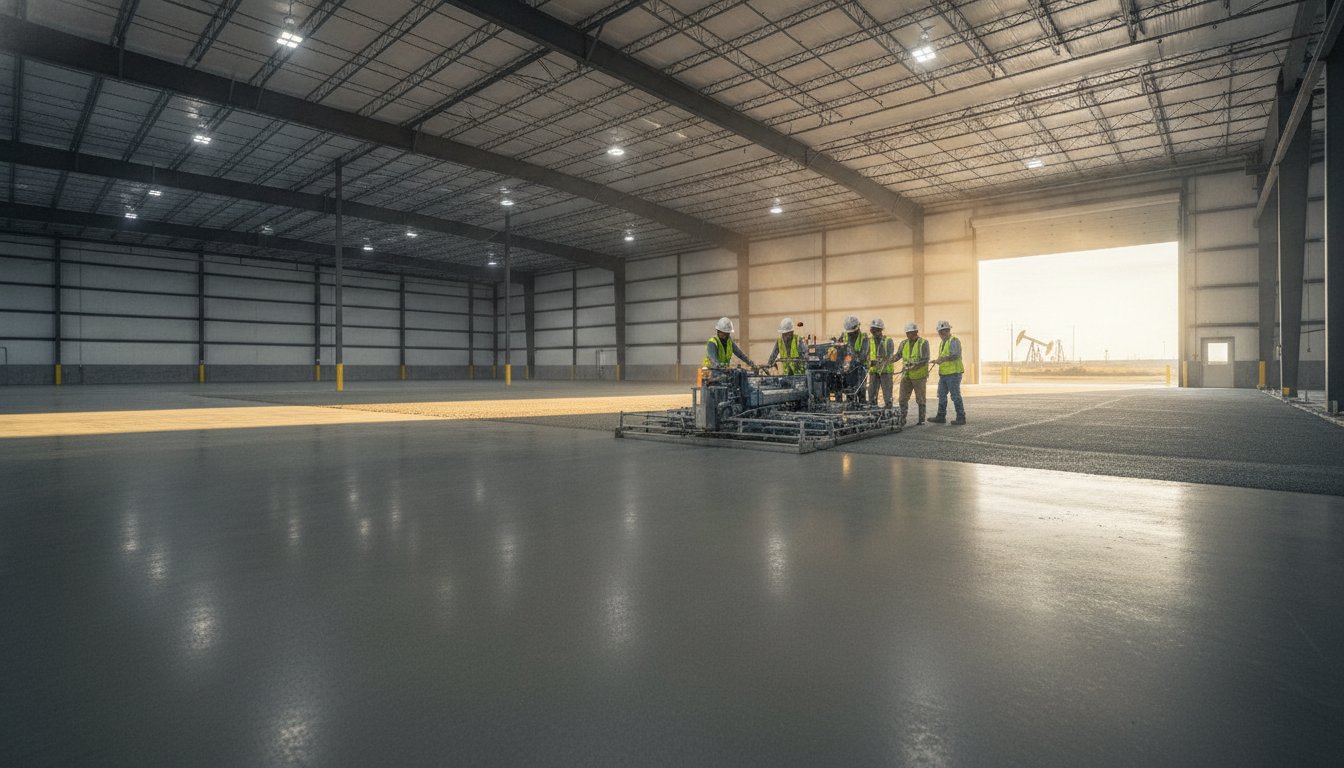
Modern industrial facilities demand extreme precision that manual methods cannot achieve. The use of 3D laser screeding technology is a necessity for meeting high floor flatness (FF) and levelness (FL) specifications. These machines utilize laser receivers to adjust the screed head thousands of times per minute, ensuring the slab remains within tight tolerances across massive footprints. Automated finishing tools are equally vital for large-scale pours to maintain consistency in the concrete surface. Laser screeds significantly reduce manual labor costs while simultaneously increasing the precision and quality of the finished structural floor. If you are seeking a partner who utilizes this level of operational precision, consult with our team about your next industrial development.
Safety, Integrity, and Efficiency
Integrity in construction begins with material sourcing and ends with meticulous project management. A professional contractor ensures the concrete mix meets the exact specified design strength, resisting the temptation to use inferior materials to cut costs. This commitment to substance over style prevents "handoff risk" between the civil and concrete phases. When one firm manages the mass excavation, soil stabilization, and the structural pour, the transition between these stages is seamless and highly organized. Site-specific safety plans are not just paperwork; they're a core pillar of a disciplined professional who values the well-being of their crew and the long-term viability of your project.
Born Integrated Construction: Your Texas Industrial Concrete Partner
Born Integrated Construction (BIC) establishes a standard of reliability for developers across the major hubs of Texas. We serve the Houston, Austin, San Antonio, and Dallas-Fort Worth regions with a steadfast commitment to professional stability and high-performance execution. As a specialized industrial concrete slab contractor, our model is built on the principle of integration. We don't just pour concrete; we manage the entire structural lifecycle of the foundation to ensure long-term viability for every development we touch. This unified approach provides a sense of security for partners who require a disciplined professional to lead their most complex builds.
Our "Turn Key Civil" approach is designed to eliminate the operational friction that typically occurs between different project phases. By managing everything from mass soil excavation and earthwork to the final structural pour, we maintain a clear hierarchy of importance on the job site. This integrated model ensures that the quality of the subgrade is perfectly matched to the requirements of the high-load slab above it. Efficiency is built into every cubic yard of concrete we place, allowing us to deliver projects on time and within the strict technical tolerances required by modern industrial standards.
Comprehensive Industrial Services
The scope of our expertise covers the full spectrum of industrial and commercial needs. We specialize in the construction of CIP garages, podium slabs, and heavy-duty structural concrete systems that support the demanding loads of the 2026 logistics landscape. Our team is also highly proficient in managing complex infrastructure and utility integration, ensuring that sub-surface systems are properly coordinated before the first yard of concrete is poured. For those developing logistics hubs or infrastructure in Montgomery County, our analysis of Commercial Concrete Paving in Conroe offers deeper insight into our engineering standards for heavy-duty roads and surfaces.
The BIC Advantage for Texas Developers
Choosing BIC means partnering with a local expert who possesses a deep-rooted understanding of Texas soil and climate challenges. We've mastered the acts of establishing and maintaining stable foundations in environments where expansive clays are a constant threat. Our brand persona is that of a seasoned authority who values substance over style, providing direct communication and unwavering consistency on every job site. We lead through proven results rather than hyperbole. If you're ready to secure the structural integrity of your next development, contact us today for a consultation on your next industrial project. We look forward to building a lasting foundation for your business operations.
Securing the Future of Your Texas Industrial Development
The longevity of an industrial facility depends on decisions made before the first yard of concrete is poured. Engineering a slab to withstand Texas's expansive clay while meeting modern flatness requirements demands a partner who understands the intersection of soil science and structural precision. By integrating mass excavation with high-performance concrete placement, developers can mitigate the risks of structural failure and operational delays. This methodical approach ensures that the finished floor remains a reliable asset rather than a maintenance liability.
Selecting a qualified industrial concrete slab contractor ensures that your project benefits from specialized expertise in soil stabilization and high-load CIP systems. This steadfast approach protects your investment and provides a secure foundation for decades of heavy-duty use. Our commitment to safety and integrity remains the core of our professional output; we deliver results that are as durable as the structures we build. Professional stability on the job site leads to predictable, high-quality outcomes for every cubic yard placed.
Partner with Born Integrated Construction for your next industrial project to secure the structural integrity of your development. We look forward to establishing a stable foundation for your long-term success.
Frequently Asked Questions
What is the typical thickness of an industrial concrete slab?
Typical thickness for an industrial slab ranges from 6 to 10 inches for standard warehouses, though heavy manufacturing facilities often require 12 inches or more. The exact depth is determined by the specific point loads of racking systems and the weight of dynamic forklift traffic. A qualified industrial concrete slab contractor uses these engineering calculations to ensure the structural integrity of the floor plate over its entire service life.
How do you prevent cracks in large industrial concrete floors?
Preventing cracks requires a combination of strategic joint placement, adequate reinforcement, and precise moisture control during the curing phase. Control joints are cut to a depth of at least one-quarter of the slab thickness to encourage cracking in predetermined locations. Utilizing post-tensioning or traditional rebar mats helps maintain the monolithic nature of the slab while managing the thermal stresses common in the Texas climate.
What is the difference between FF and FL numbers in concrete finishing?
FF numbers measure floor flatness, while FL numbers measure floor levelness. Flatness refers to the local surface profile, specifically the presence of small bumps or waves that could disrupt machinery. Levelness refers to the overall tilt or slope of the slab relative to a horizontal plane. High-density warehouses with automated systems often require FF 50 or higher to ensure the safe operation of high-reaching equipment.
How long does an industrial concrete slab take to cure before it can handle traffic?
Most industrial slabs can support light foot traffic within 24 to 48 hours, but heavy machinery should be restricted until full design strength is reached. Full compressive strength is typically achieved at 28 days. However, specific mix designs and early-entry saw cutting may allow for limited operational use sooner if the concrete reaches the required PSI as verified by documented break tests.
Why is soil stabilization necessary before pouring an industrial slab in Texas?
Soil stabilization is essential in Texas to mitigate the movement caused by expansive clay soils that swell and shrink with moisture changes. Chemicals like lime or cement are mixed into the subgrade to create a rigid, non-expansive working table. Without this critical step, the slab remains susceptible to differential settlement, which leads to structural cracking and the eventual failure of the entire floor system.
Can a commercial concrete contractor handle industrial-grade projects?
Industrial-grade projects require a higher level of technical proficiency and specialized equipment than standard commercial flatwork. Industrial slabs involve much higher PSI requirements and stricter FF/FL tolerances than typical retail floors or parking lots. An experienced industrial concrete slab contractor possesses the laser screeds and finishing technology necessary to meet these rigorous engineering specifications and high-load demands.
What are the benefits of using a laser screed for industrial flooring?
A laser screed provides automated precision that manual striking cannot replicate, allowing for the placement of significantly flatter and more level floors. These machines use laser receivers to adjust the screed head thousands of times per minute, ensuring the surface remains within tight tolerances across massive footprints. This technology increases the speed of placement and reduces the physical labor risks associated with large-scale structural pours.
How does Born Integrated Construction manage project safety?
Born Integrated Construction prioritizes safety through site-specific safety plans and a steadfast commitment to self-performance. By controlling every phase of the project from mass excavation to the final pour, we eliminate the communication gaps that often lead to on-site accidents. Our disciplined approach is reflected in a low Experience Modification Rate (EMR), which ensures professional stability and reduces liability for our development partners.